
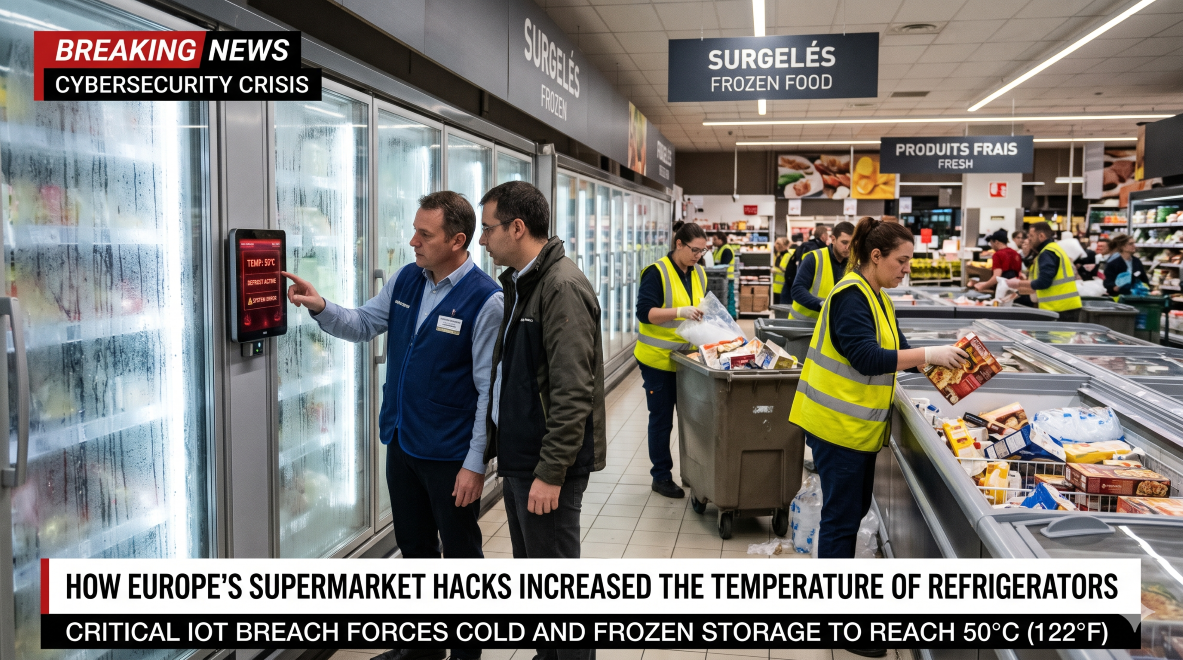
In early November 2026, grocery store managers across Sweden, Belgium, Estonia, and several other European nations arrived at work to find a scene of silent destruction. Inside dozens of supermarkets, the familiar hum of commercial freezers had been replaced by thermal alarms. Shelves filled with frozen vegetables, meats, and dairy were thawing rapidly—not because of local power outages or mechanical compressor failures, but because their automated cooling systems had been remotely commanded to heat up.
As first reported by Reuters on November 2, 2026, a Swedish grocery store in the town of Sjöbo publicly raised the alarm after its fridges and freezers overnight had their internal temperature settings remotely pushed to 50°C (122°F). What initially appeared to store clerks as a localized technical glitch quickly revealed itself as part of a coordinated, multi-national wave of cyberattacks targeting European cold chain infrastructure.
Coming just weeks after a similar incident disrupted nearly 700 supermarkets across France, this second wave of digital sabotage highlights a growing, uncomfortable reality: in an era of hyper-connected industrial systems, even the humble supermarket refrigerator has become a front in modern cyber warfare.
Anatomy of a Low-Tech, High-Impact Sabotage
Unlike high-profile ransomware attacks that deploy complex, custom-engineered malware to encrypt corporate databases, the European cold chain breaches relied on surprising operational simplicity. Forensic investigations by national cybersecurity agencies revealed that attackers did not crack complex algorithms; instead, they exploited fundamental lapses in basic security hygiene.
Modern commercial refrigeration systems rely on digital operational technology (OT) controllers manufactured by global industrial automation providers like Danfoss, alongside specialized third-party contractors. These controllers monitor temperature, manage automatic defrost cycles, and alert engineers to hardware faults. To facilitate remote management and maintenance, many of these devices are connected directly to the open internet via cellular 4G modems or local Wi-Fi networks.
Attacker Access Vector:
[Public Internet / 4G Modem]
       │
       ▼
[Exposed Industrial Refrigeration Controller]
       │
       ▼
[Default/Weak Admin Credentials]
       │
       ▼
[Configuration Change: Setpoint shifted from -18°C to +50°C / Force Defrost]
       │
       ▼
[Rapid Heating & Widespread Produce Spoilage]
Attackers scanned public IP ranges for exposed web-management portals linked to these refrigeration units. In scores of instances, the units were protected by factory-default administrative credentials—such as standard default usernames paired with simple numeric passwords—or lacked network segmentation entirely.
Once logged in, the saboteurs did not destroy the mechanical hardware. Instead, they manipulated normal operational settings:
- Thermostat Manipulation: Overriding standard operating setpoints (typically around -18°C for freezers) and replacing them with high-temperature commands up to 50°C (122°F).
- Forced Defrost Cycles: Triggering built-in heating elements intended for short defrost cycles and forcing them to run indefinitely, actively heating the storage units rather than letting them cool naturally.
At an ICA store in Sjöbo, Sweden, staff reported that freezer settings were altered to 50°C overnight, forcing the disposal of thousands of Euros in inventory. At an ICA Nära branch in Boda on the island of Öland, internal displays recorded temperature spikes reaching 55°C (131°F). Similar disruptions hit Belgium’s Delhaize and Carrefour stores, as well as retail units in Estonia, Luxembourg, Ireland, the Netherlands, and Germany.
The Escalating Timeline: From France to the Continent
The November incidents were not an isolated phenomenon, but rather the expansion of a campaign that first manifested in October 2026. The initial wave struck major French retail networks—including Intermarché, Cooperative U, Carrefour, and Monoprix—affecting hundreds of outlets simultaneously and resulting in millions of euros in ruined stock.
| Incident Window | Primary Geographic Scope | Major Affected Chains | Operational Impact | Primary Vulnerability |
| Mid-October 2026 | France | Intermarché, Carrefour, Monoprix, Cooperative U | ~700 stores affected; mass disposal of fresh/frozen goods | Exposed OT interfaces; weak credential management |
| Early November 2026 | Sweden, Belgium, Estonia, Luxembourg, Ireland, Germany | ICA, Coop Sweden, Delhaize, Carrefour Belgium, Selver | Temperature setpoint overrides up to 50°C; severe supply spoilage | Web-accessible Danfoss & third-party controllers via 4G/IP |
The breadth of the November wave demonstrated that threat actors had systematically mapped cold chain vulnerabilities across European borders. In Belgium, refrigeration contractor Sabcobel confirmed that multiple client systems had been switched into continuous defrost mode. In Estonia, quick intervention by suppliers limited temperature rises at Selver supermarkets, but the systemic intent remained undisputed: to disrupt daily retail operations and induce panic around basic food logistics.
Geopolitics in the Produce Aisle: Attribution and Motive
While commercial cybercrime typically aims for financial extortion via ransomware, the refrigeration attacks carried a different signature. No ransom notes were left, no extortion demands were issued on dark web forums, and no stolen operational data was put up for sale.
Instead, European intelligence officials view these attacks through the lens of hybrid warfare—deliberate tactics designed to test Western societal resilience and undermine public confidence in essential supply chains.
Targeting Rationale:
[Non-Critical Supply Chains] ──► [Low Technical Barrier to Entry] ──► [Direct Public Visibility & Disruption]
Following investigation of the October French breaches, France’s National Cybersecurity Agency (ANSSI) and foreign intelligence partners attributed the campaign to state-linked actors, specifically pointing toward Iranian cyber units (including infrastructure associated with the IRGC-linked group Shahid Kaveh), alongside opportunistic proxy groups operating out of Russia and China.
Security analysts note that targeting commercial cold storage offers threat actors three distinct advantages:
- High Visibility, Low Risk: Disrupting food retail causes immediate local media coverage and consumer concern without triggering the level of retaliatory response reserved for attacks on electrical grids or military networks.
- Low Technical Barrier: Exploiting unpatched, internet-connected IoT devices requires minimal custom tooling, granting attackers high leverage for very little resource expenditure.
- Probing Infrastructure Vulnerabilities: The same remote-temperature controllers used in supermarket freezers are frequently deployed in pharmaceutical distribution hubs, medical blood banks, and agricultural storage facilities. Testing tactics on retail groceries serves as a low-stakes proving ground for broader infrastructure disruption.
Conservative Realities: Why Panic is Unwarranted, but Caution is Imperative
A prudent analysis of the incident requires balancing the dramatic headlines against operational realities.
1. Financial Absorption vs. Supply Chain Fragility
From a financial perspective, the immediate economic losses—estimated in the tens of millions of euros across Europe—are easily absorbed by major retail conglomerates and their insurers. Retailers like Ahold Delhaize, Carrefour, and the ICA Group possess the balance-sheet depth to replace spoiled stock quickly and restore normal supply within days. The food distribution system did not break, and panic buying was largely avoided.
However, financial resilience should not mask operational vulnerability. Had these attacks targeted main distribution hubs or transport logistics fleets during peak seasonal demand, the resulting supply bottlenecks would have been significantly harder to remedy.
2. The Over-Digitization of Mundane Systems
The attack exposes a recurring structural mistake in corporate IT governance: the unnecessary connection of low-tier operational systems to the public internet.
In the rush to digitize facility management, corporate procurement teams routinely install smart systems to streamline maintenance and cut energy costs. However, connecting every thermostat, light fixture, and freezer compressor to an IP network expands a company’s attack surface exponentially. When an industrial freezer relies on an unsegmented cellular modem with default login credentials, it transforms an everyday appliance into a back door into corporate networks.
Institutional Recommendations for Cold Chain Security
To prevent future disruptions, commercial operators and regulatory bodies must treat cold-chain infrastructure with the same security rigor applied to traditional financial networks:
Core Principle: No critical physical control system should ever be reachable directly from the public internet without multi-layer authentication and network isolation.
- Mandatory Air-Gapping & VPN Access: Refrigeration control units must never host public-facing IP addresses. Remote vendor maintenance must require encrypted Virtual Private Networks (VPNs) paired with Multi-Factor Authentication (MFA).
- Elimination of Default Credentials: Equipment manufacturers and installer networks must enforce mandatory credential changes upon installation, prohibiting system activation until default passwords are updated.
- Automated Anomaly Detection: Facility management software should feature hardcoded physical safety limits. Systems should automatically block command inputs that request extreme setpoint shifts (e.g., setting a sub-zero freezer to +50°C) without physical key-turn verification on-site.
- Regular Security Audits for OT Subcontractors: Retailers must mandate strict cybersecurity compliance standards for third-party HVAC and refrigeration contractors, ensuring remote monitoring tools comply with national critical infrastructure frameworks.
A Measured Conclusion
The November 2026 European freezer attacks serve as a clear, measured warning for the global retail sector. The incident proved that adversaries do not need to target power plants or banking networks to cause widespread disruption; tampering with the quiet, underlying systems that preserve daily life is often enough.
By responding with sober operational upgrades—closing internet-exposed ports, revoking default access credentials, and isolating industrial control networks—retailers can neutralize this specific threat vector entirely. The challenge moving forward is not whether the technology exists to secure these systems, but whether enterprise management possesses the discipline to prioritize basic digital hygiene before the next thermal alarm sounds.