
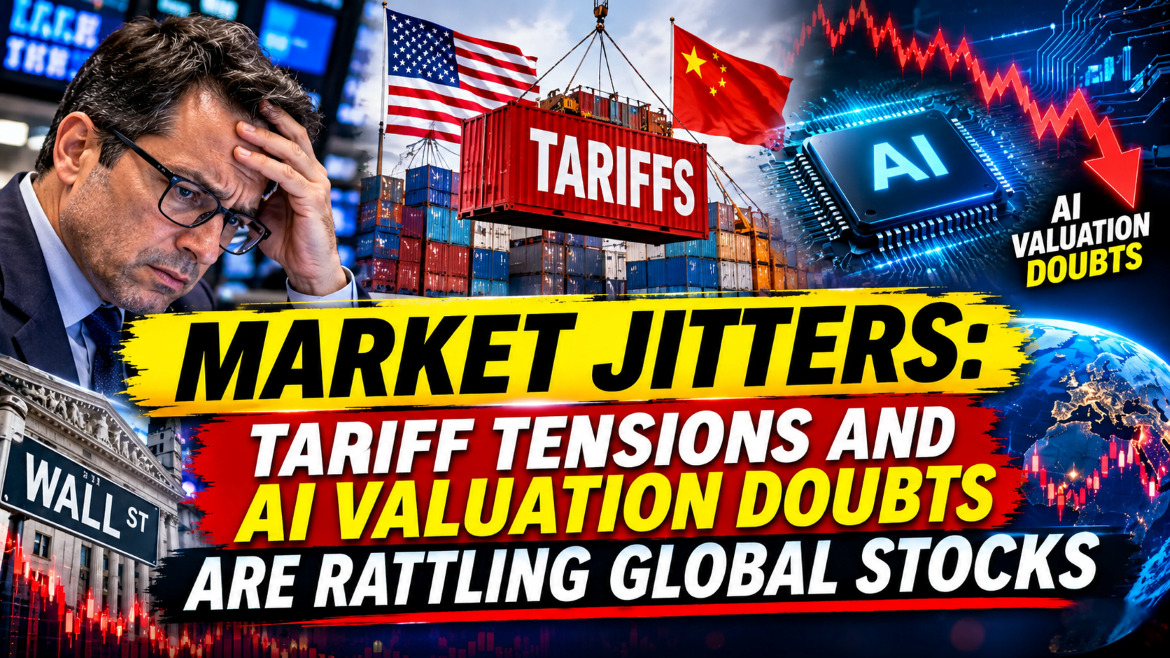
Global financial markets and U.S. equities are navigating a turbulent stretch of late-November trading as investors weigh two powerful forces reshaping the outlook for corporate earnings: renewed U.S. tariff tensions and deepening scrutiny over artificial intelligence valuations and capital spending. Ahead of the U.S. Thanksgiving market closure on Thursday, November 26, 2026, sharp intraday swings swept through Wall Street, European bourses, and Asian exchanges—wiping out more than $1.5 trillion in U.S. equity value during Wednesday’s sell-off before signs of delayed tariff implementation sparked a tentative global rebound.
At the heart of the market jitters is a shifting macroeconomic calculus. For much of the past two years, massive corporate investments in AI infrastructure propelled technology benchmarks to record heights. Now, however, fresh trade policy proposals—combined with stubborn inflation readings and rising interest-rate anxiety—have forced institutional investors to reassess whether sky-high tech multiples can withstand higher borrowing costs and disrupted global supply chains.
Tariff Shockwaves: Proposed Levies on 14 Trading Partners Unsettle Global Trade
The immediate catalyst behind this week’s risk-off wave was a new White House proposal outlining tariffs of up to 35% on 14 major U.S. trading partners—including China, Japan, South Korea, India, and the European Union—aimed at addressing industrial overcapacity.
Even though the levies remain a proposal rather than enacted policy, financial markets rarely wait for legislation or executive orders to take effect before pricing in potential disruptions:
- Supply Chain and Margin Pressure: Multinational hardware manufacturers, semiconductor designers, and consumer electronics firms rely on tightly integrated cross-border supply chains. Higher import duties threaten to squeeze profit margins or force companies to pass price increases onto consumers.
- Global Index Spillover: Asian export-driven markets bore the brunt of the initial shock on Wednesday, with South Korea’s KOSPI slumping more than 6% and Japan’s Nikkei 225 falling nearly 2.8%, while European benchmarks like Germany’s DAX, France’s CAC 40, and the UK’s FTSE 100 also retreated.
- Relief on Potential 2027 Delay: Sentiment stabilized on Thursday, November 26, as European and Asian equities rebounded following indications that any tariff implementation may be delayed until early 2027—giving exporters and manufacturers crucial breathing room to adjust logistics and pricing strategies.
The AI Reality Check: Investors Question Trillion-Dollar CapEx and Stretched Valuations
Alongside trade uncertainty, the technology sector is undergoing a fundamental reassessment of the artificial intelligence trade. While demand for AI computing hardware remains robust, investors are increasingly demanding tangible profitability and near-term return on investment rather than open-ended capital expenditure promises.
During Wednesday’s volatile session on Wall Street, the tech-heavy Nasdaq Composite plunged nearly 3.8% in early trading before staging a late-session recovery to close down 0.6% around 23,586, while the S&P 500 dipped to roughly 7,183 and the Dow Jones Industrial Average eked out a modest gain near 50,183. High-profile AI and cloud leaders experienced pronounced turbulence:
| Tech & AI Bellwether | Market Pressure Point | Key Investor Concern |
| Nvidia (NVDA) | Sharp intraday swings despite CEO Jensen Huang’s recent reinstatement | Sustainability of hyperscaler data-center CapEx over the next 12 months |
| Anthropic (ANT) | Post-IPO volatility following its record $1.5T Nasdaq debut | Stretched valuations relative to massive long-term compute commitments |
| Oracle & Alphabet | Multi-percent pullbacks during Wednesday’s tech sell-off | Rising capital intensity of cloud data-center buildouts |
| Memory & Storage (Micron, Western Digital, Seagate) | Broad hardware declines between 3% and 7% | Sensitivity to global tariff exposure and cyclical hardware demand |
As B. Riley Wealth chief market strategist Art Hogan noted, the pace of capital expenditures and the question of how much data-center expansion could slow over the next 12 months have emerged as the primary headwinds facing mega-cap technology stocks. Adding to the caution, Democratic gains in the November U.S. midterm elections have also prompted investors to factor in potential regulatory scrutiny over frontier AI deployment.
Sticky Inflation and the Fed Dilemma: Why Higher-for-Longer Rates Hurt Tech
Compounding tariff and valuation worries is a macroeconomic backdrop that leaves central bankers with limited room to maneuver. Fresh U.S. economic data showed headline Personal Consumption Expenditures (PCE) inflation ticking up to 3.8% year-over-year, while core PCE inflation—the Federal Reserve’s preferred gauge—rose 3.3%, slightly above economists’ 3.2% consensus forecast.
For equity investors, sticky inflation carries a double penalty:
- Renewed Rate-Hike Anxiety: Persistent price pressures, combined with the inflationary risk of new import tariffs, have dampened hopes for imminent monetary easing and revived market debate over whether the Federal Reserve may need to keep interest rates elevated—or even consider additional tightening—to steer inflation back toward its 2% target.
- Discount-Rate Pressure on Growth Stocks: Higher interest rates raise corporate financing costs and reduce the present value of future cash flows, disproportionately weighing on high-multiple growth and AI stocks whose valuations depend on long-term earnings expansion.
Rotation Over Capitulation: How Institutional Money Is Repositioning
Despite dramatic headline swings, market strategists point out an important distinction in how institutional investors are responding. Rather than indiscriminate panic selling across every asset class, trading desks are observing a sector rotation toward defensive equities, value stocks, and sovereign bonds:
- Defensive Resilience: While mega-cap technology shares absorbed heavy selling, traditional industrial, healthcare, and consumer-staple components helped the Dow Jones Industrial Average outperform the Nasdaq during midweek volatility.
- Flight to Government Debt: Yields on benchmark 10-year U.S. Treasuries and German Bunds (which dipped toward 3.22%) eased as investors sought safety in fixed income.
- Energy and Geopolitical Cross-Currents: Brent crude traded choppily around $90 to $92 per barrel as traders balanced global demand concerns against ongoing maritime security risks near the Strait of Hormuz and upcoming OPEC+ production reviews.
What Investors Are Watching Next
As U.S. trading resumes following the Thanksgiving holiday, global markets remain finely balanced between two competing narratives. On one hand, underlying demand for AI infrastructure, enterprise software, and cloud computing remains historically strong. On the other, policy uncertainty around U.S. tariffs, elevated core inflation, and tighter scrutiny of AI capital returns mean the era of effortless, valuation-driven tech rallies has given way to a far more selective market environment.
In the weeks ahead, three catalysts will determine whether this week’s rebound holds or gives way to renewed turbulence: official clarification on the timeline and scope of proposed U.S. tariffs, December central bank policy signals from the Federal Reserve and European Central Bank, and fourth-quarter corporate guidance on whether AI investments are translating into sustainable bottom-line earnings.