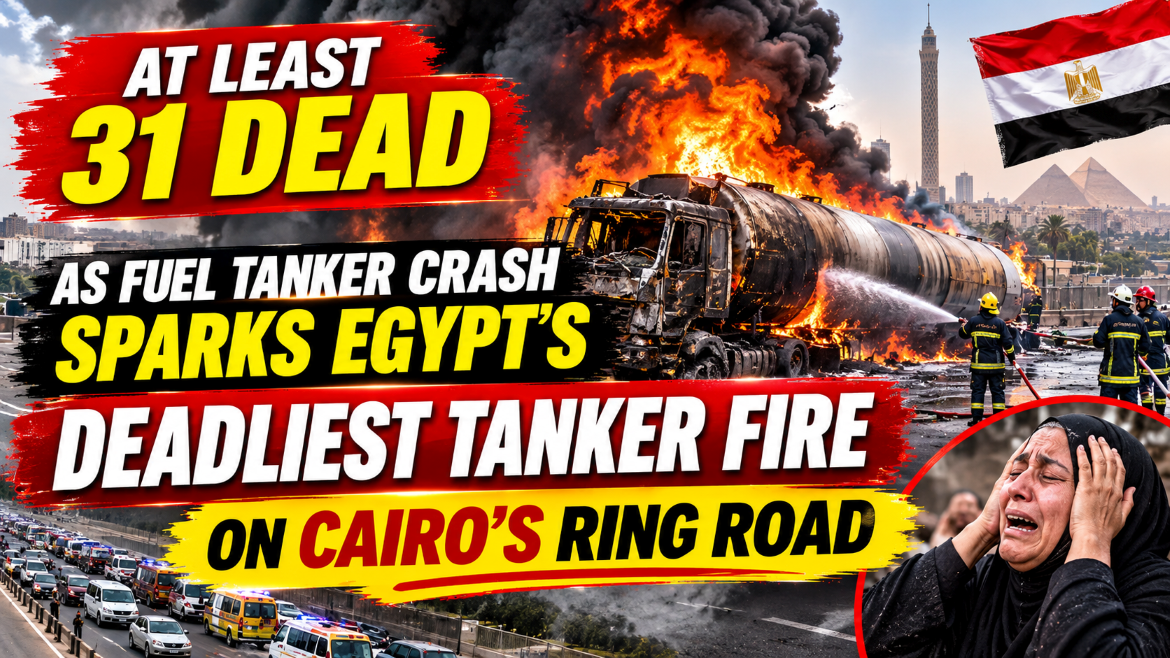
A catastrophic fuel tanker crash on a major highway circling Cairo erupted into a massive fireball on Wednesday evening, November 25, 2026, killing at least 31 people and injuring 21 to 26 others. The blaze—which tore through dense commuter traffic along the Ring Road in Giza’s densely populated Al-Warraq district—consumed 27 vehicles, including passenger cars, a bus, and motorcycles, marking the deadliest recorded fuel tanker disaster in Egyptian history.
As firefighters battled towering flames and emergency crews pulled survivors from charred wreckage, Egyptian prosecutors launched an urgent criminal investigation and ordered the arrest of a driver linked to the collision. With forensic teams conducting DNA testing to identify victims burned beyond recognition, the tragedy has ignited nationwide grief and renewed scrutiny over hazardous cargo transport and highway safety across Greater Cairo.
Anatomy of a Highway Disaster: How the Al-Warraq Inferno Unfolded
The tragedy struck during evening traffic at approximately 6:08 p.m. local time on Wednesday, November 25, along an elevated stretch of the Cairo Ring Road above Tunnel 10 in the Al-Warraq neighborhood of Giza Governorate. Serving as Greater Cairo’s vital arterial beltway, the Ring Road connects major highways linking the governorates of Cairo, Giza, and Qalyubia—meaning traffic volumes at dusk are consistently heavy.
According to findings released by Egypt’s Public Prosecution Office and emergency responders, a chain-reaction sequence turned a high-speed highway collision into an inescapable wall of fire:
- High-Speed Impact and Loss of Control: Prosecutors stated that a vehicle traveling at high speed slammed into the fuel tanker. According to the prosecution’s account, one of the tanker’s tires burst, causing the heavy petroleum truck to veer sharply to the right, smash into a concrete divider barrier, and overturn across the roadway.
- Instant Ignition of Spilled Fuel: As the overturned tanker ruptured, highly flammable petroleum spilled across the asphalt and ignited immediately. Flames raced down the highway faster than trapped motorists could reverse or escape, engulfing 27 cars and motorcycles caught in the surrounding gridlock.
- Tragedy for Good Samaritans: Among the most heartbreaking details confirmed in local reports, all 14 passengers aboard a nearby bus perished after stepping out of their vehicle in a courageous attempt to rescue motorists trapped inside burning cars.
Eyewitness Ahmed Sameer, who was stranded in halted traffic just behind the blaze, described scenes of panic and devastation to the Associated Press: “It was a huge fire, the cars got stuck together because of the fire. It was a shocking scene.” Sameer recounted seeing at least eight bodies pulled from blackened, fused vehicle frames as thick plumes of black smoke billowed into the night sky over Giza.
Emergency Response and Forensic Identification Underway
Egypt’s Health Ministry mobilized a massive emergency response within minutes of the explosion, dispatching 39 ambulances alongside civil defense firefighting units and security forces to seal off the Ring Road and divert traffic.
| Incident Metric | Verified Figure | Official Source / Details |
| Confirmed Fatalities | At least 31 | Egyptian authorities & Health Ministry; toll noted as preliminary |
| Injured Victims | 21 to 26 | Health Ministry revised initial figures to 21; prosecutors noted 26 in damage assessments |
| Vehicles Destroyed | 27 | Cars, motorcycles, and a passenger bus charred in the blaze |
| Ambulances Deployed | 39 | Transported injured patients—some with 70–80% burns—to four Cairo hospitals |
Health Minister Khaled Abdel Ghaffar visited the disaster site and confirmed that injured survivors—several suffering severe, life-threatening burns covering 70% to 80% of their bodies—were rushed to four specialized hospitals across Cairo, cautioning that the death toll could climb further. Meanwhile, because the intense heat of the petroleum fire destroyed personal identification documents and left many remains unrecognizable, Egypt’s Public Prosecution Office ordered immediate DNA testing at forensic laboratories to identify the deceased and return their bodies to grieving families.
Criminal Investigation: Driver Arrested as Prosecutors Probe Liability
On Thursday, November 26, Egypt’s Public Prosecution Office announced that a driver involved in the crash had been arrested as part of an active criminal investigation. During initial questioning, the driver told investigators he lost control of the vehicle and veered toward the right side of the highway prior to the tire blowout and barrier impact.
Prosecutors are examining multiple technical and regulatory factors surrounding the crash, including:
- Speeding and Reckless Driving: Investigators are reviewing highway surveillance footage and witness statements to determine whether excessive speed triggered the initial high-velocity impact with the fuel truck.
- Vehicle Maintenance and Private Contractor Compliance: Because the tanker was operated by a private contractor transporting hazardous petroleum products through a dense urban corridor, authorities are inspecting maintenance logs, tire condition, and safety certification records.
- Highway Infrastructure and Overhead Hazards: Preliminary accounts also noted environmental and roadway conditions near the Al-Warraq overpass, prompting engineers to inspect barrier integrity and roadway lighting along the damaged section of the Ring Road.
National Mourning and International Condolences
Egyptian President Abdel-Fattah el-Sissi issued an official statement expressing his deepest condolences and sympathy to the families of those killed, directing government ministries and social solidarity agencies to provide urgent medical care and financial support to affected households.
Messages of solidarity also arrived from abroad. Italian Foreign Minister Antonio Tajani extended his “deepest solidarity to the victims’ families” and to Egyptian Foreign Minister Badr Abdelatty, while the Embassy of Algeria in Cairo conveyed its heartfelt condolences to the Egyptian people following the tragedy.
Egypt’s Persistent Road Safety Challenge
Beyond the immediate shock of the Al-Warraq inferno, the disaster has refocused public debate on Egypt’s long-standing road safety crisis. According to official government statistics, nearly 6,000 people died in road traffic accidents across Egypt last year alone. Transportation analysts and public safety advocates consistently point to a combination of excessive speeding, heavy commercial trucks sharing congested urban highways with commuter cars, aging vehicle fleets, and inconsistent traffic law enforcement as key drivers of fatal pileups.
Previously, Egypt’s deadliest fuel tanker explosion occurred in December 2013 in Kafr Az-Zayyat, which claimed 13 lives, while a multi-vehicle highway pileup in Beni Suef earlier this year killed 21 people. Surpassing both tragedies in scale and human cost, the November 2026 Cairo Ring Road fire stands as a stark reminder of the catastrophic risks posed when hazardous fuel transport collides with rush-hour traffic—and the urgent need for stricter daytime transit restrictions and safety oversight on Egypt’s busiest highways.