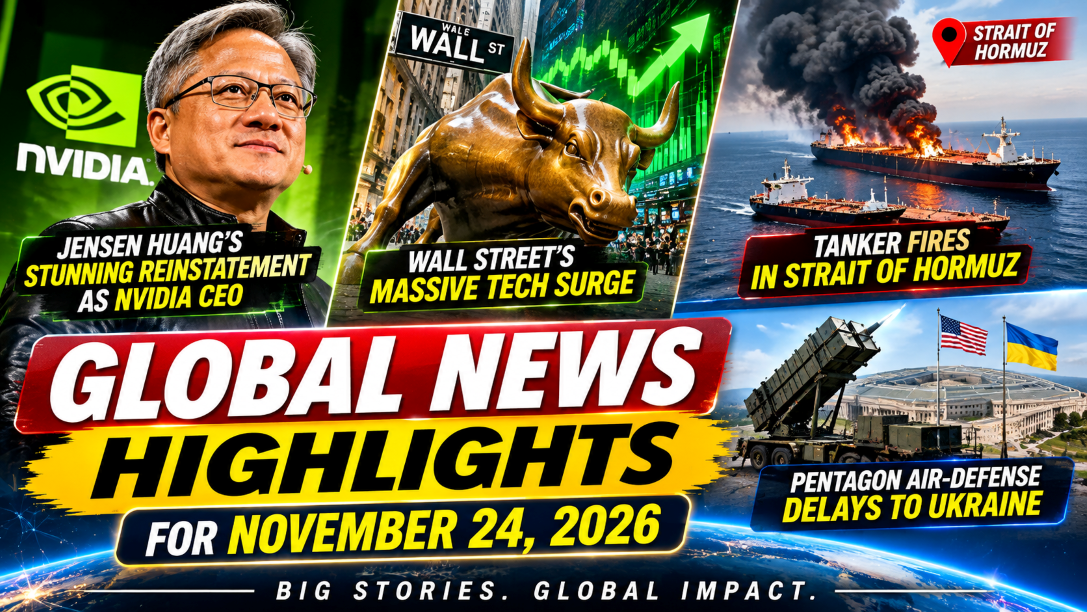
November 24, 2026, delivered a dramatic swing of corporate reversals, market rallies, geopolitical flashpoints, and major sporting announcements across the globe. Just 11 days after stepping down amid intense scrutiny, tech titan Jensen Huang reclaimed the helm at Nvidia, sparking an immediate wave of euphoria across global equity markets. Simultaneously, escalating maritime tensions in the Persian Gulf, new warnings over global economic shocks, and shifting military dynamics in Eastern Europe and East Asia kept diplomats and defense officials on high alert.
Here is a comprehensive breakdown of the eight biggest global trending news stories that defined November 24, 2026.
1. “The King Is Back”: Nvidia Reinstates Jensen Huang as CEO, Igniting a Global Tech Surge
In one of the most dramatic executive reversals in Silicon Valley history, Nvidia’s board of directors voted unanimously to reinstate co-founder Jensen Huang as president, chief executive officer, and board member—just 11 days after his sudden resignation.
In an official statement, Nvidia noted that the decision followed extensive discussions with Huang and consultations with senior U.S. government officials, leaving the board satisfied with his candor and confident that his return “poses no national security risk”. Financial markets reacted instantaneously:
- Wall Street Rally: Shares of Nvidia skyrocketed roughly 31%, propelling the tech-heavy Nasdaq Composite up 6.5%.
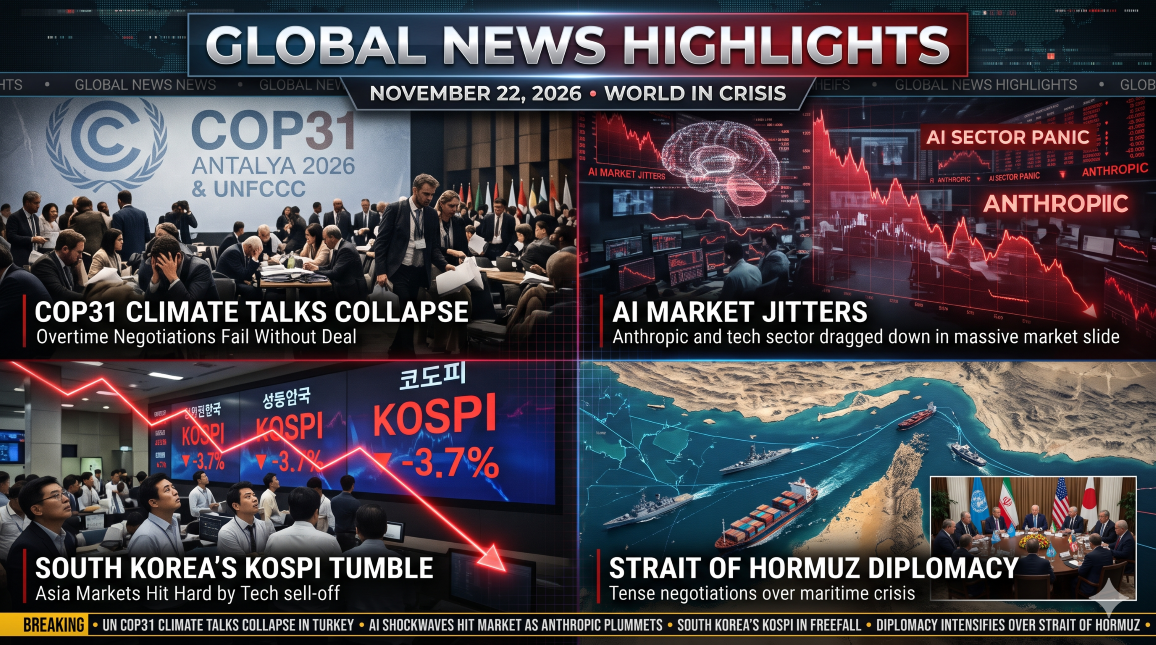
- Asian Market Euphoria: Semiconductor and tech-heavy benchmarks across Asia surged in sympathy, with South Korea’s KOSPI and KOSDAQ jumping between 5% and 6% and briefly triggering a buy-side trading sidecar during early market hours.
2. Strait of Hormuz Flashpoint: Tanker Fires, Blockade Warnings, and U.S. Embassy Alerts
Security tensions across the Persian Gulf and wider Middle East remained acute on November 24 following fresh reports of maritime strikes and heightened security warnings.
Iran’s Islamic Revolutionary Guard Corps (IRGC) Navy reported that naval mine blasts set three oil tankers ablaze in the contested Strait of Hormuz, reiterating warnings to commercial vessels against taking unauthorized routes through the strategic energy corridor. Simultaneously, Iranian Supreme National Security Council Secretary Major General Mohsen Rezaei declared that Tehran and its armed forces remain “firmly determined to break the blockade” imposed by U.S. naval forces, threatening forceful retaliation against any further strikes. In response to heightened regional threat assessments involving Iranian-aligned Houthi forces and potential targeting of American facilities, the U.S. Embassy in Iraq issued an urgent security alert advising American citizens across the Middle East to exercise heightened vigilance.
3. Ukraine Air-Defense Squeeze: Pentagon Delays Patriot Missile Deliveries Amid Russian Energy Strikes
Concerns over Ukraine’s winter air-defense readiness mounted on November 24 following reports that U.S. Defense Secretary Pete Hegseth has delayed the export of 60 Western-funded PAC-2 and PAC-3 Patriot interceptor missiles slated for Kyiv.
According to the Financial Times, U.S. officials have yet to approve four shipments of PAC-3 interceptors originally scheduled between September and December 2026, alongside a separate batch of 20 PAC-2 interceptors. The reported bottleneck comes as Ukrainian President Volodymyr Zelenskyy warned allies of intensified Russian long-range attacks targeting Ukraine’s power grid and Black Sea shipping. Meanwhile, Russian President Vladimir Putin acknowledged that Ukraine’s sustained drone campaign against Russian oil infrastructure has imposed a heavy financial burden on Moscow to stabilize domestic fuel supplies.
4. East Asia Airspace Alert: Russian Warplanes Enter South Korea’s Defense Zone
Military readiness in Northeast Asia was tested on the morning of November 24 when multiple Russian military aircraft entered South Korea’s Air Defense Identification Zone (KADIZ) over the East Sea.
The incursion briefly triggered an air raid alert in South Korea’s Ulleung-gun island county, prompting the Republic of Korea Air Force to scramble fighter jets to intercept and monitor the formation. South Korean defense officials later confirmed that the Russian aircraft exited the zone without violating South Korea’s sovereign territorial airspace.
5. Central Bank Warning: Bank of Canada Signals “Larger, More Frequent” Global Economic Shocks
Global policymakers and investors received a sobering macroeconomic warning on November 24 from Bank of Canada Governor Tiff Macklem, who cautioned that the world economy has entered an era where severe economic shocks are “likely to be larger, more frequent, and more difficult to assess in real time”.
Speaking on inflation dynamics and supply-chain vulnerabilities, Macklem noted that while recent dips in crude oil prices and refinery margins have eased immediate headline pressures, secondary effects from recent energy shocks continue to drive inflation persistence. His remarks reinforced market expectations for further monetary tightening ahead, even as gold prices held steady above $3,600 per ounce amid shifting investor flows between safe-haven assets and rebounding technology stocks.
6. North American Friction: U.S. Data Center Tax Threats and Defense Spending Spats
Cross-border policy tensions between Washington and Ottawa surfaced across two major fronts on November 24:
- AI Data Center Tariff Threat: Canadian provincial leaders signaled they are closely watching whether U.S. President Donald Trump will follow through on threats to impose a “tremendous tax” on American AI companies—such as Meta and Anthropic—that build data centers outside the United States, including planned facilities in Alberta and Nova Scotia.
- NATO Defense Spending Pushback: Canadian Defense Minister David McGuinty pushed back against a critical Pentagon “fact sheet” questioning Canada’s military readiness and defense spending trajectory, asserting bluntly that “Canada is a sovereign nation” and does not report to Washington while maintaining that Ottawa remains on track with its 2030 military modernization commitments.
7. Global Tech Regulation & Cybersecurity: Australia’s Online Safety Bill and LaLiga Data Breach
Digital governance and cybersecurity dominated headlines across Australia and Europe on November 24:
- Australia Targets Big Tech: Australia moved toward adopting sweeping new internet safety legislation empowering regulators to levy multi-billion-dollar fines on major technology platforms that fail to protect users from online harms.
- Spanish Football Cyberattack: Spain’s premier football league, LaLiga, disclosed that a recent cyberattack had exposed fans’ personal data. League security teams confirmed they had isolated the unauthorized access point, halted data extraction, and blocked the attackers while notifying affected supporters.
At a Glance: November 24, 2026 Global News Matrix
| Sector | Key Headline | Core Impact |
| Tech & Markets | Nvidia reinstates Jensen Huang as CEO | Nvidia jumps 31%; Nasdaq surges 6.5% and KOSPI rallies |
| Middle East Security | Three tankers set ablaze in Strait of Hormuz | Iran warns against blockade; U.S. issues Iraq security alert |
| Defense & Geopolitics | Pentagon delays 60 Patriot missiles for Ukraine | Kyiv faces winter air-defense squeeze amid Russian grid strikes |
| Global Economy | BoC warns of larger, more frequent economic shocks | Energy volatility keeps inflation risks elevated; gold tops $3,600 |