November 22, 2026, delivered a dramatic convergence of diplomatic breakdowns, financial market turbulence, South Asian statecraft, and sporting history. From tense late-night negotiating halls in Antalya, Turkey, to financial centers in New York and Seoul, and from high-level bilateral talks in New Delhi to the cricket grounds of Wellington, the day’s developments underscored the fragility of global consensus and the volatility of rapid technological transformation.
Here is a comprehensive breakdown of the eight biggest global trending news stories that defined November 22, 2026.
1. Climate Deadlock in Antalya: UN COP31 Talks Collapse Without Overarching Agreement
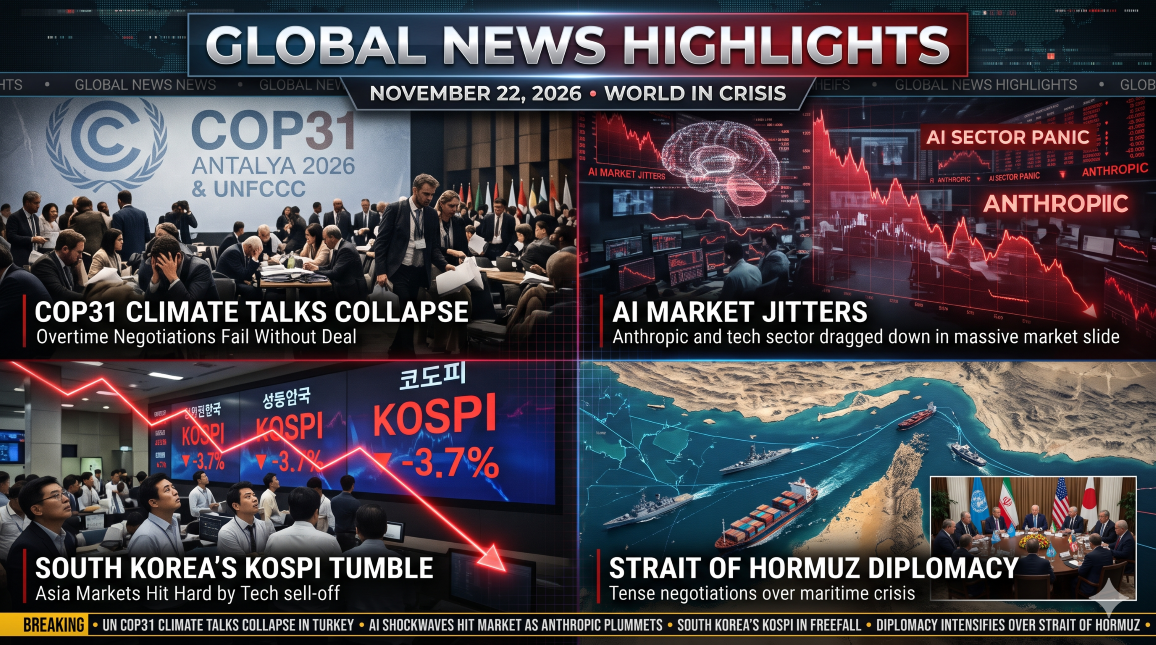
Two weeks of high-stakes United Nations climate negotiations at COP31 in Antalya, Turkey, ended without an overarching political agreement on November 22 after deep divisions over fossil fuels and climate finance proved insurmountable.
In the early hours of Sunday morning, summit co-president and Turkish Environment Minister Murat Kurum released a final draft text that notably omitted any explicit mention of fossil fuels—the primary drivers of global warming. Facing sharp pushback from climate-vulnerable nations and deadlocked positions among major economies amid soaring global energy prices and Middle East geopolitical tensions, the summit presidency ruled out issuing a revised draft. The collapse left delegates returning home without a unified roadmap, raising serious questions about the future pace of multilateral climate diplomacy.
2. AI Valuation Jitters: Anthropic Slips 9% Post-IPO as South Korea Readies Market Stabilization Funds
Global financial markets experienced sharp turbulence on November 22 as investor anxiety over massive artificial intelligence infrastructure spending dampened enthusiasm following Anthropic’s record-shattering initial public offering.
Shares of the frontier AI company fell 9% after its blockbuster debut, as institutional investors weighed the sustainability of sky-high valuations against nearly $1 trillion in long-term compute commitments. The sell-off rippled quickly across Asian technology benchmarks, pushing South Korea’s KOSPI index down to a 10-month low. In response, South Korean financial regulators announced preparations to deploy market stabilization funds and ease share buyback rules to stem equity outflows and restore investor confidence.
3. South Asian Diplomacy: Nepal PM Balendra Shah Arrives in New Delhi for Landmark State Visit
Regional diplomacy in South Asia took center stage on November 22 as Nepal Prime Minister Balendra Shah arrived in New Delhi for a two-day state visit—his first official trip to India since assuming office in March 2026.
Received at the airport by Union Minister Jitin Prasada before holding talks with External Affairs Minister Dr. S. Jaishankar, Shah’s visit focused on strengthening bilateral connectivity, cross-border infrastructure, energy cooperation, and regional stability. Dr. Jaishankar reaffirmed that India cherishes its “special friendship” with Nepal, while separate high-level diplomatic engagements in New Delhi saw Jaishankar meet Dutch Foreign Minister Tom Berendsen to advance the India-Netherlands Strategic Partnership. Simultaneously, Indian and Chinese military officials held fresh border talks aimed at maintaining stability along the Arunachal frontier.
4. Strait of Hormuz Standoff: Iran Signals Waterway Reopening Terms Amid Endurance Swim Protest
Maritime security and energy supply routes in the Persian Gulf remained in the spotlight on November 22 as Tehran outlined conditions for easing restrictions in the contested Strait of Hormuz.
Iranian Foreign Minister Abbas Araghchi stated that reopening the vital oil transit corridor is “not difficult,” while maintaining that the waterway will remain closed to unauthorized shipping until Tehran’s security and diplomatic demands are met. The remarks came just hours after British endurance swimmer Lewis Pugh completed a perilous 15-kilometer swim through the conflict-hit Strait of Hormuz to draw international attention to marine pollution and environmental risks caused by ongoing attacks on commercial tankers.
5. Escalating Unrest in Bangladesh: Nearly 30 Homes Torched as Border Guards Deploy Nationwide
Security forces across Bangladesh went on high alert on November 22 following a wave of political arson targeting supporters of former Prime Minister Sheikh Hasina.
According to local reports, nearly 30 houses belonging to Hasina’s supporters were set on fire across several districts, prompting authorities to deploy 95 platoons of the Border Guard Bangladesh (BGB)—including two full battalions stationed in Gopalganj—to restore law and order. The unrest underscored persistent political volatility in the country ahead of proposed political transitions.
6. AI Espionage & Chip Curbs: Reports Detail Secret Chinese Semiconductor Intelligence Campaign
National security and semiconductor supply chains drew fresh scrutiny on November 22 following investigative reports detailing a multi-year espionage effort targeting advanced artificial intelligence hardware.
Intelligence assessments cited by international media indicated that Chinese intelligence agencies ran a covert campaign to help domestic technology firms acquire restricted AI chips and gather sector intelligence—an effort linked to broader U.S. investigations surrounding former Megaspeed executive Alice Huang and alleged shell-company networks used to bypass American export controls. Meanwhile, U.S. President Donald Trump reiterated plans to penalize American companies that construct AI data centers overseas, aiming to keep strategic computing infrastructure anchored within the United States.
7. Global Governance & Europe: UN Advances “Killer Robots” Talks as EU Unveils Trimmed Budget Draft
International regulatory and fiscal negotiations produced major developments across Geneva and Brussels on November 22:
- Autonomous Weapons Talks: Nearly 100 nations agreed at the United Nations to pursue negotiations aimed at regulating autonomous weapons systems—widely referred to as “killer robots”—by 2028, though opposition from major arms-producing nations including the United States, Russia, and Israel resulted in a narrower mandate than advocates sought.
- EU Budget & Big Tech Tax Proposal: In Brussels, European Council President António Costa unveiled a revised European Union spending proposal that trims €204 billion ($224 billion) from an earlier European Commission plan while introducing a proposed levy on major technology corporations to help bridge fiscal gaps.
8. Cricket History in Wellington: India Piles Up Record 720/9 to Dominate New Zealand
On the sporting front, India etched its name into the cricket record books on Day 4 of the first Test against New Zealand at the Basin Reserve in Wellington on November 22.
Powered by commanding centuries from KL Rahul (136) and Rishabh Pant (128), India declared its first innings at an imposing 720 for 9—the highest Test innings total ever recorded by any team in New Zealand—securing a massive 352-run lead. By stumps on Day 4, New Zealand reached 119 for 2 in its second innings, still trailing India by 233 runs heading into the final day.
At a Glance: November 22, 2026 Global News Matrix
| Sector | Key Headline | Core Impact |
| Climate & Environment | UN COP31 talks in Turkey end without overarching agreement | Deadlock over fossil fuels leaves global climate roadmap unresolved |
| Markets & Tech | Anthropic drops 9% post-IPO; KOSPI hits 10-month low | South Korea readies stabilization funds amid AI valuation jitters |
| South Asia Diplomacy | Nepal PM Balendra Shah visits New Delhi | Talks with India focus on connectivity, energy, and regional ties |
| Global Security | UN backs 2028 talks on autonomous weapons; BGB deploys in Bangladesh | 95 border guard platoons deployed after political arson attacks |
| Sports | India declares at record 720/9 against New Zealand | Highest Test total in NZ gives India commanding 352-run lead |