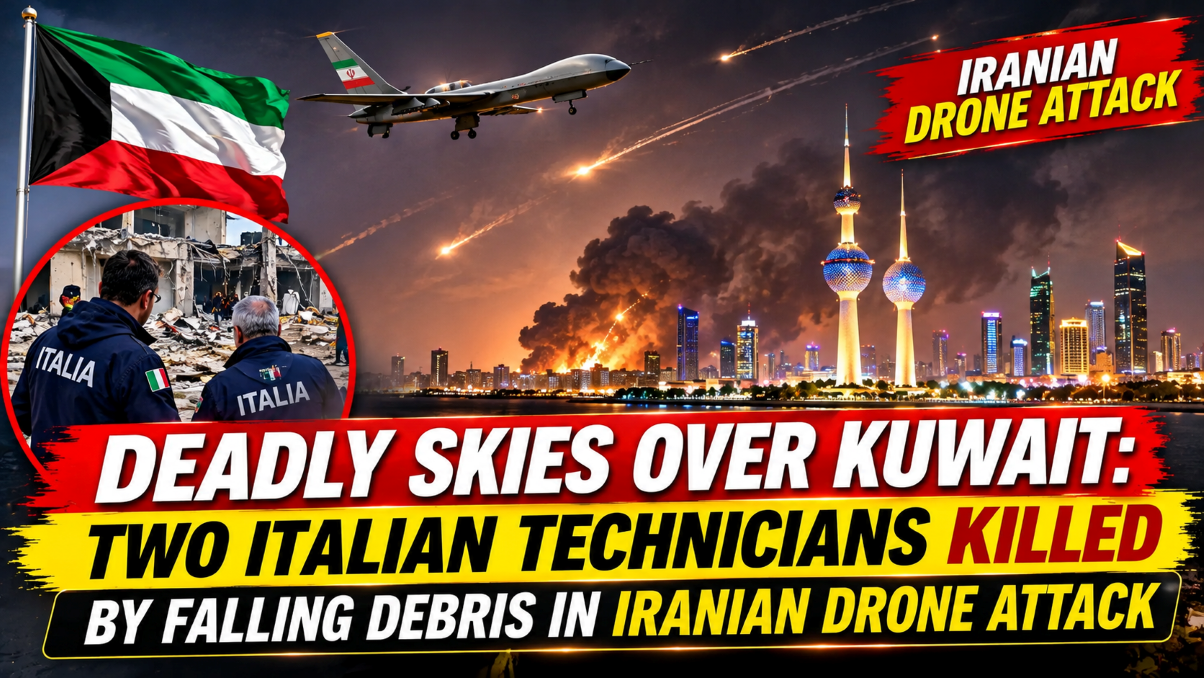
Two Italian civilian technicians were killed in Kuwait on Thursday, November 26, 2026, after falling debris from intercepted Iranian drones struck an air-defense facility, according to official statements from both Kuwaiti and Italian authorities. The fatal incident marks the first deadly Iranian attack on Kuwaiti soil in nearly four months, underscoring the severe human toll of escalating military friction across the Persian Gulf.
While Kuwait’s air defenses successfully intercepted multiple hostile unmanned aerial vehicles entering the country’s airspace, the resulting shrapnel and explosion claimed the lives of the two European specialists and left two additional personnel—a Kuwaiti army captain and a Pakistani national—wounded. Coming amid renewed strikes in the Strait of Hormuz and across neighboring Gulf states, Thursday’s tragedy has prompted sharp diplomatic condemnation from Kuwait City, Rome, and Brussels.
Inside the Attack: What Happened at Kuwait’s Air-Defense Surveillance Station?
According to Kuwait’s Ministry of Defence and armed forces spokesperson Col. Saud Al Atwan, Kuwaiti air defense units detected and engaged several hostile Iranian drones targeting what officials initially described as an unspecified “vital facility”. Although interceptors neutralized the incoming aerial threats mid-air, falling debris and shrapnel struck the ground installation, causing material damage and inflicting critical injuries on four people at the site.
Addressing the Italian Senate in Rome later on Thursday, Italian Foreign Minister Antonio Tajani provided specific details regarding the victims and the location of the blast. Tajani confirmed that the incident occurred around 2:00 p.m. local time at an air-defense detection and surveillance station in Kuwait where the two Italians were working.
| Casualty / Affected Individual | Nationality & Role | Employer / Affiliation | Status Confirmed by Officials |
| Victim 1 | Italian civilian technician | Rheinmetall Italia (German defense group Rheinmetall) | Died of injuries sustained in the blast |
| Victim 2 | Italian civilian technician | Rheinmetall Italia (German defense group Rheinmetall) | Died of injuries sustained in the blast |
| Injured Official | Kuwaiti Army Captain | Kuwait Armed Forces | Hospitalized with injuries |
| Injured Worker | Pakistani national | On-site personnel | Hospitalized with injuries |
Both deceased Italian nationals were employed by Rheinmetall Italia, the Italian subsidiary of German defense contractor Rheinmetall, which specializes in radar and air-defense systems. Kuwait’s Defense Ministry initially reported that all four individuals had been transported to medical facilities with injuries before confirming shortly afterward that the two Italian technicians had succumbed to their wounds.
The Hidden Danger of Aerial Interceptions: Why Falling Debris Proves Lethal
Thursday’s casualties highlight a sobering operational reality of modern air and missile defense across densely populated or strategically staffed Gulf facilities: a successful interception does not eliminate danger on the ground.
When surface-to-air interceptors destroy incoming attack drones in mid-air, high-velocity metallic fragments, unspent fuel, and structural debris rain down over wide impact zones. Because civilian engineers and defense contractors frequently operate alongside military personnel inside radar, surveillance, and early-warning detection stations, personnel stationed at targeted air-defense sites face acute risks even when defensive batteries perform as intended.
International Outcry: Rome, Brussels, and Kuwait City Condemn Tehran
News of the deaths triggered swift diplomatic reactions across Europe and the Middle East on Thursday evening:
- Kuwait’s Foreign Ministry: Manama-aligned and regional partners echoed Kuwait City’s sharp rebuke, with Kuwait’s Foreign Ministry branding the strike a “flagrant violation of the sovereignty of the State of Kuwait, a direct threat to its security and a grave breach of the rules of international law”. The ministry warned that continued strikes represent a dangerous escalation that undermines diplomatic de-escalation efforts, while affirming Kuwait’s right to respond.
- Italian Prime Minister Giorgia Meloni: Expressing deep sorrow in Rome, Prime Minister Giorgia Meloni offered public condolences to the victims’ families, writing that her thoughts were with everyone affected by the attack. Foreign Minister Antonio Tajani similarly confirmed the fatalities before lawmakers in the Senate while Italian diplomatic officials coordinated directly with Kuwaiti authorities.
- European Union Leadership: European Commission President Ursula von der Leyen called for intensified international pressure on Tehran following the deaths of the two European workers, stating that Europe must act to halt “these unacceptable attacks against its neighbors and our partners in the Gulf”.
Regional Context: Renewed Gulf Strikes and the Strait of Hormuz Standoff
Thursday’s fatal drone strike broke a nearly four-month period without deadly Iranian attacks on Kuwaiti territory—the previous fatal incident having occurred on July 30, 2026, when a strike in northern Kuwait killed a Nepali driver. After a relative autumn lull spanning more than two months, Iran resumed aerial attacks against U.S.-allied Gulf states in mid-November, targeting installations in both Kuwait and Bahrain.
The escalation in Kuwaiti airspace unfolded alongside broader military and maritime volatility across the region on November 26:
- Strait of Hormuz Maritime Alerts: The United Kingdom Maritime Trade Operations (UKMTO) reported two new maritime security incidents involving commercial shipping near the contested Strait of Hormuz—one near Khasab, Oman, and another approximately 50 nautical miles off the coast of Dubai—amid ongoing U.S. naval efforts to escort vessels through the strategic oil chokepoint.
- Continued Red Sea and Arabian Peninsula Exchanges: Meanwhile, cross-border hostilities between Saudi Arabia and Yemen’s Iran-aligned Houthi movement persisted, with Saudi air defenses intercepting incoming drones and ballistic missiles following Houthi claims of strikes on Saudi ports, and coalition airstrikes hitting targets across Sanaa, Hodeidah, and Saada.
What the Kuwait Drone Casualties Mean for Gulf Security
The deaths of two European defense technicians on Kuwaiti soil add a consequential international dimension to the Persian Gulf standoff. Beyond testing Kuwait’s air-defense readiness, the incident directly impacts European nations whose industrial specialists and defense contractors help maintain critical regional infrastructure. As diplomatic pressure mounts from European capitals alongside Gulf Cooperation Council states, preventing further spillover across Kuwait, Bahrain, and the Strait of Hormuz has become an urgent test for regional stability