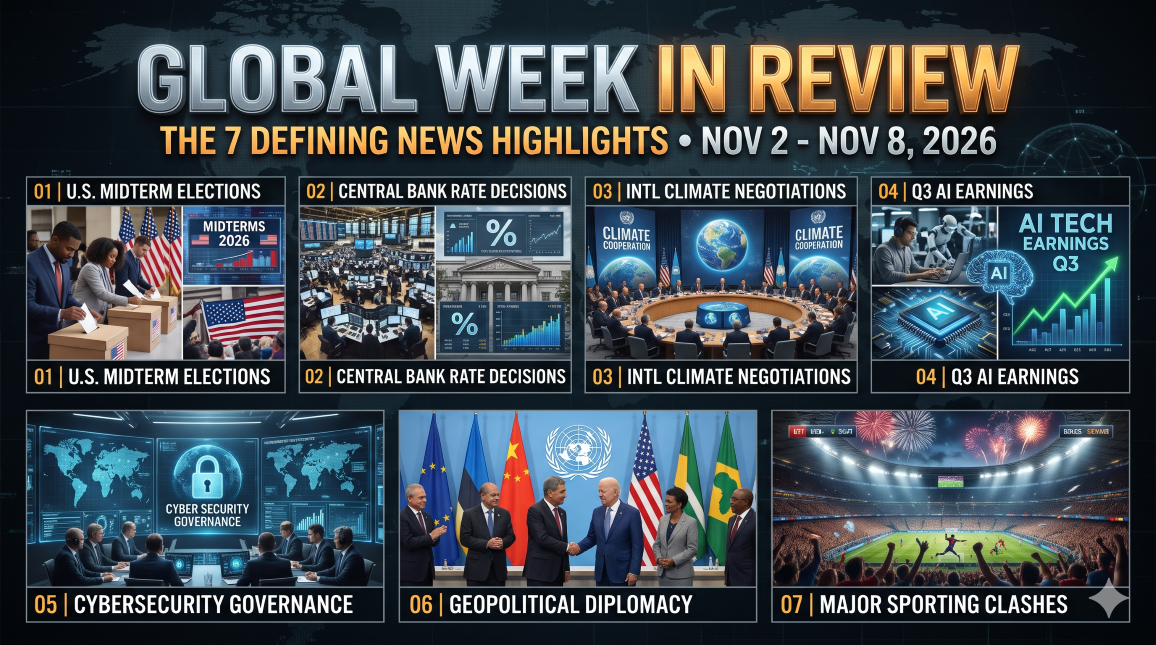
The week of November 2 to November 8, 2026, marked one of the most consequential stretches on the global calendar, uniting major democratic elections, central bank policy decisions, international climate negotiations, and peak corporate earnings disclosures within a single seven-day window. Across capitals, financial exchanges, and diplomatic forums, policymakers and market participants navigated pivotal decisions with lasting implications for global governance, economic stability, and technological oversight.
Because fast-moving elections, economic releases, and diplomatic talks generate continuous updates, readers seeking verified official tallies and primary documents can consult the authoritative institutions referenced throughout each highlight below.
1. Ballot Boxes and Power Shifts: High-Stakes U.S. Midterm Elections Reshape Political Mandates
Political attention worldwide centered on the United States during the week of November 2 to November 8, 2026, as voters headed to the polls for the federal midterm election cycle. Held on the first Tuesday following the first Monday in November, the ballot determined control of the U.S. House of Representatives, contested seats in the U.S. Senate, state governorships, and key state-level policy referendums.
For domestic and international observers alike, the midterm elections carried major consequences for fiscal policy, trade tariffs, semiconductor export controls, energy regulation, and foreign aid commitments. Campaigning in the final days of the race focused heavily on household affordability, inflation dynamics, healthcare costs, border enforcement, and industrial competitiveness. Certified precinct-level vote counts, campaign finance disclosures, and official congressional tallies are published by individual state secretaries of state, the Federal Election Commission (FEC), and national news wire services including the Associated Press and Reuters.
2. Central Banks at a Crossroads: Interest Rate Decisions and Labor Market Signals
Global financial markets faced a dense slate of macroeconomic catalysts between November 2 and November 8, 2026, anchored by scheduled autumn monetary policy meetings and monthly employment reports. Major central banks—including the U.S. Federal Reserve and the Bank of England—deliberated over benchmark interest rate paths as policymakers weighed persistent services-sector price pressures against signs of cooling labor demand and uneven manufacturing activity.
Alongside central bank rate statements and press conferences, investors closely tracked national employment surveys and Purchasing Managers’ Index (PMI) readings across North America, Europe, and Asia to gauge economic momentum heading into the final stretch of the year. Currency markets, sovereign bond yields, and equity valuations reacted sharply to subtle shifts in forward guidance from central bank governors. Official monetary policy statements, economic projections, and verified labor statistics are published directly by the Federal Reserve Board, the Bank of England, the U.S. Bureau of Labor Statistics (BLS), and S&P Global.
3. Climate Diplomacy Under Pressure: Global Leaders Confront Emissions and Adaptation Goals
Environmental governance returned to the forefront of international diplomacy during the first full week of November as government ministers, climate scientists, Indigenous leaders, and civil society delegations gathered for the annual United Nations Climate Change Conference cycle. Negotiators focused on auditing national emissions-reduction pledges, scaling climate adaptation finance for vulnerable developing nations, and operationalizing loss-and-damage funding mechanisms.
Discussions underscored the growing tension between rising global energy demand—driven in part by heavy industrial electrification and hyperscale data center expansion—and international commitments to accelerate clean power deployment. Observers also scrutinized transparent carbon-market rules and corporate climate-disclosure standards. Official negotiating agendas, national climate submissions, and global meteorological assessments are maintained by the United Nations Framework Convention on Climate Change (UNFCCC) and the World Meteorological Organization (WMO).
4. Silicon Valley’s Reality Check: Corporate Earnings Test AI Infrastructure Spending
The week of November 2 to November 8, 2026, coincided with the peak of third-quarter corporate earnings season, putting major technology, semiconductor, cloud computing, and consumer enterprises under intense Wall Street scrutiny. Institutional investors focused less on broad promises around artificial intelligence and far more on concrete revenue conversion, cloud margin durability, and capital expenditure discipline.
Executives across enterprise software and hardware faced pointed questions regarding whether multi-billion-dollar investments in AI data centers, custom accelerators, and power infrastructure are translating into sustainable enterprise adoption. At the same time, industrial and retail bellwethers offered vital readouts on consumer spending resilience, freight volumes, and cross-border supply chain costs. Audited quarterly financial statements and executive guidance are filed publicly through the U.S. Securities and Exchange Commission (SEC) EDGAR system and corporate investor relations portals.
5. Guarding the Digital Backbone: Cloud Resilience and Autonomous AI Oversight Take Center Stage
Technology policy and cybersecurity governance emerged as major talking points throughout the week as enterprises and public-sector agencies confronted rising operational risks tied to centralized cloud infrastructure and autonomous software agents. Security leaders emphasized the need for multi-region failover architectures, strict identity-and-access controls, and continuous third-party vendor auditing to prevent localized technical faults from cascading across critical industries.
Simultaneously, regulators and chief information security officers accelerated debates around guardrails for agentic AI systems capable of executing multi-step tasks across corporate networks without constant human intervention. European and North American privacy watchdogs also maintained pressure on major digital platforms over user data collection, algorithmic transparency, and informed consent practices. Technical vulnerability alerts and formal regulatory rulings are issued by the U.S. Cybersecurity and Infrastructure Security Agency (CISA), the European Data Protection Board (EDPB), and national data protection authorities.
6. Geopolitical Fault Lines: Maritime Security and Diplomatic Maneuvering Across Flashpoints
International security headlines from November 2 to November 8, 2026, remained dominated by protracted conflicts in Eastern Europe and West Asia, alongside heightened vigilance over strategic maritime trade corridors. Diplomatic ministries worked through bilateral backchannels and multilateral forums to prevent regional hostilities from disrupting global energy shipments and commercial vessel transit through critical chokepoints.
In Europe, defense officials prioritized air-defense replenishment, energy grid protection ahead of winter, and deterrence against hybrid threats targeting critical infrastructure. Across the Indo-Pacific, foreign ministers prepared for upcoming autumn leadership summits aimed at managing trade friction, supply chain diversification, and maritime code-of-conduct talks. Verified diplomatic resolutions, peacekeeping briefings, and official security communiqués are published by the United Nations Security Council, NATO, and participating foreign ministries.
7. Championship Pressure Mounts: Pivotal Clashes Across Global Football, Cricket, and Motorsport
Global sport delivered high drama throughout the week of November 2 to November 8, 2026, as autumn schedules entered decisive phases across multiple disciplines:
- European and International Football: Clubs across domestic leagues and continental competitions battled for crucial table positioning ahead of the November international break, testing squad depth amid congested fixture lists.
- International Cricket: Bilateral Test and white-ball series continued across major cricketing nations, with teams fine-tuning combinations and vying for valuable championship points.
- Motorsport and Tennis: Late-season rounds in international motorsport tightened championship standings, while elite tennis players competed for final qualification spots ahead of the season-ending tour championships.
Official match scorecards, championship standings, and disciplinary rulings are published by FIFA, UEFA, the International Cricket Council (ICC), the Fédération Internationale de l’Automobile (FIA), and the ATP and WTA tours.
At a Glance: November 2–8, 2026 Global News & Primary Source Matrix
| Global Beat | Core Focus During Nov 2–8, 2026 | Authoritative Primary Sources |
| Politics & Elections | U.S. federal midterm elections, legislative control, and state ballot measures | State Secretaries of State, Federal Election Commission (FEC), AP, Reuters |
| Macroeconomics | Central bank interest rate decisions, inflation outlook, and monthly jobs data | Federal Reserve Board, Bank of England, U.S. Bureau of Labor Statistics (BLS) |
| Climate & Energy | International climate negotiations, emissions pledges, and adaptation finance | United Nations Framework Convention on Climate Change (UNFCCC), WMO |
| Business & Markets | Third-quarter corporate earnings, AI capital expenditure, and consumer demand | U.S. Securities and Exchange Commission (SEC) EDGAR, corporate filings |
| Tech & Cybersecurity | Cloud infrastructure resilience, autonomous AI guardrails, and data privacy | CISA, European Data Protection Board (EDPB), national regulators |
| World Diplomacy | Regional conflict mediation, maritime trade security, and summit preparations | United Nations Security Council, NATO, official foreign ministries |
| Global Sports | Continental football fixtures, international cricket tours, and season finales | FIFA, UEFA, International Cricket Council (ICC), FIA, ATP/WTA |
Looking Beyond the Week
Taken together, the developments of November 2 to November 8, 2026, underscored how tightly intertwined domestic politics, monetary policy, technological infrastructure, and international diplomacy have become. Shifts at the ballot box directly influence fiscal and regulatory trajectories; central bank decisions shape corporate investment in artificial intelligence and clean energy; and geopolitical stability remains foundational to global trade. Following primary disclosures from the institutions above ensures clarity as these storylines continue unfolding through the remainder of the year.