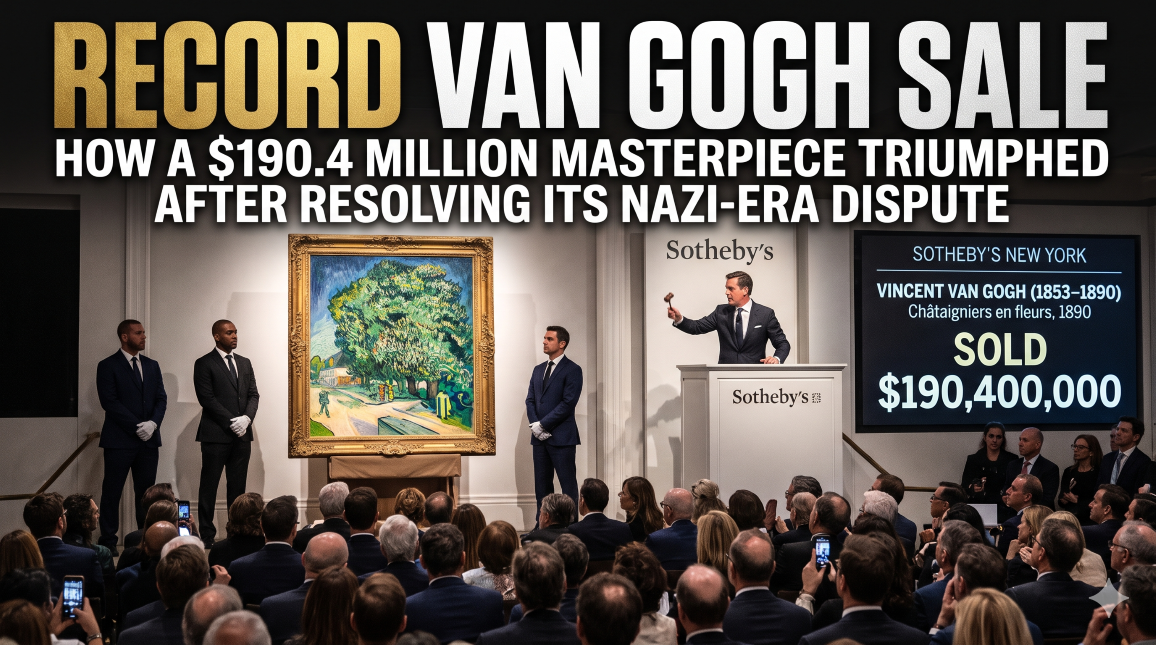
The international art market witnessed a historic milestone as a masterpiece by Dutch Post-Impressionist icon Vincent van Gogh sold for a reported $190.4 million—shattering previous auction and private-sale expectations for the artist and cementing its place among the most valuable works of art ever traded. Yet beyond the staggering nine-figure price tag, the transaction stands out for a far deeper reason: it was only made possible after parties reached a formal agreement resolving a complex, decades-long dispute over the painting’s Nazi-era ownership history.
For years, questions surrounding wartime displacement and forced sales cast a shadow over the canvas, keeping it entangled in legal and ethical uncertainty. By reaching a comprehensive settlement prior to bringing the work to market, the stakeholders not only cleared its title for an historic sale, but also demonstrated how transparent provenance resolution can unlock immense cultural and financial value while honoring historical justice.
Shattering Records: Inside the $190.4 Million Van Gogh Milestone
Few artists command the universal reverence and market fervor of Vincent van Gogh. Although the painter famously struggled for financial recognition during his brief life—selling only a handful of canvases before his death in 1890 at age 37—his expressive brushwork, vivid color palettes, and emotional intensity have made his late-period landscapes, portraits, and still lifes the ultimate trophies for global museums and private collectors.
At a reported $190.4 million, this sale vaults dramatically past Van Gogh’s previous auction high—set when Verger avec cyprès (Orchard with Cypresses) fetched $117.1 million at Christie’s New York in 2022—and rivals the highest echelons of twentieth- and nineteenth-century art transactions worldwide.
| Milestone / Transaction | Artist | Reported Price | Market Significance |
| Latest Historic Van Gogh Sale | Vincent van Gogh | $190.4 Million | New reported benchmark for Van Gogh following Nazi-era restitution settlement |
| Verger avec cyprès (2022) | Vincent van Gogh | $117.1 Million | Former public auction record for Van Gogh (Paul G. Allen Collection) |
| Portrait of Dr. Gachet (1990) | Vincent van Gogh | $82.5 Million | Iconic 1990 sale that defined modern trophy-art pricing for decades |
| Les Femmes d’Alger (Version O) (2015) | Pablo Picasso | $179.4 Million | Benchmark for modern auction trophies surpassed by the $190.4M Van Gogh figure |
In the upper tier of the global art market, ultra-high-net-worth collectors and sovereign cultural institutions compete fiercely for “irreplaceable” museum-grade works—paintings from an artist’s peak creative period that rarely, if ever, enter private circulation. However, even the most celebrated canvas cannot command record-breaking bids if its legal title carries any ambiguity.
Shadows of the Past: Understanding the Nazi-Era Provenance Dispute
To understand why the resolution agreement was essential to this $190.4 million sale, one must look back to Europe during the 1930s and 1940s. Between 1933 and 1945, the Nazi regime orchestrated the largest systematic theft and forced displacement of art in human history, confiscating hundreds of thousands of paintings, sculptures, books, and cultural treasures—predominantly from Jewish collectors, gallery owners, and families across Germany, Austria, France, the Netherlands, and beyond.
Even when artworks were not seized directly by Nazi squads, thousands of collectors were compelled to sell prized masterpieces under duress—often at fraction-of-value prices—to fund emergency visas, pay punitive emigration taxes, or survive persecution. Decades later, many of these works surfaced in prestigious museum collections or private holdings with gaps in their ownership records, known in the art world as provenance.
When heirs of original pre-war owners identify a painting that was looted or sold under persecution, they may assert legal or moral restitution claims. Until such claims are thoroughly investigated and resolved:
- Major auction houses will not consign the work, as reputable sellers require guaranteed clean title before offering an artwork to international buyers.
- Museums and institutional buyers refuse to acquire or exhibit the piece, bound by international ethical frameworks such as the 1998 Washington Conference Principles on Nazi-Confiscated Art.
- Market value drops precipitously, because no sophisticated collector is willing to spend tens or hundreds of millions of dollars on an asset vulnerable to future seizure or litigation.
How Restitution Agreements Turn Legal Deadlocks into Historic Sales
Rather than allowing the Van Gogh masterpiece to remain locked in prolonged, costly courtroom battles—which frequently stall for decades and erode value for every party involved—the stakeholders pursued a negotiated resolution.
In high-profile art restitution cases, settlement agreements typically follow one of several established frameworks:
- Joint Sale and Proceeds Sharing: The current possessor and the heirs of the pre-war family agree to waive competing ownership claims, bring the painting to market together with unified, indisputable title, and divide the net sale proceeds according to a negotiated formula.
- Restitution Followed by Consignment: Full legal title is formally restored to the heirs, who subsequently choose to offer the painting at auction or private sale to divide the inheritance equitably among family members.
- Financial Settlement and Title Confirmation: The current holder compensates the claimant family directly in exchange for a permanent release of claims, clearing the path for a subsequent record-setting sale.
Regardless of the specific contractual structure, the outcome is transformative: moral accountability meets market certainty. Buyers receive an airtight guarantee that the painting’s wartime history has been transparently documented and fairly settled, freeing collectors to bid purely on artistic merit and historical rarity.
Why Clean Provenance Is Now the Ultimate Currency in the Global Art Market
The $190.4 million Van Gogh transaction highlights a fundamental shift in how the twenty-first-century art world operates. Decades ago, collectors focused almost exclusively on authenticity, condition, and exhibition history. Today, provenance research and ethical due diligence carry equal weight.
Major auction houses, art funds, and private banks now employ dedicated teams of historians and legal specialists to trace every artwork’s ownership chain year by year, particularly across the critical 1933–1945 window. When a dispute is resolved openly prior to sale, it actually enhances the painting’s desirability. Collectors increasingly view works with documented restitution settlements as carrying an added layer of historical integrity—proof that an injustice from the twentieth century has been acknowledged and rectified in the twenty-first.
Furthermore, resolving a Nazi-era claim brings the full story of the artwork into the public record. Pre-war collectors—many of whom were visionary patrons who championed Van Gogh and his contemporaries long before the wider public appreciated their genius—have their names and cultural legacies restored to the painting’s official exhibition and catalog history.
What This Landmark Deal Means for Future Trophy Art Transactions
Industry analysts and art law specialists view the $190.4 million Van Gogh sale as a bellwether for the broader collectibles and fine art market:
- Validation of Trophy-Tier Demand: Even amid shifting global interest rates and geopolitical headwinds, demand for museum-quality Impressionist and Post-Impressionist masterpieces remains remarkably resilient at the top end of the market.
- Momentum for Out-of-Court Settlements: The financial success of this sale sends a clear signal to other museums, foundations, and private families embroiled in provenance disputes that collaborative settlements yield far better outcomes than protracted litigation.
- Heightened Transparency Standards: Going forward, sellers bringing any European artwork created before 1945 to market will face rigorous scrutiny from buyers who expect complete clarity regarding wartime ownership.
A Triumph of Artistic Legacy and Historical Resolution
The reported $190.4 million sale of a Vincent van Gogh masterpiece is far more than a headline-grabbing auction figure. It represents the convergence of two powerful forces: the enduring, universal resonance of Van Gogh’s art and the modern art world’s commitment to confronting and resolving the lingering injustices of World War II. By settling its Nazi-era dispute before stepping onto the global stage, the painting achieved both a clean historical slate and a monumental market triumph—proving that when provenance is honored, true masterpieces can finally shine without shadow.