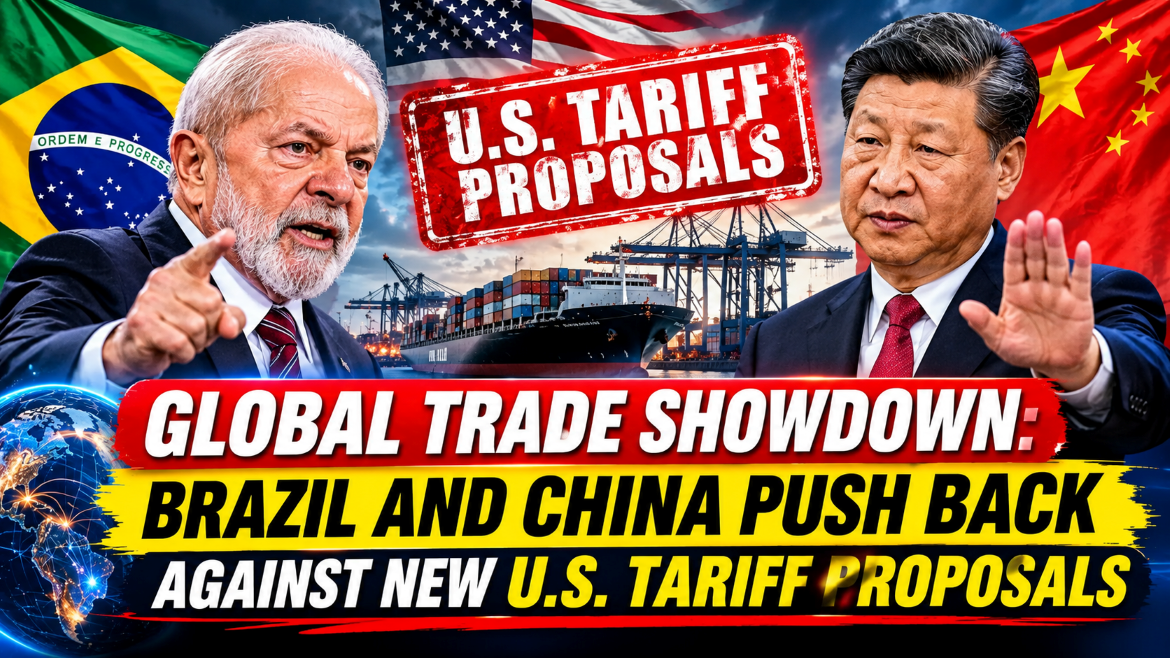
Fresh trade friction rippled across global markets on November 26, 2026, after Brazil and China led a sharp international pushback against sweeping new tariff proposals unveiled by the United States Trade Representative (USTR). Unveiled under Section 301 of the Trade Act of 1974, the Trump administration’s proposals target 14 major trading partners over alleged state-subsidized industrial overcapacity while singling out Brazil with separate punitive duties on aircraft and sugar.
Within hours of Washington’s announcement, Brasília condemned the proposed levies as “unacceptable” and refused to rule out retaliatory tariffs, while Beijing denounced the U.S. narrative as baseless “political manipulation” and warned that it reserves the right to take necessary countermeasures to protect its economic interests.
Inside Washington’s New Section 301 Tariff Blueprint
The latest trade offensive represents the Trump administration’s effort to reconstruct its tariff architecture following a U.S. Supreme Court ruling in February 2026 that struck down earlier sweeping global import taxes. By pivoting to Section 301—a statutory authority permitting import duties against nations deemed to engage in unreasonable or discriminatory trade practices—the USTR laid out a tiered schedule of proposed levies scheduled for public hearings in January 2027, with final implementation eyed for February or March.
| Target Economy / Bloc | Proposed U.S. Tariff Structure | Key Focus & Strategic Context |
| China | New 20% duty (stacking up to 45% on select goods) | Targets alleged state-subsidized industrial overcapacity; includes a proposed $30B exemption tied to an expiring trade truce |
| Brazil | Additional 10% tariff on finished aircraft + higher out-of-quota sugar duties | Separate Section 301 action aimed at pressuring Brasília amid stalled bilateral trade talks |
| India & Vietnam | 17% (India) / 20% (Vietnam) if deals finalize; rising to 25% / 35% if talks fail | Conditional rates designed to accelerate pending bilateral trade agreements |
| EU, Japan, South Korea, Taiwan, Switzerland | Capped at 15% (including existing most-favored-nation duties) | Aligned with bilateral framework agreements negotiated over the past year |
| Southeast & South Asian Partners | Capped at 18% (Cambodia, Indonesia, Malaysia, Thailand, Bangladesh) | Addresses regional supply-chain routing and manufacturing subsidies |
According to Goldman Sachs estimates, if enacted in full, the measures would lift the overall effective U.S. tariff rate from 7.8% to 9.2%—effectively restoring duties on affected economies to pre-February levels without stacking atop existing sector-specific tariffs on steel and automobiles.
“Unacceptable”: Brazil Rejects U.S. Pressure on Embraer Aircraft and Sugar
While 14 economies were named in the broader overcapacity framework, Brazil drew particular ire in Washington after bilateral trade negotiations stalled. In a separate filing, the USTR proposed raising tariffs on out-of-quota raw and refined sugar imports and imposing a brand-new 10% tariff on finished aircraft from Brazil—a direct blow to aerospace giant Embraer, Brazil’s largest aircraft manufacturer and a major supplier of regional jets to U.S. airlines.
Brazil’s government responded with immediate indignation, arguing that Brasília had negotiated in good faith for more than a year. In an official communiqué, Brazil declared:
“The USTR’s unilateral decision constitutes an unacceptable action within the ongoing bilateral negotiating process. Brazil will not yield to this type of threat.”
Brasília confirmed it would continue pursuing diplomatic dialogue while preserving its right to challenge the duties at the World Trade Organization (WTO) and without ruling out reciprocal retaliatory measures. Embraer also pushed back sharply, defending the global aerospace industry’s decades-old zero-tariff regime and noting that its U.S. industrial footprint—spanning $3.5 billion in assets and more than 2,500 American employees—is projected to generate an $8 billion trade surplus for the U.S. economy over the next five years.
Beijing’s Counter-Warning: China Denounces “Political Manipulation” Ahead of G20 Talks
In China, officials swiftly rejected Washington’s central justification—that Chinese industrial subsidies create market-distorting global overcapacity. For select Chinese imports, the proposed 20% Section 301 levy would stack atop existing duties to reach a combined 45% tariff rate, even as USTR Jamieson Greer noted plans for a broad exemption covering $30 billion in Chinese goods under a bilateral trade truce set to expire on January 10, 2027.
China’s Ministry of Foreign Affairs condemned the announcement on Wednesday and Thursday, warning that Beijing reserves the right to take “necessary measures” to safeguard its legitimate rights and interests. Ministry spokesperson Guo Jiakun accused Washington of weaponizing trade rules for political ends, reiterating that “a tariff war or a trade war serves no party’s interests” and urging the United States to resolve disputes through equal dialogue.
The timing adds delicate diplomatic tension: the tariff flare-up comes just days after President Trump met Chinese President Xi Jinping in Shenzhen and only weeks before Xi is scheduled to travel to Florida for December’s Group of 20 (G20) summit, where rare-earth mineral access, U.S. agricultural purchases, and extending the bilateral trade truce top the agenda.
Global Ripple Effects: European Skepticism and Domestic U.S. Pushback
Opposition to the USTR proposals extended well beyond Brasília and Beijing:
- European Union and India Push Back: The European Union rejected the premise of fresh tariffs and insisted Washington honor the bilateral trade deal struck last year, noting that while Brussels shares concerns over state-driven overcapacity, unilateral levies violate agreed frameworks. Meanwhile, India—facing a conditional 17% to 25% tariff rate depending on ongoing trade talks—denied Washington’s allegations of structural excess capacity.
- Domestic U.S. Political and Business Backlash: At home, small-business coalition We Pay the Tariffs warned that stacking new import taxes worsens affordability pressures for American families and small enterprises. On Capitol Hill, incoming Senate Finance Committee Chair Ron Wyden (D-Ore.) pledged to use every legislative tool available to challenge what he called an attempt to reconstruct “illegal global tariffs”.
What Comes Next on the Global Trade Calendar?
With public submissions opening ahead of a formal USTR hearing on January 14, 2027—just four days after the current U.S.-China trade truce expires—global businesses and policymakers face a decisive winter window. Whether Washington’s Section 301 proposals serve primarily as negotiating leverage ahead of December’s G20 summit in Florida or ignite a new cycle of retaliatory duties from Brazil, China, and major trading partners will shape global supply chains and inflation trajectories well into 2027.