
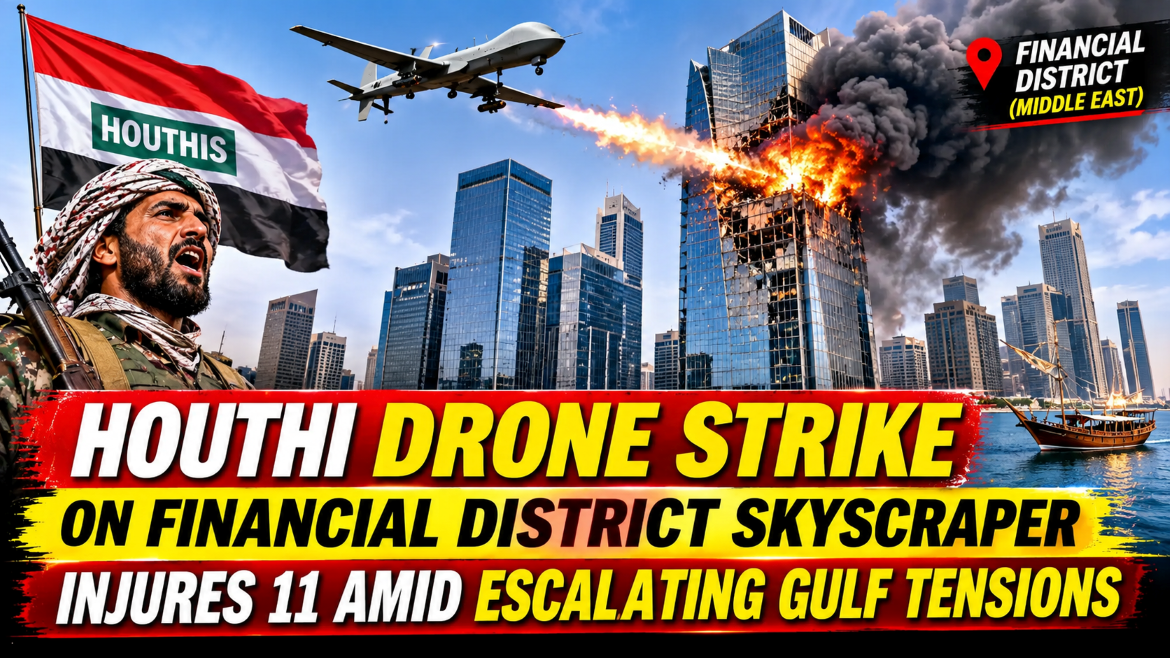
A drone strike launched by Yemen’s Iran-backed Houthi militia slammed into a landmark skyscraper in the heart of Riyadh’s financial district on Tuesday, November 24, 2026, injuring 11 people—including two Indian nationals, four Egyptians, three Nepalese citizens, and two Saudi nationals. Confirmed by Saudi Arabia’s General Directorate of Civil Defense, the strike hit the 80-story Public Investment Fund (PIF) Tower inside the King Abdullah Financial District (KAFD)—marking the second direct attack on Riyadh’s tallest building in less than a week and the third incident in the district this month.
As smoke rose from the damaged facade of Saudi Arabia’s premier economic showcase, the attack underscored a sobering reality for the Gulf’s largest economy: the resurgence of the conflict in Yemen has brought cross-border drone and missile warfare directly into the commercial center of the Saudi capital.
Inside the Attack: What Happened at Riyadh’s Landmark PIF Tower?
According to statements from Saudi Civil Defense and eyewitness accounts, the strike occurred on Tuesday when an unmanned aerial vehicle penetrated Riyadh’s airspace and struck roughly halfway up the 385-meter (1,263-foot) Public Investment Fund Tower.
Crucially, workers were inside the building repairing damage sustained from a previous Houthi strike on Thursday, November 19, when the second impact occurred. In that earlier incident, windows were shattered across seven to eight floors and sections of the exterior metal cladding were buckled, though no casualties were reported at the time. Tuesday’s strike proved far more dangerous:
- Severe Injuries Among Workers and Residents: According to reports citing sources familiar with the incident, at least two of the 11 injured victims suffered severe burns and were listed in critical condition.
- Emergency Response: Saudi Civil Defense units deployed immediately to evacuate the area, contain localized facade damage, and transport the wounded to nearby medical facilities. Witnesses reported that security vehicles used loudspeakers to warn pedestrians to take cover as police cordoned off entrances to the financial district.
| Nationality of Injured Victims | Number of Casualties | Official Confirmation Source |
| Egyptian Nationals | 4 | Saudi General Directorate of Civil Defense |
| Nepalese Nationals | 3 | Saudi General Directorate of Civil Defense |
| Indian Nationals | 2 | Saudi Civil Defense & India’s Ministry of External Affairs (MEA) |
| Saudi Citizens | 2 | Saudi General Directorate of Civil Defense |
| Total Injured | 11 | Confirmed across official Saudi and diplomatic statements |
Why the Houthis Are Targeting Riyadh’s Economic Crown Jewel
The King Abdullah Financial District is far more than a cluster of glass-and-steel office towers; it is the architectural centerpiece of Crown Prince Mohammed bin Salman’s Vision 2030 strategy to transform Riyadh into a global financial hub. Housing the headquarters of the Public Investment Fund (PIF)—Saudi Arabia’s sovereign wealth fund and the primary financial engine behind its economic diversification—the tower carries immense symbolic and economic weight.
By repeatedly striking KAFD—following an earlier November 8 incident in which falling debris from an intercepted projectile caused limited damage to a Saudi Aramco office tower in the same district—the Houthis are executing a deliberate economic pressure campaign. Sustained drone and missile alerts across Riyadh have already forced the cancellation of numerous international commercial flights and prompted the postponement or relocation of major international sporting and business events, including the AFC Asian Cup.
Global Outcry: India, the United States, and Gulf Allies Condemn Civilian Targeting
Because Saudi Arabia’s commercial hubs rely heavily on millions of international workers—including an estimated 2.7 million Indian expatriates, the Kingdom’s largest foreign community—the strike drew immediate diplomatic condemnation from New Delhi, Washington, and neighboring capitals:
- India’s Ministry of External Affairs (MEA): On Wednesday, November 25, New Delhi strongly condemned the strike, stating that such attacks “seriously endanger civilian lives, violate the sovereignty of Saudi Arabia, and undermine regional security and stability”. The MEA confirmed that the Indian Embassy in Riyadh is in close contact with hospital authorities and providing all necessary medical and consular assistance to the two injured Indian nationals and their families.
- Saudi Coalition Warning: Maj. Gen. Turki Al-Malki, spokesman for the Coalition to Restore Legitimacy in Yemen, denounced the drone strike as a “cowardly terrorist attack” and pledged a firm, decisive military response to the deliberate targeting of civilians and civilian infrastructure. Crown Prince Mohammed bin Salman similarly affirmed that the Kingdom will not tolerate any infringement on its sovereignty.
- U.S. and Regional Solidarity: The United States condemned the strike and issued updated security advisories warning American citizens in Saudi Arabia of ongoing attack risks and travel disruptions. Fellow Gulf Cooperation Council members—including the United Arab Emirates, Qatar, and Kuwait—alongside Pakistan and Lebanon expressed solidarity with Riyadh and warned against further regional escalation.
A Two-Front Escalation: From Riyadh’s Skyline to the Outskirts of Aden
Tuesday’s strike in Riyadh cannot be separated from the rapidly shifting military reality on the ground in Yemen. A UN-brokered truce that had largely held since 2022 collapsed in July 2026 amid broader regional hostilities tied to the wider conflict involving Iran.
Since fighting reignited, Houthi forces have waged a coordinated two-front campaign:
- Cross-Border Infrastructure Strikes: Launching near-daily drone and ballistic missile barrages against Saudi airports—including a deadly October 10 strike on Riyadh’s King Khalid International Airport that killed at least 12 people and injured over 300—as well as oil fields and financial landmarks.
- Ground Offensives in Southern Yemen: Simultaneously, Houthi fighters have seized strategic territory across Yemen, pushing to within roughly 60 kilometers of Aden, the interim seat of Yemen’s internationally recognized, Saudi-backed government, forcing government-aligned forces into major defensive retreats.
In response, the Saudi-led coalition has intensified airstrikes across Houthi-controlled territory in Yemen, targeting missile launch sites, drone depots, and port infrastructure.
What Comes Next for Gulf Security and Expatriate Safety?
With Houthi military spokesmen issuing fresh warnings to commercial aviation and energy facility workers across Saudi Arabia, diplomatic efforts to restore calm face steep hurdles. For Riyadh and its international partners, the immediate challenge is twofold: strengthening layered air-defense protection over densely populated urban business districts like KAFD while preventing the escalating war in Yemen from destabilizing global energy markets and endangering the millions of foreign workers who power the Gulf economy