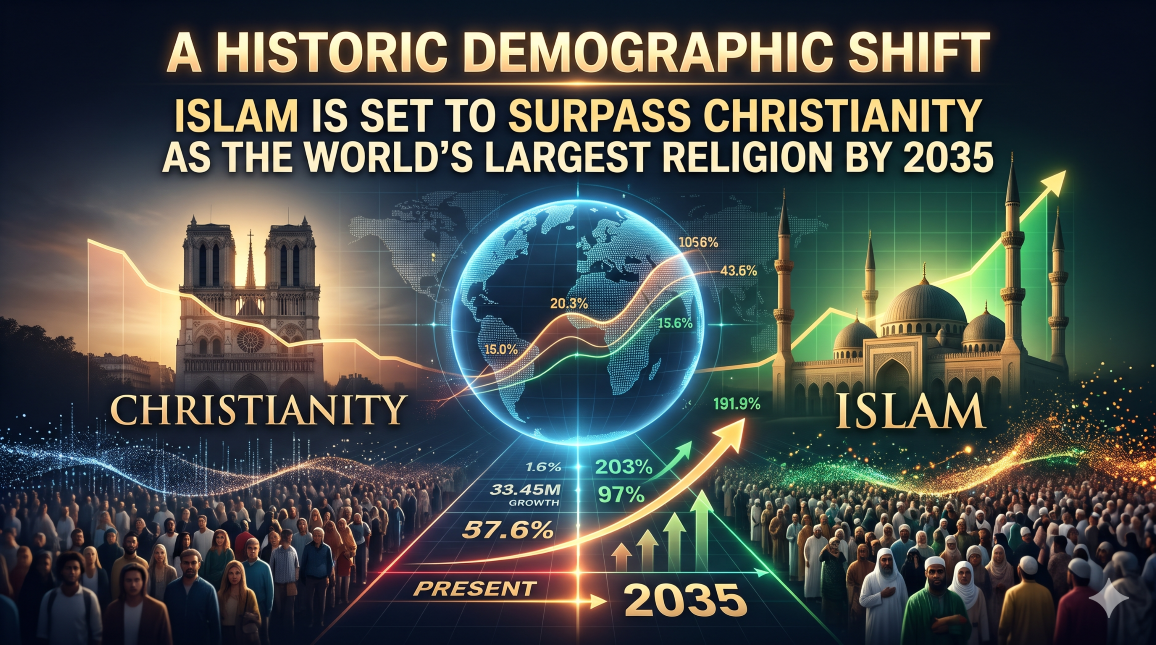
For centuries, Christianity has stood as the world’s largest religious group by population. However, landmark demographic projections released by the Pew Research Center in November 2026 indicate that the global religious landscape is approaching a historic turning point. According to Pew’s comprehensive study covering 201 countries and territories—representing 99.98% of the global population—Islam is projected to surpass Christianity as the world’s largest religion by 2035.
Far from signaling a zero-sum decline for Christianity, the report emphasizes that both of the world’s two largest faiths are steadily expanding in absolute numbers. Instead, the projected milestone reflects powerful, long-term demographic dynamics—led by higher fertility rates, a substantially younger global Muslim age profile, and rapid population expansion across Asia and sub-Saharan Africa.
The Numbers Behind the 2035 Milestone: How Fast Are Global Faiths Growing?
To map how religious adherence will evolve over half a century, Pew Research Center demographers analyzed baseline data from 2020 alongside fertility rates, mortality trends, migration patterns, and religious switching through 2070.
In 2020, Christians numbered approximately 2.27 billion worldwide, compared to 2.02 billion Muslims. Yet over the 15-year window between 2020 and 2035, the faster pace of Muslim population growth is projected to close that 250-million gap entirely. By 2035, the global Muslim population is forecast to reach 2.57 billion, edging past the projected Christian population of 2.52 billion.
| Religious Group | 2020 Population Estimate | 2035 Projected Population | 2070 Projected Population | 2020–2070 Growth Rate |
| Islam (Muslims) | 2.02 Billion | 2.57 Billion | 3.64 Billion | +80% |
| Christianity (Christians) | 2.27 Billion | 2.52 Billion | 2.96 Billion | +30% |
If current demographic trends hold through 2070, the divergence will widen further: the global Muslim population is expected to grow by 80% to reach 3.64 billion—representing roughly 36% of humanity—while the Christian population is projected to rise by 30% to 2.96 billion, keeping pace with the overall 29% growth of the world’s total population. By contrast, Pew projects that Hindus and Jews will grow more slowly than the global population overall, while the total number of Buddhists and religiously unaffiliated people worldwide is expected to decline in absolute terms.
“It’s the Babies”: Why Fertility and Youth—Not Conversion—Drive the Shift
A common public misconception surrounding global religious shifts is that one faith expands primarily through mass conversions from another. Pew’s findings dismantle that assumption.
As Pew senior demographer and study co-author Conrad Hackett succinctly summarized the findings: “It’s the babies.”
- Fertility Rate Differentials: Between 2020 and 2025, Muslim women had an average of 3.1 children per woman, compared to 2.5 children among Christian women and 1.6 children among women in all other religious groups combined—well below the 2.1 children per woman generally required for a generation to replace itself.
- Natural Population Momentum: Because the global Muslim population has the youngest median age of any major religious group, a larger share of Muslims are entering or currently in their prime childbearing years. Between 2020 and 2070, natural population change (births minus deaths) is projected to add 1.6 billion Muslims globally, compared to 792 million Christians.
- Religious Switching Balances Out: Globally, movement between Christianity and Islam is projected to remain virtually neutral. Over the 50-year period, Pew projects roughly 9.2 million Muslims will convert to Christianity while 9.0 million Christians will convert to Islam—confirming that religious switching plays virtually no role in Islam’s rise to the top spot.
“A misconception that could come out of our report is that somehow Muslim growth will happen at the expense of Christians, and that would be a wrong interpretation. It’s definitely not in our data a zero sum competition where one group can only go up in size if the other goes down in size.” — Conrad Hackett, Senior Demographer at Pew Research Center
Shifting Centers of Gravity: Where Most Muslims and Christians Will Live
Beyond headline global totals, the 2026 Pew report reveals a dramatic geographic redistribution of the world’s major faiths over the coming decades.
Pakistan, India, and Nigeria Lead Muslim Population Growth
Roughly 74% of global Muslim population growth between 2020 and 2070—an increase of 1.2 billion people—will occur across the 53 countries that already have Muslim majorities. However, the ranking of nations with the largest Muslim populations is set to reorder significantly:
- Pakistan Surpasses Indonesia: In 2020, Indonesia held the world’s largest Muslim population at 239 million, just ahead of Pakistan. With Pakistan’s Muslim population projected to double to 461 million by 2070—while Indonesia’s grows at a slower pace of 15%—Pakistan is forecast to become home to the world’s largest Muslim population well before 2070.
- India Rises to Second Place: India’s Muslim population is projected to expand from 213 million in 2020 to 334 million by 2070, moving India from third to second place globally while remaining a Hindu-majority nation.
- Sub-Saharan Africa’s Rapid Expansion: Nigeria’s Muslim population is forecast to more than double to 282 million, vaulting the West African nation from fifth to third place ahead of Indonesia. By 2070, four of the world’s ten largest Muslim populations will reside in Africa: Nigeria, Egypt, Ethiopia, and Sudan.
Sub-Saharan Africa Becomes the Heartland of Global Christianity
Christianity is undergoing an equally profound geographic transformation. While Christian populations in Europe are projected to decline by roughly a third (from 505 million in 2020 to 324 million in 2070) and the United States is projected to lose its Christian majority by 2065 amid rising religious non-affiliation, Christianity is surging across sub-Saharan Africa.
By 2070, more than half of all Christians worldwide will live in sub-Saharan Africa, and the Democratic Republic of the Congo—whose Christian population is forecast to more than triple to 299 million—will surpass the United States as the nation with the largest Christian population on Earth.
Caveats and Real-World Variables: Why Projections Are Not Destiny
Pew’s demographers emphasize that population projections are mathematical models built on current trajectories rather than guarantees of the future. Over a multi-decade horizon, real-world disruptions—including armed conflicts, economic transformations, rapid urbanization, rising female educational attainment, climate-induced migration, and sudden shifts in family planning policies—can alter fertility rates and demographic outcomes faster than models anticipate.
Even so, because demographic momentum is anchored in generations already born today, the trajectory toward 2035 is remarkably clear. As global populations continue to shift southward and eastward toward younger, faster-growing nations in Asia and Africa, the arrival of Islam as the world’s largest religion by 2035 stands as one of the defining social and cultural milestones of the twenty-first century.