
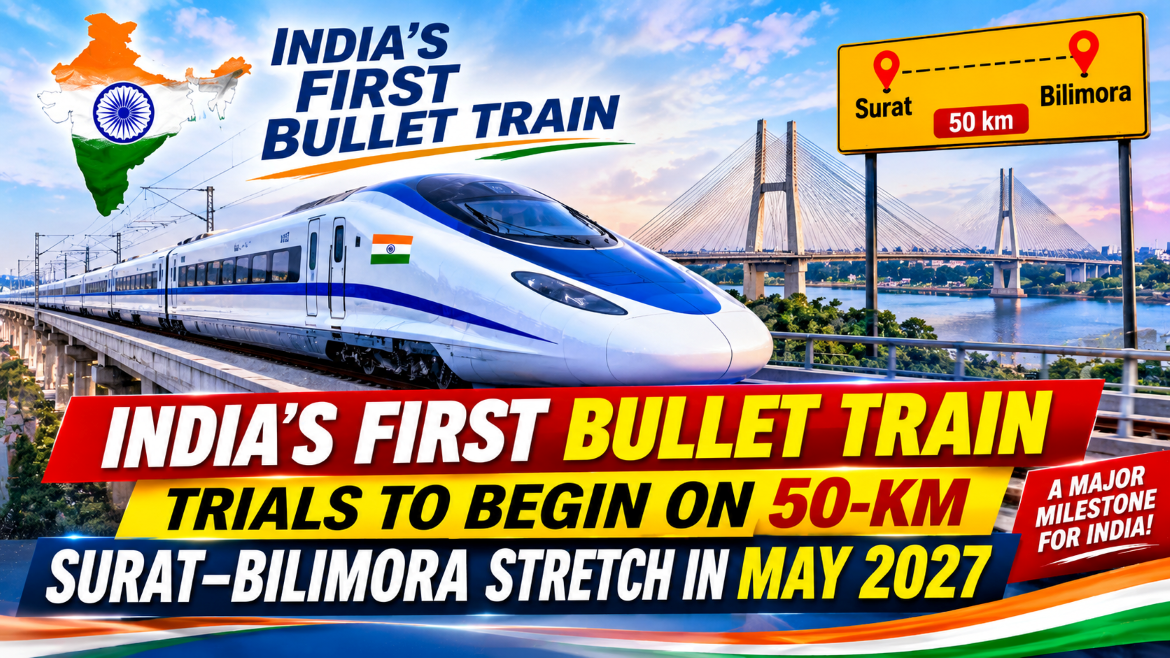
India’s decades-long ambition to enter the elite league of high-speed rail nations has crossed a decisive engineering threshold. Union Railway Minister Ashwini Vaishnaw confirmed on November 23, 2026, that trial runs for India’s first bullet train are scheduled to begin in May 2027 along the 50-kilometre Surat–Bilimora section of the Mumbai–Ahmedabad High-Speed Rail (MAHSR) corridor.
The announcement follows the successful energisation of the Overhead Electrification (OHE) system across both the Up and Down tracks of the elevated Surat–Bilimora stretch on November 20, 2026. With electrification complete and signalling systems slated for completion by January 2027, India’s flagship 508-kilometre bullet train corridor is transitioning rapidly from civil construction to live dynamic testing.
Electrification Complete: Inside the 2×25 kV Traction Milestone on Surat–Bilimora
Before a high-speed train can glide at speeds exceeding 300 km/h, its power delivery infrastructure must meet exacting international safety and stability standards. On November 20, the National High Speed Rail Corporation Limited (NHSRCL) officially energised the overhead electrical lines along the 50-km Surat–Bilimora viaduct in Gujarat.
Key technical highlights of this electrification breakthrough include:
- Advanced 2×25 kV Traction System: Unlike conventional Indian Railways routes that operate on standard 25 kV single-phase systems, the Mumbai–Ahmedabad bullet train corridor employs a specialized 2×25 kV Overhead Traction System. This global high-speed rail standard minimizes voltage drops over long distances and delivers uninterrupted, high-wattage power required for rapid acceleration and sustained top speeds.
- Bilimora Traction Substation Ready: Installation work across the Control Panel, Changeover Switch, Transformer, and Circuit Breaker buildings at the first Traction Substation (TSS) in Bilimora (Navsari district) has been completed. The facility draws power from the 220 kV Ambetha Grid Substation operated by the Gujarat Energy Transmission Corporation Limited (GETCO).
- Corridor-Wide Power Architecture: Once fully operational, the entire 508-km route between Mumbai and Sabarmati will be powered by 14 strategically located Traction Substations, all monitored continuously through a centralized control center.
Following the energisation of the high-voltage wires, NHSRCL issued a public safety advisory cautioning residents and workers along the alignment to maintain safe distances from overhead electrical installations as system-level electrical validation gets underway.
Why the 50-km Surat–Bilimora Section Is India’s High-Speed Proving Ground
Choosing the 50-kilometre stretch between Surat and Bilimora as the initial testing corridor was a deliberate strategic decision by railway engineers. Constructed entirely on an elevated viaduct alignment, this section serves as a comprehensive microcosm of the broader corridor’s engineering complexities.
| Engineering Feature | Surat–Bilimora Stretch Specifications | Operational Purpose |
| Total Length & Alignment | 50 km fully elevated viaduct | Eliminates at-grade crossings for zero-obstruction high-speed runs |
| Major River Crossings | 4 river bridges | Validates dynamic structural load behavior over wide water spans |
| Highway Overpass | Steel bridge spanning National Highway 53 (NH-53) | Tests heavy steel-truss stiffness under high-speed aerodynamic forces |
| Acoustic Protection | Approximately 94,000 noise barriers installed | Reduces aerodynamic and wheel-rail noise across surrounding towns |
For commuters in south Gujarat, the transformation in travel time will be dramatic. While conventional express and passenger trains currently take anywhere from 45 minutes to over an hour to cover the distance between Surat and Bilimora, a bullet train operating at high speed will complete the 50-km journey in roughly six minutes.
Countdown to May 2027: Signalling, Pressure Testing, and Phased Rollout
With civil structures and overhead power lines in place on the priority stretch, engineers are focusing on the final subsystems required before rolling stock hits the tracks in May 2027.
1. Signalling and Train Control by January 2027
Railway Minister Ashwini Vaishnaw noted that signalling and telecommunication installation along the Surat–Bilimora stretch is scheduled to wrap up by January 2027. High-speed rail relies on continuous digital cab signalling rather than traditional lineside color-light signals, allowing automated speed supervision and real-time braking curves at velocities where human reaction times alone are insufficient.
2. Aerodynamic Pressure Endurance
Operating trains at 280 km/h to 320 km/h generates intense atmospheric pressure waves—particularly when trains enter tunnels or pass one another on adjacent tracks. According to Vaishnaw, specialized high-speed trainsets (including the indigenous B-28 / Vande Bullet testing platform alongside Shinkansen technology) have undergone rigorous airtightness and pressure-endurance testing at twice the atmospheric pressure expected during normal commercial operations to guarantee passenger ear comfort and structural integrity.
3. Phased Commercial Opening Through 2029
Rather than waiting for every kilometer of the 508-km route to finish before welcoming passengers, Indian Railways is executing a phased commissioning roadmap:
- May 2027: Commencement of live dynamic trial runs on the 50-km Surat–Bilimora section.
- Mid-to-Late 2027: Launch of India’s first commercial bullet train passenger services following mandatory safety clearances, with plans to extend operations across the wider Gujarat segment between Ahmedabad and Vapi by the end of 2027.
- By 2029: Full corridor commissioning extending into Maharashtra—reaching Thane and Mumbai’s Bandra-Kurla Complex (BKC) via India’s first undersea rail tunnel beneath Thane Creek.
Transforming the Western Economic Corridor: Beyond Faster Commutes
The Mumbai–Ahmedabad High-Speed Rail corridor—spanning 12 planned stations across Mumbai, Thane, Virar, Boisar, Vapi, Bilimora, Surat, Bharuch, Vadodara, Anand/Nadiad, Ahmedabad, and Sabarmati—is engineered to function as an economic integration engine rather than merely a point-to-point transport link.
Once the entire line opens, end-to-end travel time between Mumbai and Ahmedabad will drop from roughly six to eight hours by conventional rail to approximately two hours. That compression of distance effectively merges western India’s premier financial, diamond-cutting, textile, chemical, and manufacturing hubs into a single unified labor and business market. Simultaneously, station-area urban development plans—such as transit-oriented township proposals around Virar and Sabarmati—are poised to spur commercial real estate, logistics hubs, and localized manufacturing ecosystems.
A New Era on Indian Tracks
The energisation of the Surat–Bilimora overhead traction network and the confirmation of May 2027 for India’s inaugural bullet train trial runs mark a turning point for Indian infrastructure. What was long debated on blueprints is now visible in concrete viaducts, energized 2×25 kV catenary wires, and completed traction substations across Gujarat. As signalling integration concludes in early 2027 and test trains prepare to roll out in May, India stands on the threshold of a high-speed rail revolution that will redefine intercity mobility for generations to come