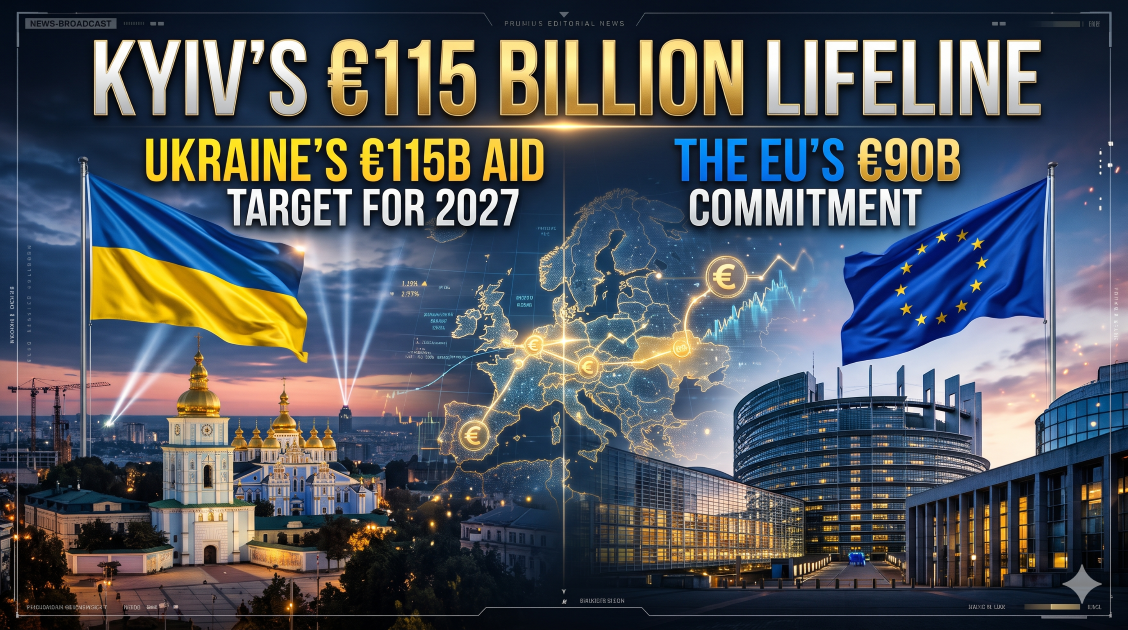
As Russia’s full-scale invasion stretches deeper into its fifth year, Ukraine has laid out the massive financial reality required to sustain its defense, economy, and public services through 2027. Ukrainian President Volodymyr Zelenskyy announced on November 24, 2026, that Kyiv will require €115 billion (approximately $125.45 billion) in external financial support next year.
Speaking to top regional officials at a meeting of the Congress of Local and Regional Authorities, Zelenskyy confirmed that Ukraine has already secured roughly €90 billion in commitments from the European Union for 2027. While that European backing establishes a critical financial floor, it leaves an urgent €25 billion funding shortfall that Kyiv and its international partners must bridge in the months ahead.
Breaking Down the €115 Billion Ledger: What Has Been Secured vs. What Remains
Ukraine’s 2027 external financing plan highlights both the scale of European financial mobilization and the ongoing diplomatic effort needed to assemble multi-billion-euro support packages from global allies.
According to Zelenskyy’s announcement and European Commission legislative proposals, Kyiv’s 2027 external funding structure breaks down into three distinct pillars:
| Funding Component | Amount (EUR) | Status & Mechanism | Primary Purpose |
| First EU Tranche (2027 Allocation) | €45 Billion | Previously approved under the €90B 2026–2027 Ukraine Support Loan package | Budgetary stability (€13.3B) and defense industrial capacity (€31.7B) |
| Second EU Tranche (New Proposal) | €45 Billion | Proposed by the European Commission on Nov. 18, 2026, via capital-market borrowing | Additional macro-financial support and resilience for 2027 |
| Remaining External Shortfall | €25 Billion | Unsecured — active negotiations underway with international partners | Bridging the gap to meet total €115B external requirement |
| Total 2027 External Need | €115 Billion | ~78% committed via EU; ~22% still to be raised | Sustaining wartime state operations, weapons, and infrastructure |
“Recently, we agreed on additional funding – an additional 45 billion. So we understand that Ukraine will receive €90 billion next year,” Zelenskyy told regional leaders. “The European Commission has already presented a way to secure this funding, and we are now working to ensure that the European Union supports it. We need to find another 25 billion. I am confident that we will accomplish this task.”
Europe Steps Up as Kyiv’s Anchor: Inside the EU’s €90 Billion Architecture
With U.S. foreign assistance facing ongoing political uncertainty in Washington, the European Union has solidified its role as Ukraine’s primary financial backstop. The €90 billion European commitment for 2027 rests on two sequential legislative pillars advanced in Brussels:
- The 2026–2027 Ukraine Support Loan (€45 Billion for 2027): Approved in December 2025 as part of a two-year €90 billion financing framework, this mechanism channels €45 billion to Kyiv in 2027. Under European Commission implementation plans, €31.7 billion of that allocation is dedicated directly to strengthening Ukraine’s defense industrial capacity, while €13.3 billion supports core state budget functions split between the Ukraine Facility and Macro-Financial Assistance.
- The New Instrument for Coordinated Support (€45 Billion): On November 18, 2026—just days before Zelenskyy’s address—European Commission President Ursula von der Leyen unveiled a new legislative package proposing up to €45 billion in additional 2027 loans, financed by EU borrowing on international capital markets and guaranteed by the EU’s Multiannual Financial Framework.
“For 2026, Ukraine’s needs are covered. And today we are proposing a further €45 billion to cover two thirds of its needs for 2027,” von der Leyen stated when presenting the proposal, emphasizing that Brussels aims to keep Ukrainian schools and hospitals operating while helping Kyiv defend its cities against persistent drone and missile barrages.
However, securing final unanimous approval across all 27 EU member states remains a critical diplomatic hurdle. Previous EU funding packages faced prolonged vetoes from Hungary before final adoption, and domestic political debates in major European capitals—including warnings from French opposition figures over national budgetary pressures—underscore that Brussels must navigate complex internal politics to ratify the second €45 billion tranche smoothly.
Why the Price Tag Is So Steep: Air Defense, Energy Grids, and a €155 Billion War Budget
Ukraine’s €115 billion external request reflects the staggering economic toll of prolonged high-intensity warfare. Zelenskyy noted that fighting the war is projected to cost €155 billion in total next year, requiring Kyiv to combine domestic tax revenues with massive international inflows just to maintain a baseline financial foundation.
Three urgent operational priorities are driving the scale of Ukraine’s 2027 budget needs:
- Protecting Energy and Critical Infrastructure: Systematic Russian missile and drone strikes against power plants, electrical substations, and transport bridges have forced Ukraine to spend billions on emergency grid repairs, decentralized power generation, and winter heating resilience.
- Expanding Air Defense and Domestic Weapons Production: Strengthening air defense networks—including drone interceptors, radar systems, and surface-to-air munitions—remains Kyiv’s highest military spending priority alongside scaling up domestic drone and artillery manufacturing.
- Maintaining Essential Public Services: Beyond the front lines, external macro-financial aid ensures the Ukrainian state can continue paying salaries for teachers, doctors, emergency responders, and civil servants, as well as pensions for millions of citizens displaced or affected by the conflict.
Zelenskyy also acknowledged that if hostilities persist into 2028, Ukraine will likely require a comparable level of international financial backing—signaling to Western capitals that long-term, predictable financing mechanisms are essential rather than ad-hoc emergency grants.
Closing the €25 Billion Gap: Where Will the Remaining Funds Come From?
With €90 billion lined up from European institutions, Ukrainian diplomats and finance officials are actively negotiating with non-EU G7 partners and multilateral lenders to secure the remaining €25 billion.
To incentivize broader burden-sharing, the European Commission’s November 18 legislative package specifically included amendments to the Ukraine Facility and the Ukraine Loan Cooperation Mechanism, creating financial incentives designed to encourage non-EU international partners—such as the United Kingdom, Japan, Canada, Norway, and multilateral institutions like the International Monetary Fund (IMF)—to contribute additional loans and grants.
Meanwhile, strict governance benchmarks remain attached to every tranche. To unlock European and international disbursements, Kyiv must continue meeting reform milestones centered on judicial independence, public procurement transparency, rule of law, and anti-corruption enforcement.
A High-Stakes Financial Test for 2027
President Volodymyr Zelenskyy’s €115 billion ($125.45 billion) projection offers the clearest roadmap yet of what it will take to keep Ukraine economically solvent and militarily resilient in 2027. With €90 billion already anchored by European Union commitments and legislative proposals, Kyiv enters 2027 with nearly four-fifths of its external financing target in sight. Yet turning the European Commission’s newly proposed €45 billion loan into approved cash—and rallying international partners to fill the remaining €25 billion shortfall—will define the diplomatic and financial battleground for Ukraine and its allies in the months ahead