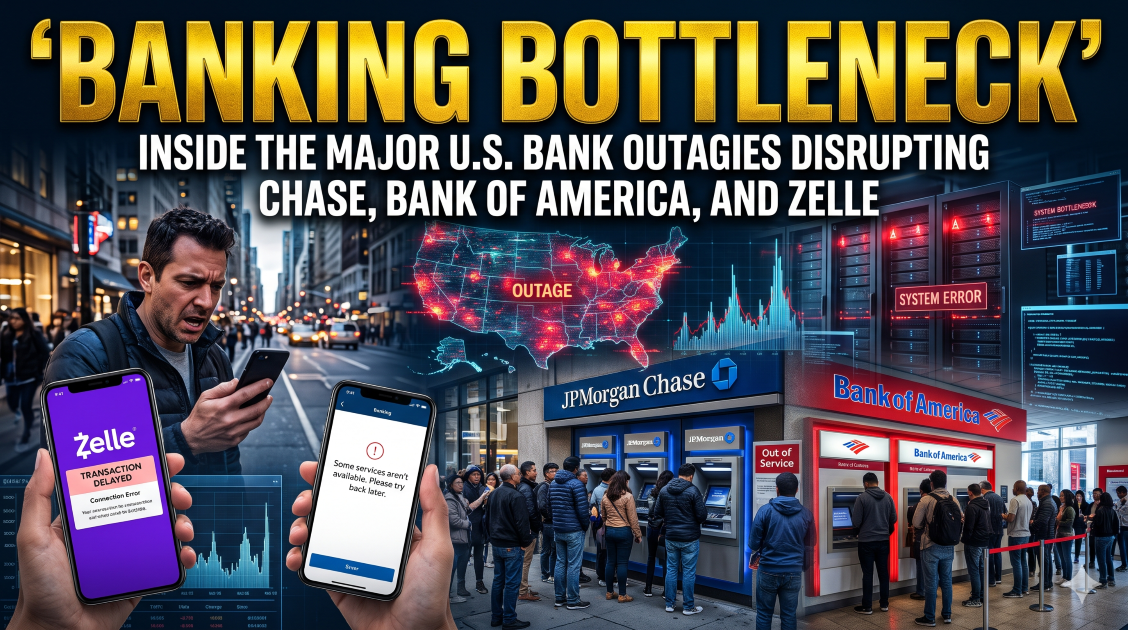
Thousands of banking customers across the United States faced unexpected digital roadblocks on Monday, November 16, 2026, after widespread service disruptions hit several of the nation’s largest financial institutions, including JPMorgan Chase, Bank of America, Wells Fargo, and U.S. Bank. As login failures, missing account balances, and stalled peer-to-peer transfers piled up from the morning into the afternoon, outage-tracking platforms recorded thousands of complaints—triggering immediate questions about whether America’s financial infrastructure had suffered a coordinated cyberattack.
By Monday afternoon, JPMorgan Chase—the largest U.S. bank by total assets, serving more than 86 million customers—stepped forward to clarify the root cause. Rather than a malicious cyber intrusion or a systemic banking collapse, the disruption originated from a software bug inside Chase’s on-premises hardware systems. Because modern banking networks are tightly woven together for clearing payments and interbank transfers, a technical bottleneck at one financial giant quickly rippled across rival banks and digital payment platforms nationwide.
How the Banking Outages Unfolded Across Major U.S. Institutions
Reports of digital banking trouble began surfacing on Monday morning before surging dramatically during peak afternoon business hours. According to outage-monitoring service Downdetector.com, customers across multiple tier-one banks and payment networks encountered error screens, delayed transaction histories, and stalled wire or peer-to-peer transfers.
Some Chase users attempting to access their accounts online or via mobile apps were greeted with an automated notice reading: “Some services aren’t available. We’re working on them. Please try back later.” Breakdown data from outage trackers showed that roughly 53% of affected Chase users reported difficulties viewing account balances and transaction details, 20% encountered web or mobile login failures, and 17% ran into problems executing transfers and wire transactions.
| Financial Institution / Platform | Peak Reported Outage Volume (Monday, Nov. 16) | Primary Symptoms Reported by Customers | Official Institution Status / Explanation |
| JPMorgan Chase | Nearly 4,800–5,000 reports | Missing balances, login errors, delayed transfers and wires | Confirmed a software bug in on-premises hardware systems; not a cyberattack |
| Bank of America | ~2,000–2,100 reports | Online account access issues and delayed interbank transactions | Impacted by cross-bank transaction delays linked to third-party/Chase processing |
| Wells Fargo | Over 800 reports | Difficulty signing in, checking balances, and completing transfers | Experienced spillover friction on interbank transfers and account visibility |
| U.S. Bank & Truist / Capital One | Elevated complaint spikes | Delays sending or receiving cross-bank transfers and app access friction | U.S. Bank confirmed internal systems were unaffected, noting cross-bank Zelle delays |
| Zelle (Early Warning Services) | Spikes in failed/pending transfers | Payments stuck in pending status between sender and recipient banks | Confirmed Zelle’s core network was fully operational; delays stemmed from participating banks |
Why One Bank’s Software Bug Triggered a Multi-Bank Ripple Effect
One of the most striking aspects of Monday’s disruption was how quickly trouble at JPMorgan Chase appeared to spill over onto customers of Bank of America, Wells Fargo, U.S. Bank, Capital One, and Truist.
In a statement posted to social media, JPMorgan Chase acknowledged that the software bug in its on-premises hardware infrastructure affected other financial institutions “when we were party to a transaction involving other banks,” while stressing that the underlying issue was not systemic. Chase representatives added that while certain transactions were taking longer than usual to settle, customers retained access to their accounts and funds, and engineering teams expected to resolve the bug by the end of Monday.
Other institutions echoed that explanation. A spokesperson for U.S. Bank confirmed that its own internal banking systems were not directly compromised, but noted that customers attempting to send or receive Zelle payments involving another financial institution could experience processing delays. Similarly, Early Warning Services—the bank-owned operator behind Zelle—stated that the Zelle network itself remained fully operational throughout the day, explaining that an issue at participating financial institutions was delaying payment settlement for some users.
Because consumers rarely know which bank their payment recipient uses, a processing bottleneck at a major clearing institution like Chase inevitably looks like an outage across the entire peer-to-peer ecosystem.
Three Infrastructure Crises in One Week: Growing Anxiety Over U.S. Digital Reliability
Monday’s banking disruption did not occur in a vacuum. Instead, it landed at the tail end of a turbulent multi-day stretch that exposed how fragile critical American technology infrastructure has become:
- Nationwide Aviation Ground Stop: Days earlier, the Federal Aviation Administration (FAA) was forced to issue a rare four-hour, 21-minute nationwide ground stop—grounding over 8,000 flights—after newly deployed equipment overloaded legacy air-traffic routers with data.
- Global Microsoft Cloud and Server Disruption: Over the weekend, Microsoft recovered from a major multi-day global outage that disrupted Outlook, Teams, Microsoft 365, and enterprise server workloads worldwide.
- Major U.S. Banking Bottleneck: On Monday, November 16, a localized software bug inside on-premises banking hardware slowed interbank transfers and online account access for thousands of Americans.
Although federal officials and bank spokespeople confirmed that none of these incidents stemmed from coordinated cyberattacks, the back-to-back timing has fueled intense debate among cybersecurity analysts, regulators, and enterprise risk officers. Modern commerce depends on deeply interconnected software layers, legacy hardware bridges, and real-time clearing rails. When a single hardware bug or router overload occurs at a major hub, cascading friction spreads across institutions within minutes.
Practical Steps for Customers Navigating Banking Outages
When online banking portals or payment apps experience intermittent disruptions, financial security experts recommend taking a few measured precautions:
- Avoid Resending Pending Transfers: If a Zelle payment, ACH transfer, or wire appears stuck or delayed during an active outage, do not submit duplicate transactions. Once clearing queues catch up, duplicate requests can result in unintended double charges.
- Verify Through Official Bank Channels: Check your bank’s official status page or verified social media accounts before assuming your individual account has been locked or compromised.
- Stay Alert for Phishing Scams: Cybercriminals routinely exploit high-profile banking outages by sending fake text messages or emails claiming your account requires urgent verification. Never click links in unsolicited security alerts during a service disruption.
- Keep a Backup Payment Method: Carrying a secondary debit or credit card from a separate issuing bank—along with a modest amount of physical cash—ensures uninterrupted purchasing power when a primary institution’s digital systems hit a temporary snag.
A Wake-Up Call for Interconnected Finance
Monday’s service disruptions at JPMorgan Chase, Bank of America, and peer institutions demonstrated both the resilience and the interdependence of modern U.S. banking. Core customer deposits remained safe, internal ledgers stayed intact, and engineers isolated the root cause to an internal software bug rather than a security breach. Yet for millions of everyday consumers and small businesses who rely on instant digital balances and real-time transfers, the incident served as a pointed reminder that even in an era of instant finance, a single technical glitch can still bring everyday transactions to a crawl.