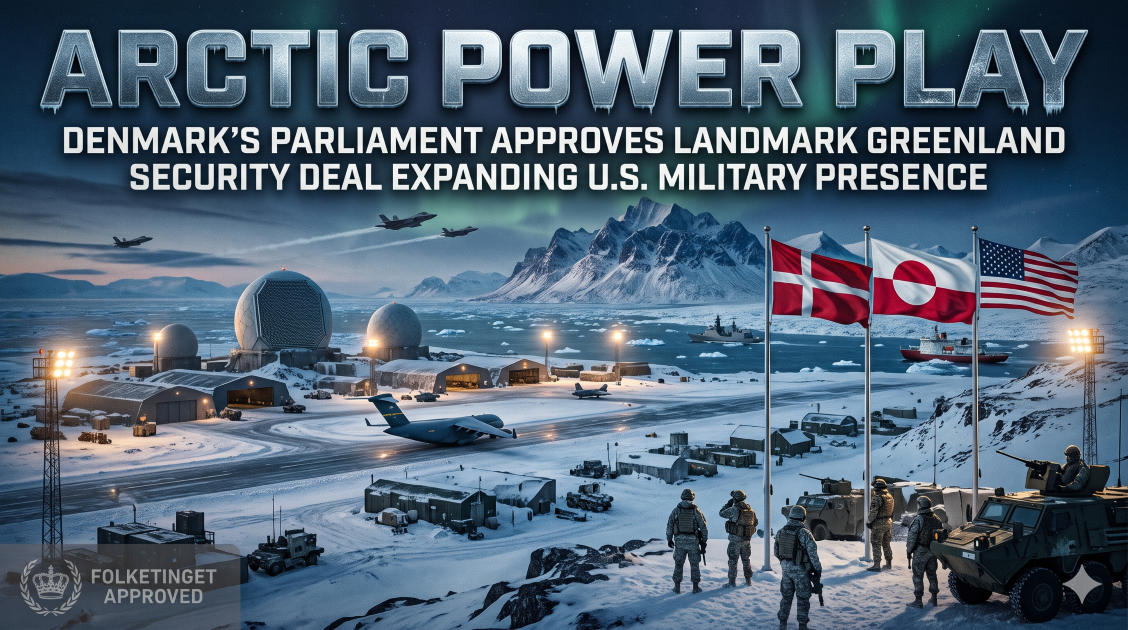
In a defining moment for transatlantic relations and High North security, Denmark’s parliament (the Folketing) has officially approved a sweeping security agreement involving Greenland and the United States. The legislation significantly expands the operational footprint and defense role of American armed forces across the world’s largest island, cementing deeper military cooperation in the rapidly warming Arctic while formally reaffirming Danish sovereignty and Greenlandic self-governance.
The parliamentary vote closes a turbulent diplomatic chapter marked by heightened friction between Copenhagen, Nuuk, and Washington over earlier U.S. proposals to annex or purchase the semi-autonomous territory. Rather than yielding sovereignty, Danish lawmakers and Greenlandic leaders opted for a structured defense framework—anchoring U.S. security commitments within NATO and bilateral treaty rules while addressing urgent strategic vulnerabilities across the North Atlantic and Arctic corridors.
Inside the Denmark-Greenland-U.S. Security Agreement: What the Pact Actually Does
At its core, the newly ratified defense pact updates and broadens long-standing Cold War-era arrangements governing American military operations in Greenland. While the United States has maintained a strategic foothold in northern Greenland for decades—most notably at Pituffik Space Base (formerly Thule Air Base)—the new agreement modernizes legal, logistical, and operational protocols for an era of renewed great-power competition.
Key provisions approved by the Folketing establish a clearer operational framework across several critical areas:
- Expanded U.S. Operational Access: The agreement grants U.S. forces streamlined access to designated military zones, airfields, and port facilities in Greenland to support joint Arctic surveillance, air defense, and maritime patrol missions.
- Modernized Infrastructure and Early Warning: Washington is authorized to upgrade radar installations, satellite tracking nodes, and cold-weather logistics hubs vital for North American and European missile defense.
- Jurisdictional and Legal Clarity: Modeled alongside broader Nordic-U.S. defense cooperation frameworks, the legislation sets defined rules governing the legal status of U.S. personnel, equipment prepositioning, and environmental compliance on Greenlandic soil.
- Explicit Sovereignty Safeguards: Crucially, the text of the agreement explicitly recognizes the Kingdom of Denmark’s territorial integrity and respects Greenland’s Self-Government Act, ensuring that expanded military access does not alter constitutional ownership or local political authority.
From Annexation Tensions to Structured Alliance: How Diplomacy De-Escalated the Crisis
The parliamentary approval stands in stark contrast to the diplomatic storm that engulfed Copenhagen and Nuuk following renewed U.S. rhetoric regarding acquiring or annexing Greenland. Those proposals triggered immediate pushback from Danish officials, Greenland’s government (Naalakkersuisut), and European Union allies, all of whom emphasized that Greenland is not for sale and that its future rests solely with its people.
Behind closed doors, however, policymakers in Copenhagen and Nuuk recognized a fundamental geopolitical reality: Washington’s core strategic anxieties—securing the Arctic approaches to North America, monitoring submarine transit routes, and countering rival influence—could not simply be ignored. By channeling American security demands into a formal, rules-based bilateral and NATO-aligned defense agreement, Denmark’s coalition government achieved a dual objective:
- Neutralizing Sovereignty Threats: Bringing U.S. military expansion under a binding parliamentary treaty eliminated ambiguity and locked Washington into recognizing Danish and Greenlandic jurisdiction.
- Sharing the Arctic Defense Burden: Denmark, whose vast Arctic territory stretches across more than two million square kilometers, gained high-tech American surveillance, airlift, and defense capabilities that Copenhagen could not field alone on a compressed timeline.
Nuuk’s Voice at the Table: Greenland’s Strategic Calculus and Local Priorities
For Greenland’s roughly 56,000 residents and their elected leadership in Nuuk, the security agreement represents both an opportunity and a delicate balancing act. Under the 2009 Self-Government Act, Greenland holds broad autonomy over domestic affairs, natural resources, and economic development, while Copenhagen retains constitutional responsibility for foreign and defense policy—subject to mandatory consultation with Nuuk on matters affecting the island.
During parliamentary debates and trilateral consultations leading up to the vote, Greenlandic representatives pressed for concrete guarantees ensuring that an expanded U.S. military presence delivers tangible benefits to local communities rather than operating in isolation:
- Civilian-Military Dual-Use Infrastructure: Greenlandic leaders prioritized investments in runways, ports, search-and-rescue capabilities, and telecommunications networks that serve commercial aviation, fishing fleets, and remote settlements alongside defense needs.
- Environmental and Cultural Protections: Given the fragile Arctic ecosystem and historic sensitivities surrounding Cold War military sites, Nuuk insisted on strict environmental remediation standards and transparent oversight mechanisms.
- Economic Participation: Authorities emphasized local contracting opportunities, workforce training, and civilian service agreements tied to base modernization projects.
Why Greenland Matters More Than Ever in Global Geopolitics
The ratification of the Greenland security pact reflects the broader transformation of the Arctic from a remote, ice-locked periphery into one of the world’s most consequential strategic theaters.
| Strategic Driver | Geopolitical Significance | Role of the New Security Pact |
| Missile & Space Warning | Greenland sits directly along the shortest polar flight path for intercontinental ballistic missiles and space launches between Eurasia and North America. | Enables upgrades to high-latitude radar arrays, space-domain awareness sensors, and satellite communications. |
| GIUK Gap & Maritime Chokepoints | The Greenland-Iceland-United Kingdom (GIUK) gap governs naval access between the Arctic Ocean and the North Atlantic. | Expands maritime domain awareness, anti-submarine patrol staging, and joint NATO air-sea coordination. |
| Melting Sea Ice & New Shipping Lanes | Rapid Arctic warming is opening seasonal transit routes and increasing commercial and military vessel traffic. | Strengthens search-and-rescue readiness, port logistics, and persistent aerial monitoring across vast distances. |
| Critical Minerals & Supply Chains | Greenland holds major deposits of rare earth elements, graphite, and other minerals essential for clean energy and defense manufacturing. | Reinforces Western geopolitical alignment and discourages strategic infrastructure inroads by rival powers. |
As Russia expands its northern military bases and icebreaker fleet, and as China increasingly characterizes itself as a “near-Arctic state” seeking polar research and shipping footholds, Washington and its European NATO allies view a secure, well-monitored Greenland as indispensable to collective deterrence.
Parliamentary Debate and European Reaction: Balancing Deterrence with Autonomy
While a decisive majority in Denmark’s parliament backed the agreement as essential for national and alliance security, the debate in Copenhagen highlighted lingering political sensitivities. Opposition lawmakers on both ends of the spectrum scrutinized provisions governing U.S. legal jurisdiction over visiting troops, the prohibition against nuclear weapons on Danish territory, and the importance of keeping Nuuk fully empowered in day-to-day implementation.
Across Europe, NATO partners welcomed the vote as a stabilizing milestone. With Finland and Sweden fully integrated into the alliance, nearly the entire Arctic rim—outside Russia—now operates under a unified NATO defense umbrella. The Denmark-Greenland-U.S. accord bridges the North American and European flanks of that northern architecture, turning what had been a source of transatlantic friction into an institutionalized pillar of Arctic cooperation.
What Comes Next for Arctic Security and Transatlantic Ties
With parliamentary approval secured, implementation will move into an operational phase focused on joint military planning, infrastructure upgrades, and regular trilateral consultations among Copenhagen, Nuuk, and Washington. How smoothly those deployments unfold—and how visibly U.S. investments respect Greenlandic autonomy and environmental stewardship—will determine whether the pact builds lasting trust on the ground.
By trading confrontation over annexation talk for a formal security partnership, Denmark and Greenland have reshaped the rules of engagement in the High North—proving that even intense geopolitical pressure can be steered back into alliance diplomacy when sovereignty and shared security are anchored in law.