
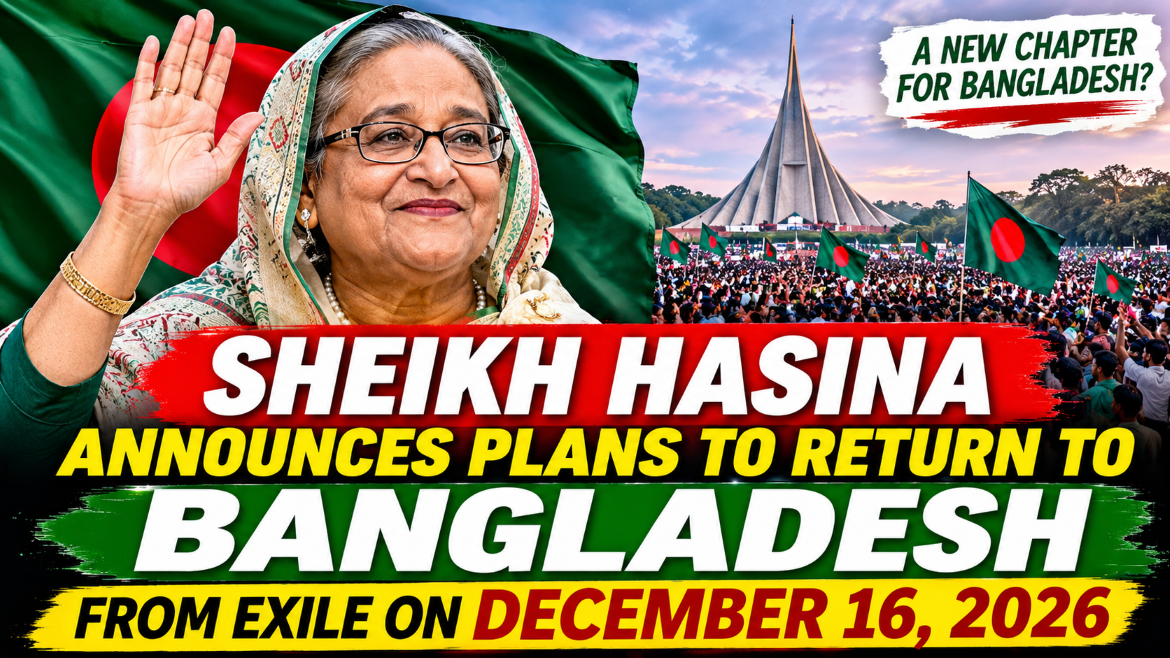
More than two years after fleeing Dhaka aboard a military aircraft amid a deadly mass uprising, ousted Bangladeshi Prime Minister Sheikh Hasina has officially set a date for her return. Through her spokesperson in New Delhi, the 79-year-old former leader announced that she intends to return to Bangladesh on December 16, 2026—the nation’s historic Victory Day—and called upon the Bangladeshi government to arrange her travel from New Delhi to Dhaka aboard state flag carrier Biman Bangladesh Airlines.
The announcement sets the stage for an extraordinary political, legal, and diplomatic showdown. In Dhaka, the government of Prime Minister Tarique Rahman and his Bangladesh Nationalist Party (BNP) swiftly rejected any notion of a ceremonial homecoming. Having convicted Hasina in absentia and sentenced her to death over the crackdown on 2024 protesters, Bangladeshi officials declared that she is a “convicted fugitive” who will be arrested the moment she sets foot in the country—and insisted she can only return in handcuffs through formal extradition from India.
Victory Day Gambit: Inside Sheikh Hasina’s December 16 Homecoming Demand
While Hasina had hinted at an eventual return for months, this marks the first time she has committed to a specific calendar date. Choosing December 16 carries immense symbolic weight in Bangladesh: Victory Day commemorates the 1971 surrender of Pakistani forces that secured Bangladesh’s independence—a liberation struggle led by Hasina’s late father and founding president, Sheikh Mujibur Rahman.
In a statement issued to Reuters, Hasina’s spokesperson, Syed Mozammel Ali, framed her return as a constitutional obligation for authorities in Dhaka:
- Demand for State Air Transport: Ali noted that because Hasina was flown to India aboard a Bangladeshi aircraft on August 5, 2024, she is calling on the current administration to arrange her return flight from New Delhi to Dhaka on Biman Bangladesh Airlines.
- Challenge to Her Exile: The statement asserted that Hasina had been “exiled contrary to the Constitution,” arguing it is the government’s responsibility to facilitate her return on Victory Day.
- Missing Travel Documents: Hasina’s announcement follows her request earlier in November 2026 for a new passport and travel papers—documents that were revoked months after her 2024 ouster and which Dhaka has refused to reissue.
“In Handcuffs”: Dhaka’s Uncompromising Legal Warning and Death Sentence Standoff
If Hasina’s announcement was designed to test the political waters in Dhaka, the response from Prime Minister Tarique Rahman’s administration was immediate and unambiguous.
| Official / Institution | Stated Position on Hasina’s December 16 Return | Legal & Procedural Basis |
| Humaiun Kobir (State Minister for Foreign Affairs) | Declared Hasina “will not be able to return… as an ordinary commercial passenger; she will be brought back in handcuffs”. | Cites bilateral extradition treaty with India and her status as a convicted fugitive. |
| Shama Obaed (Minister of State for Foreign Affairs) | Stated Hasina will be arrested immediately upon entering Bangladesh, taken to jail, and “will have to face the music”. | Urges New Delhi to honor existing extradition obligations. |
| Aminul Islam (Chief Prosecutor, International Crimes Tribunal) | Dismissed her request for a state flight as “unreasonable” for a convicted fugitive. | Notes she missed the appeal deadline on her November 2025 death sentence. |
In November 2025, Bangladesh’s International Crimes Tribunal sentenced Hasina to death in absentia for crimes linked to the violent suppression of the July–August 2024 student-led uprising, during which the United Nations estimated as many as 1,400 people were killed. Bangladeshi judicial authorities have previously stated that because Hasina missed the statutory deadline to appeal the verdict, there is no remaining legal mechanism to stay execution other than presidential clemency—an option Hasina has never sought, instead denouncing the tribunal’s proceedings as politically motivated.
From 2024 Ouster to BNP Ascendancy: How Bangladesh’s Political Landscape Transformed
To grasp the volatility surrounding Hasina’s proposed return, it is necessary to trace the dramatic political realignment that has reshaped Bangladesh over the past two years:
- The August 2024 Uprising: After ruling Bangladesh for 15 consecutive years, Hasina resigned and fled to India on August 5, 2024, following weeks of mass student protests against civil service job quotas that escalated into a nationwide anti-government revolt.
- Interim Rule and the Awami League Ban: Nobel laureate Muhammad Yunus stepped in to lead an interim administration on August 8, 2024. In May 2025, authorities banned all political activities by Hasina’s Awami League and its affiliated wings—a prohibition later codified by lawmakers in April 2026, suspending the party’s Election Commission registration and outlawing its rallies, press statements, and online campaigning.
- The February 2026 Elections: Barred from the ballot, the Awami League sat out the landmark February 12, 2026 parliamentary elections. The Bangladesh Nationalist Party (BNP), led by Tarique Rahman—who had himself recently returned to Dhaka after years of exile—won a decisive mandate, ushering in a new political era.
Despite the sweeping legal ban, Awami League loyalists have grown increasingly active since Hasina applied for new travel documents earlier in November 2026. Protests and street demonstrations in support of her return escalated across several districts, culminating in a disruptive nationwide lockdown on November 19 and raising fears of renewed street clashes ahead of December 16.
New Delhi’s Diplomatic Tightrope: India-Bangladesh Relations Under Strain
Hasina’s planned return also places intense diplomatic pressure on New Delhi, where she has resided under Indian protection since August 2024.
Dhaka has repeatedly invoked the bilateral India-Bangladesh extradition treaty to demand Hasina’s formal handover. While India has refrained from issuing a public response to Dhaka’s latest extradition demands, rhetoric from senior Bangladeshi officials has grown sharper. Both Prime Minister Tarique Rahman and State Minister Humaiun Kobir have accused Awami League agitators of taking direction from across the border, warning that Dhaka seeks balanced bilateral ties that do not compromise Bangladesh’s sovereignty or dignity.
For New Delhi, the dilemma is acute: refusing extradition risks further alienating the elected BNP government in Dhaka and complicating regional cooperation across trade, water-sharing, and border security, whereas forcibly handing over a longtime strategic ally who faces a death sentence carries heavy political and humanitarian sensitivities inside India.
High Stakes on the Horizon: What Happens Next Before December 16?
With fewer than three weeks remaining before December 16, critical practical and political questions hang over Hasina’s announcement:
- How Could She Travel Without a Passport? With Dhaka refusing to issue new travel documents or dispatch a state carrier, Hasina lacks standard Bangladeshi travel credentials—meaning any journey from New Delhi would require extraordinary diplomatic intervention or special travel papers.
- Will Street Unrest Escalate? Security forces in Dhaka and major cities are bracing for heightened mobilization by underground Awami League networks alongside counter-protests by student groups and BNP supporters who spearheaded the 2024 uprising.
- Is the Announcement a Political Signal or an Actual Flight Plan? Some regional analysts suggest naming Victory Day may be aimed primarily at rallying demoralized Awami League cadres and projecting defiance from exile, rather than signaling an imminent commercial arrival into guaranteed arrest.
Whether Sheikh Hasina actually boards a plane for Dhaka on December 16 or remains in New Delhi, her declaration has already reignited the deepest fault lines in Bangladeshi politics—turning the nation’s upcoming Victory Day into a pivotal test of institutional stability, rule of law, and South Asian diplomacy