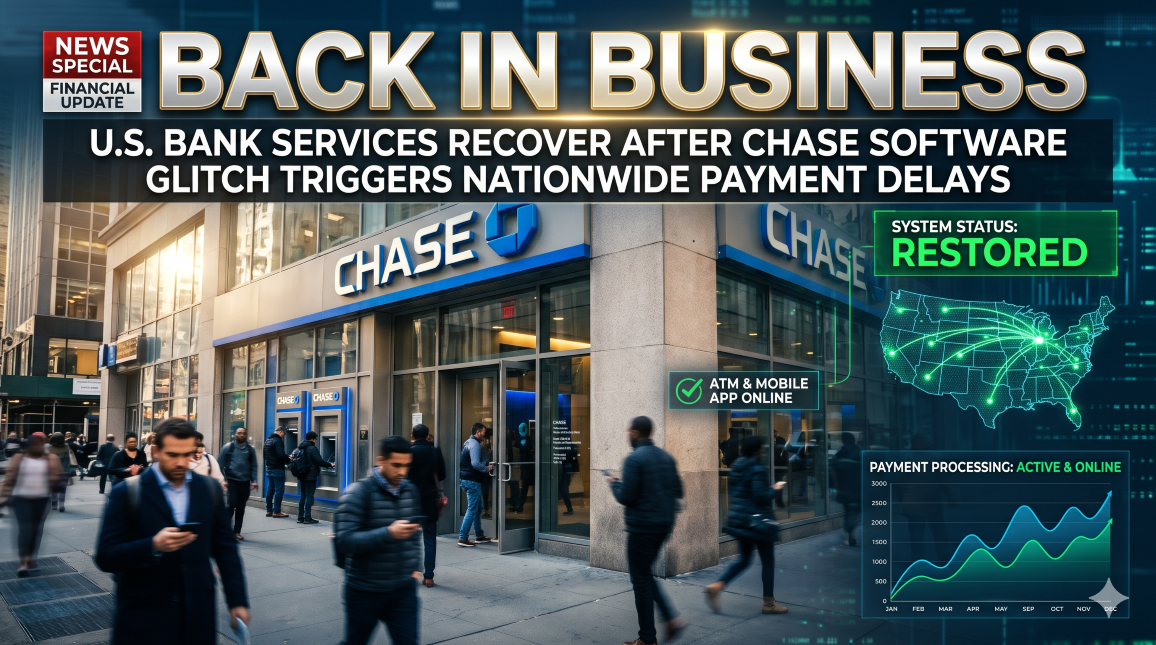
Major U.S. banking services—led by JPMorgan Chase—have officially returned to normal operation following a software glitch that triggered hours of widespread login errors, delayed transfers, and payment bottlenecks across the country on Monday, November 16, 2026. By roughly 6:30 p.m. Eastern Time on Monday evening, a Chase spokesperson confirmed that customer transactions were posting normally once again, bringing relief to millions of retail consumers and businesses whose digital financial workflows stalled mid-day.
While outage-tracking dashboards briefly made it appear as though the entire American financial sector had suffered a simultaneous collapse, bank officials and federal authorities clarified that the disruption originated from a single technical source: an internal software bug within JPMorgan Chase’s on-premise hardware systems. Because JPMorgan Chase is the largest bank in the United States by assets and serves as a central counterparty for interbank transfers, slowdowns inside its systems rapidly cascaded into delayed Zelle payments and cross-bank transactions at rival institutions including Bank of America, Wells Fargo, U.S. Bank, Truist, and Capital One.
Inside the November 16 Banking Disruption: Timeline and Root Cause
The disruption began unfolding on Monday morning, November 16, 2026, with user error reports on Downdetector starting around 9:53 a.m. EST and surging sharply through early afternoon before peaking near 2:00 p.m. EST. Customers attempting to check balances or initiate transfers through the Chase website and mobile app were greeted with an error notice stating: “Some services aren’t available. We’re working on them. Please try back later.”
According to an FBI official cited by Fox Business, the issue was traced to a software release rolled out by JPMorgan Chase earlier on Monday that affected a subset of the bank’s internal systems. In public statements on X and to news outlets, JPMorgan Chase spokesperson Joe Evangelisti emphasized two critical points to calm anxious account holders:
- No Cyberattack Involved: The bank confirmed there was no evidence of malicious activity, external intrusion, or a cyberattack, attributing the slowdown strictly to a software bug inside an on-premise hardware environment.
- Customer Funds Remained Safe: Despite temporary difficulties viewing updated balances or logging into digital portals, Chase stressed that customers continued to have access to their underlying accounts and funds throughout the incident.
By early Monday evening, engineering teams resolved the faulty software behavior and cleared backlogged transaction queues, restoring normal payment posting across Chase’s network.
Why a Glitch at One Bank Affected Customers Across Six Major Institutions
One of the most confusing aspects of Monday’s outage for everyday consumers was seeing error spikes appear simultaneously for multiple banks and peer-to-peer payment networks. At their peak on November 16, Downdetector logged roughly 4,810 issue reports for Chase alongside 2,045 for Bank of America, 1,072 for U.S. Bank, and 1,059 for Wells Fargo, with additional complaints involving Capital One, Truist, and Zelle.
However, most of those institutions were not experiencing direct failures of their own core infrastructure:
| Financial Institution / Network | Peak Downdetector Reports (Nov. 16) | Official System Status & Operational Explanation |
| JPMorgan Chase | ~4,810 | Primary Source: Experienced a software bug in on-premise hardware systems; resolved and posting normally by ~6:30 p.m. ET. |
| Bank of America | ~2,045 | External Spillover: Bank stated its own systems operated normally; delays occurred on transactions involving Chase. |
| U.S. Bank | ~1,072 | External Spillover: Confirmed internal systems were unaffected, but cross-bank Zelle payments experienced delays. |
| Wells Fargo | ~1,059 | External Spillover: Investigated customer reports tied to interbank transfers and shared payment rails. |
| Capital One & Truist | Elevated | External Spillover: Both banks confirmed their own platforms remained operational throughout the day. |
| Zelle Network | Elevated | Network Operational: Early Warning Services confirmed Zelle itself was not down; delays occurred when senders or recipients banked with Chase. |
As cybersecurity experts noted following the incident, modern banking is interconnected by design. When an institution of JPMorgan Chase’s scale slows down, any wire transfer, ACH settlement, or instant Zelle payment where Chase sits on either the sending or receiving side stalls in transit. To a user sending money from U.S. Bank or Bank of America to a friend who banks with Chase, the stalled transfer looks like an outage at their own bank—even when their own bank’s servers are functioning normally.
Back-to-Back Tech Outages Test Public Confidence in Digital Infrastructure
Monday’s banking disruption struck a nerve across the United States in part because it arrived on the heels of two other high-profile infrastructure failures within the span of a single week:
- Global Microsoft Cloud and Email Disruption: Days earlier, a software bug in a Microsoft update knocked Outlook, Teams, and cloud server services offline for organizations worldwide before full restoration was confirmed.
- Historic FAA Nationwide Ground Stop: On November 13–14, an equipment upgrade overloaded legacy air-route routers and forced the Federal Aviation Administration (FAA) to issue a rare four-hour nationwide ground stop that disrupted thousands of flights.
Although federal officials and technology analysts confirmed that the Chase software bug had no connection to either the Microsoft outage or the FAA router failure, the rapid succession of glitches sparked widespread debate over infrastructure fragility. Financial analysts also pointed out an important distinction for consumers: unlike bank insolvencies or failures where deposits can be disrupted by institutional collapse, a technical software glitch temporarily delays screen visibility and payment settlement without putting insured customer funds at risk.
Practical Steps for Customers Following the Banking Recovery
Now that JPMorgan Chase and connected payment networks have confirmed a return to normal operations, consumers and small businesses who attempted transactions during Monday’s window should take a few quick precautions:
- Check Pending Transfers Before Resending: Review your recent transaction history and Zelle activity log to confirm whether Monday’s payments have now posted. Avoid submitting duplicate transfers until you verify that an earlier payment failed outright rather than simply queuing during the slowdown.
- Verify Scheduled Bill Payments: If you had automatic utility, mortgage, or credit card payments scheduled to clear through Chase on November 16, confirm that the settlements completed cleanly.
- Watch Out for Phishing Scams: Major bank outages frequently trigger waves of fraudulent text messages and emails claiming your account has been locked or requires re-verification. Always log in directly through your bank’s official mobile app or typed web address rather than clicking links in unsolicited messages.
Resilience in an Interconnected Financial Ecosystem
The swift recovery of U.S. banking services on November 16 demonstrates both the robustness of emergency engineering response and the inherent vulnerability of tightly coupled financial networks. While JPMorgan Chase isolated its on-premise software bug and restored normal transaction posting within hours—without any compromise to customer funds or cybersecurity—the incident serves as a vivid reminder that in a real-time digital economy, a single line of faulty code at a major clearing institution can momentarily ripple across wallets nationwide