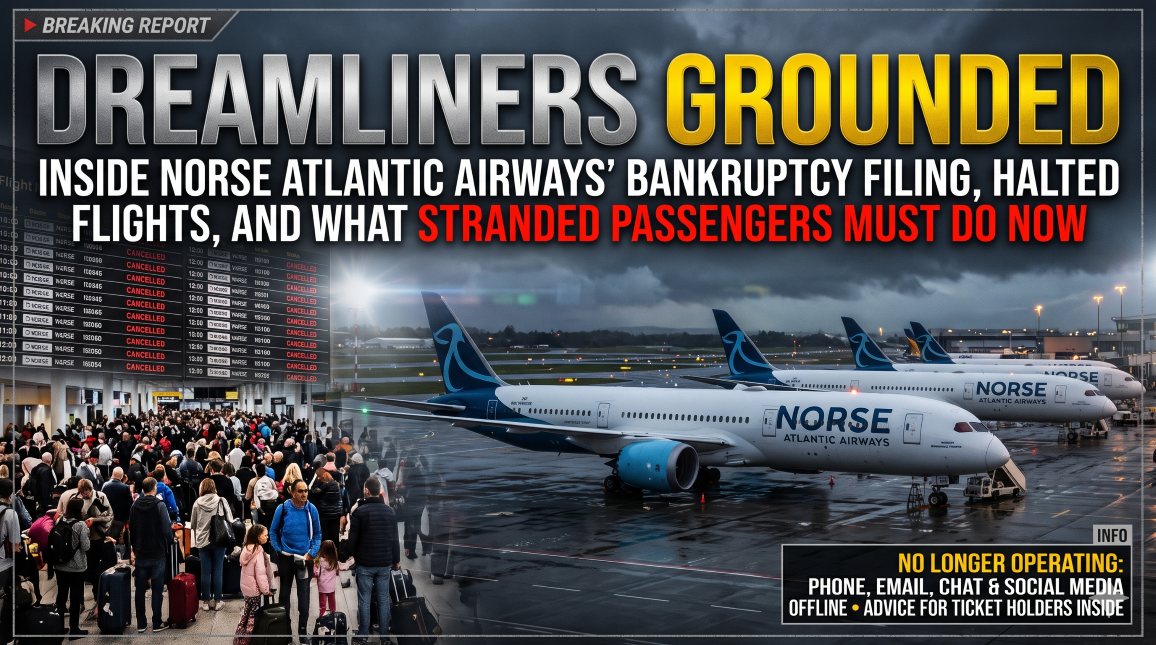
The long-haul budget aviation sector suffered another major casualty on Friday, November 27, 2026, when Norse Atlantic Airways AS—the Norwegian operating subsidiary of Oslo-listed Norse Atlantic ASA—filed for bankruptcy protection, abruptly canceling all flights and halting ticket sales. The filing came just hours after aircraft lessors served termination notices covering all 12 Boeing 787-9 Dreamliners in the carrier’s fleet, capping a rapid 48-hour liquidity spiral that left travelers scrambling across Europe, North America, Asia, and Africa.
Founded in 2021 to fill the transatlantic void left by Norwegian Air’s exit from budget long-haul routes, Norse Atlantic sought to prove that low-cost intercontinental travel could thrive with lean staffing and modern widebody jets. Instead, relentless jet fuel inflation triggered by the Middle East conflict, structural challenges in long-haul budget economics, and the sudden loss of wet-lease contracts pushed the carrier past its breaking point.
Rapid Descent: How Norse Atlantic Collapsed in 48 Hours
While Norse Atlantic had spent months attempting to stabilize its balance sheet, its final descent unfolded with startling speed during the final week of November 2026:
| Date & Time (CET) | Key Development | Operational & Market Impact |
| Nov. 25, 2026 | Norse Atlantic ASA issues critical liquidity warning. | Oslo Stock Exchange places shares in its “Recovery Box” distress tier. |
| Nov. 26, 2026 | Board suspends all flight operations and ticket sales pending emergency funding. | Aircraft return to bases in Norway, Sweden, and the UK; passengers left stranded. |
| Nov. 27, 08:30 CET | Aircraft lessors AerCap and BOC Aviation serve termination notices on all 12 Boeing 787-9 jets. | Norse contests notices, but fleet access is effectively severed. |
| Nov. 27, 14:00 CET | Board of Norse Atlantic Airways AS resolves to file bankruptcy petition with Agder District Court. | All future flights canceled permanently; Oslo shares plunge ~69% on the day (down 99.86% YTD). |
“We are deeply sorry for the impact this has on our passengers, employees and partners,” Chief Executive Officer Eivind Roald said following the filing. Crucially, while the primary Norwegian operating unit entered court-supervised bankruptcy proceedings, the parent holding company (Norse Atlantic ASA) and its UK subsidiary (Norse Atlantic UK, airline code Z0) were not initially included in the Norwegian bankruptcy petition—though all UK flights were simultaneously suspended and ticket sales remained frozen while advisers explored whether any remnant of the group could survive.
“Fuel Is What Toppled This Company”: Why the Long-Haul Budget Model Failed Again
Speaking to Norwegian public broadcaster NRK, CEO Eivind Roald pointed directly to the primary culprit behind the airline’s demise: “We were unable to absorb the extra cost … Fuel is what toppled this company.”
According to data tracked by the International Air Transport Association (IATA), global jet fuel prices surged 71% over the preceding year—and jumped more than 78% in Europe—driven by supply disruptions and geopolitical turmoil stemming from the U.S.–Iran conflict that began in late February 2026. For a low-fare long-haul carrier whose ticket prices rely on razor-thin margins and high price sensitivity, fuel represents an outsized share of operating costs that cannot easily be passed on to budget-conscious leisure travelers.
Beyond fuel costs, several deeper structural pressures converged on Norse Atlantic throughout 2026:
- Loss of Crucial Wet-Lease (ACMI) Contracts: Recognizing the difficulty of filling widebody jets year-round without a short-haul feeder network, Norse had pivoted toward leasing aircraft and crew to larger airlines. However, a six-aircraft wet-lease deal with Indian carrier IndiGo was mutually terminated effective November 1 due to high fuel costs and long routing constraints, followed by the end of a brief two-aircraft agreement with Pakistan International Airlines (PIA) on November 25.
- Unfinished Cost-Cutting Overhaul: Over the summer, Norse launched “Project Falcon,” a $50 million (£38 million) restructuring drive that eliminated roughly 75 jobs, relocated headquarters from Norway to lower-cost offices in Latvia, and saw founder Bjørn Tore Larsen step down. Despite October unit revenue climbing 19% year-on-year, the savings arrived too late to plug the immediate cash deficit.
- Wider European Airline Distress: Industry observers noted that Norse Atlantic became the 12th European carrier to enter severe financial distress since February 2026, following Chapter 11 restructuring at Latvia’s airBaltic in September and financial strain at carriers including Volotea and Plus Ultra.
Global Ripple Effects: Stranded Routes and Partner Disruptions
The sudden grounding of Norse Atlantic’s 12 Boeing 787-9 Dreamliners rippled immediately across international aviation schedules. Cirium schedule data showed 122 one-way flights planned across Norse’s Norwegian and UK operating certificates during November alone, spanning major leisure corridors from London Gatwick to Orlando, Bangkok, and Cape Town, as well as a planned winter route from Manchester to Thailand slated to launch in December.
The shutdown also forced immediate operational adjustments for partner carriers. Pakistan International Airlines—which had contracted Norse to operate UK services—saw two departures from London and Manchester canceled as passengers prepared to board, prompting PIA to rapidly deploy its own Boeing 777 fleet to maintain connectivity. Meanwhile, pilots represented by the Norse Atlantic Pilots Association expressed devastation for crews and passengers alike as AerCap Holdings and BOC Aviation moved to repossess their widebody jets.
Passenger Action Guide: How to Recover Money and Rebook Cancelled Flights
In a stark notice posted on its website, Norse Atlantic confirmed that customer service via phone, email, chat, and social media is no longer operating, warning travelers away from home that they must make independent arrangements. While passengers can register claims in the Norwegian bankruptcy estate, refunds through insolvency proceedings are not guaranteed.
If you hold a ticket with Norse Atlantic Airways, take these immediate steps to recover your funds:
- File a Credit Card Chargeback or Section 75 Claim: If you booked directly with Norse using a credit card, contact your card issuer immediately to request a chargeback for services not rendered. In the United Kingdom, purchases over £100 paid by credit card may qualify for statutory protection under Section 75 of the Consumer Credit Act 1974, while debit card users can pursue a bank chargeback.
- Contact Your Travel Agent or Package Provider: If you booked through an online travel agency (OTA) or as part of a bundled flight-and-hotel package, reach out to the booking platform directly. In the UK and European Union, ATOL-protected or package travel bookings carry statutory refund or repatriation protections.
- Review Travel Insurance Policies: Check whether your travel insurance includes Scheduled Airline Failure Insurance (SAFI) or supplier insolvency coverage, which can reimburse non-recoverable ticket expenses and emergency rebooking costs.
- Watch for Rescue Fares on Rival Carriers: Following major airline collapses, competing transatlantic and long-haul carriers frequently offer discounted “rescue fares” for stranded travelers who can present proof of a canceled booking.
What Norse Atlantic’s Collapse Signals for the Future of Budget Flying
Norse Atlantic Airways’ bankruptcy reinforces one of commercial aviation’s hardest lessons: running a standalone, low-cost long-haul airline without domestic feeder traffic or deep balance-sheet reserves leaves virtually zero margin for macroeconomic shocks. When geopolitical crises send jet fuel prices soaring and aircraft lessors demand strict payment certainty, nimble startups are the first to run out of runway. For travelers, the collapse serves as a timely reminder to always book long-haul flights using credit cards and comprehensive travel protection—ensuring that even when an airline’s wings are clipped overnight, your financial safety net remains intact.