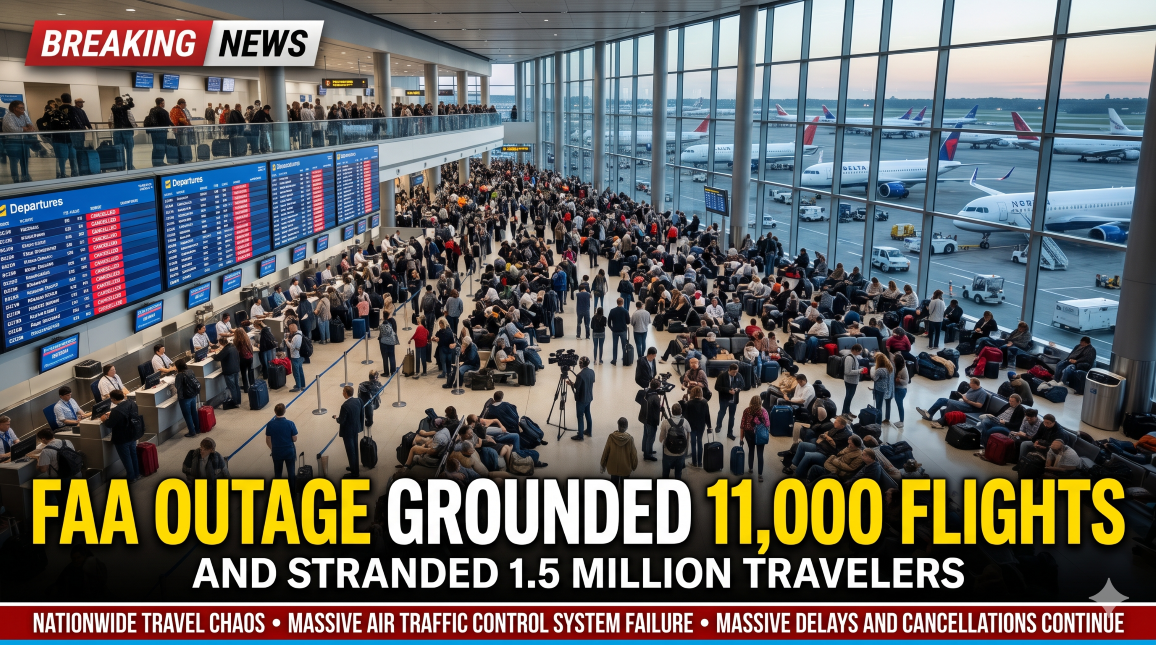
On Friday afternoon, November 13, 2026, the busiest domestic aviation network on Earth abruptly froze. At 3:54 p.m. Eastern Time, just as millions of weekend travelers, business flyers, and collegiate athletes were boarding planes across the country, the Federal Aviation Administration (FAA) issued an emergency nationwide ground stop—halting every commercial departure across the United States.
For four hours and 21 minutes, America’s skies emptied out. According to aviation analytics firm Cirium, roughly 11,000 flights scheduled to take off after 4:00 p.m. ET were caught in the freeze, stranding or disrupting an estimated 1.5 million passengers. By the time the FAA lifted the order at 8:15 p.m. ET after confirming its networks were stable, more than 8,000 flights had been outright canceled and hundreds of airborne planes had been forced to divert. Marking only the third nationwide ground stop in U.S. history, the shutdown exposed a sobering vulnerability at the core of American aviation: critical air traffic control infrastructure pushed past its breaking point by decades-old hardware.
Inside the Timeline of the November 2026 FAA Ground Stop
Nationwide ground stops are the aviation equivalent of pulling an emergency brake. Prior to Friday’s shutdown, the FAA had halted all domestic air traffic only twice before: in the immediate aftermath of the September 11, 2001 terrorist attacks, and during a January 2023 computer failure involving the Notice to Air Missions (NOTAM) system.
The November 13 crisis unfolded rapidly across major hubs from coast to coast:
| Milestone | Time / Metric | Operational Impact |
| Nationwide Ground Stop Issued | 3:54 p.m. ET (Nov. 13) | FAA halts all U.S. departures “out of an abundance of caution” following telecommunications failures. |
| Mid-Air Diversions Peak | By 7:05 p.m. ET | At least 827 airborne flights diverted, including hundreds forced back to their departure airports. |
| Ground Stop Lifted | 8:15 p.m. ET (Nov. 13) | Airspace reopens after 4 hours and 21 minutes once FAA engineers verify system stability. |
| Total Flight Impact | ~11,000 Flights | More than 8,000 flights canceled nationwide, leaving 1.5 million passengers stranded or delayed into the weekend. |
While aircraft already cruising at altitude were safely guided to their destinations or diverted to nearby runways, every plane waiting at a gate or taxiway was locked in place. Early Cirium tracking revealed that out of the initial wave of 600 diversions, 496 flights turned around to land back at their origin airports while 104 were rerouted to alternate airfields. Only select transatlantic departures from the East Coast were permitted to leave U.S. airspace on a case-by-case basis, while SpaceX’s Starship Flight 15 launch in Texas proceeded on schedule under a pre-existing airspace restriction.
What Caused the Air Traffic Control Outage?
In the first chaotic hours of the shutdown, social media rumors swirled around potential cyberattacks or cascading software failures following a global Microsoft outage the previous day. During a late Friday evening briefing at the White House, Homeland Security Secretary Markwayne Mullin and Transportation Secretary Sean Duffy firmly dismissed those theories. Mullin confirmed there was no indication of a cyberattack or any “nefarious” foreign interference, adding that the aviation outage was entirely unrelated to Microsoft’s earlier service disruption.
Instead, officials pointed to an internal telecommunications failure spanning the FAA’s Air Route Traffic Control Centers (ARTCCs)—the regional facilities responsible for guiding aircraft through high-altitude airspace between airports. Hours before the ground stop, controllers began noticing intermittent radio frequency dropouts and inconsistent radar data caused by malfunctioning network switches and routers.
Transportation Secretary Sean Duffy offered a blunt assessment of the root cause, blaming decades of deferred maintenance and a fragile patchwork of aging equipment. According to Duffy, newly installed modern FAA software had inadvertently overwhelmed legacy analog infrastructure—relying on “old switches, old routers,” and “1980s little copper lines”. When data traffic surged across those outdated conduits, systems began producing conflicting flight information, forcing the FAA to suspend departures until technicians could isolate the bottleneck and validate signal integrity.
Ripple Effects Across Airports, Airlines, and Weekend Sports
When 11,000 flights stop moving at the start of a Friday evening rush, the logistical fallout cascades far beyond a single four-hour window. Major aviation hubs—including Chicago O’Hare, Dallas Fort Worth, Denver International, Los Angeles International (LAX), New York’s JFK and LaGuardia, and Washington’s Reagan National and Dulles—quickly turned into makeshift campgrounds.
- Grueling Tarmac Delays: At LAX, passengers aboard stalled aircraft reported sitting on the tarmac for up to five hours before gates opened to let them deplane. Baggage claim halls overflowed with unclaimed suitcases as rebooking lines stretched across terminals.
- North American Cross-Border Disruptions: Because North American airspace is tightly integrated, airlines in Canada and Mexico temporarily halted U.S.-bound departures during the freeze. Canadian air navigation provider Nav Canada stepped in to assist with handling diverted aircraft until U.S. centers restored normal communications.
- Weekend Sports Schedules Thrown Into Chaos: Friday afternoon is prime travel time for collegiate and professional athletics. Multiple NBA, NHL, and college sports teams were stranded in transit, forcing leagues to postpone or reschedule several weekend matchups. NFL franchises scheduled to travel on Saturday ahead of Sunday kickoffs were largely spared the worst of the freeze, though teams still faced tight aircraft availability.
Even after the FAA lifted the ground stop at 8:15 p.m. ET, airlines warned travelers that schedules would remain fractured throughout Saturday and Sunday. Modern hub-and-spoke carriers depend on precise choreography; when thousands of jets and flight crews end up stranded in the wrong cities—and pilots hit federally mandated maximum duty-hour limits—repositioning fleets takes days rather than hours. Airports including Baltimore/Washington International (BWI) and Washington Dulles advised flyers to expect rolling delays and residual cancellations all weekend.
Stranded Passenger Rights: Are You Entitled to Compensation?
For the 1.5 million travelers caught in the November 13 meltdown, one pressing question dominated terminal concourses: who pays for missed connections, overnight hotel stays, and ruined weekend plans?
Under U.S. Department of Transportation regulations, airlines are legally required to provide a full cash refund—or an alternative flight at no extra cost—if a carrier cancels or significantly delays your trip and you choose not to travel. However, because the November 13 ground stop was mandated by the FAA due to federal air traffic control infrastructure rather than an airline-controlled mechanical or staffing issue, carriers are not required to provide extra cash compensation, meal vouchers, or hotel rooms.
Travelers still dealing with weekend rebooking backlogs can protect themselves with a few practical steps:
- Use Airline Apps Over Gate Lines: Automated rebooking tools inside carrier apps update faster than terminal desks and allow you to lock in scarce remaining seats before queues move.
- Check Credit Card Travel Protections: Many mid-tier and premium travel credit cards include trip delay reimbursement policies that cover hotel stays, meals, and ground transportation after delays of six to twelve hours, even when the root cause is an FAA ground stop.
- Request Interline Rebooking: While not mandatory for air traffic control outages, major legacy carriers occasionally invoke interline agreements during severe national disruptions to place stranded passengers on partner airlines with open seats.
A Wake-Up Call for America’s Aging Aviation Infrastructure
The November 2026 FAA communication outage ended without a single safety incident in the sky, a testament to the rapid decision-making of air traffic controllers and flight crews who prioritized caution over schedule adherence. Yet on the ground, the sight of 1.5 million stranded passengers served as an unmistakable warning.
During his White House briefing, Secretary Duffy highlighted that many U.S. air traffic control towers are nearly a century old—plagued by leaking roofs, failing elevators, and copper-wire telecommunications networks designed in the 1980s. Calling on Congress to approve emergency modernization funding, Duffy argued that bolting next-generation software onto aging analog hardware can no longer sustain record passenger volumes. Until Washington matches the pace of commercial aviation growth with comprehensive infrastructure upgrades, America’s skies remain vulnerable to another sudden standstill.