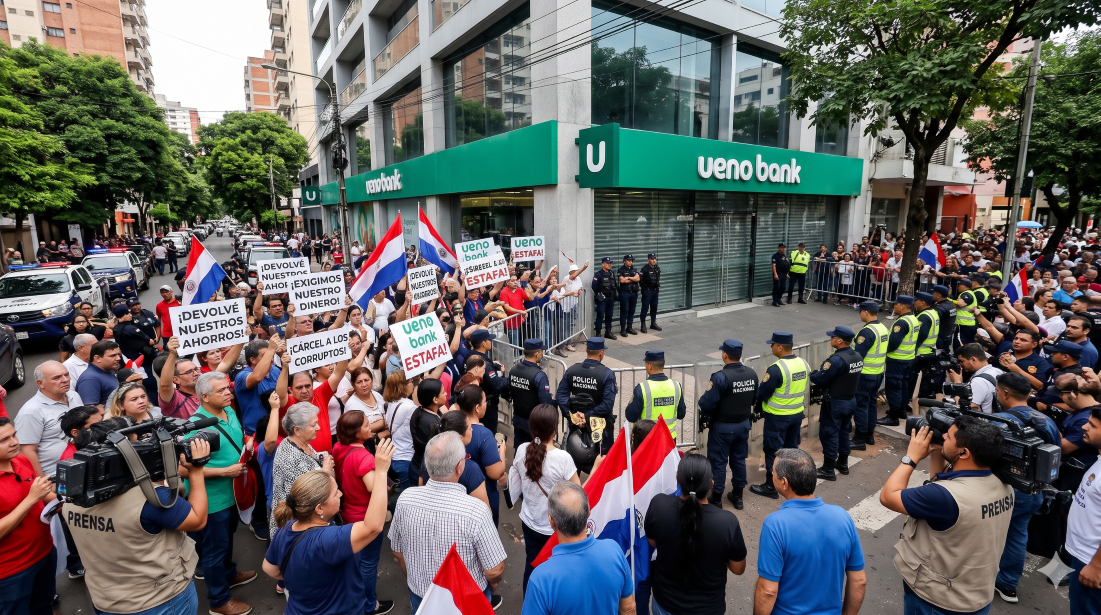
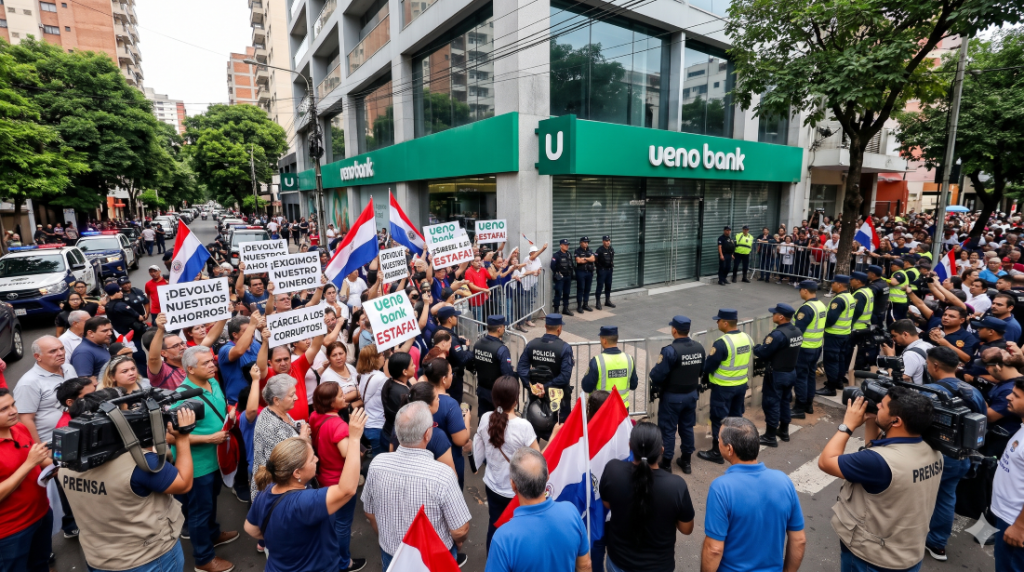
On the morning of Tuesday, November 3, 2026, millions of Paraguayans woke up to a quiet financial nightmare. Across Asunción and rural towns alike, smartphones flashed error messages, debit cards were declined at grocery checkouts, and digital wallets refused to load. Overnight, the Central Bank of Paraguay (BCP) had placed Ueno Bank—the country’s fastest-growing financial institution—into forced resolution, freezing the liquid savings of nearly three million retail depositors and locking up more than $800 million in public and pension funds.
What began as a liquidity and solvency crisis inside a flagship digital lender detonated within seventy-two hours into Paraguay’s gravest political upheaval in decades. By Friday, November 6, President Santiago Peña had been unanimously impeached by Congress, stripped of his constitutional immunity, and placed in custody alongside his former central bank governor on charges of corruption and financial misconduct. For a nation recently marketed to global investors as the low-tax, hyper-stable “Dubai of South America,” the collapse of Ueno Bank stripped away a carefully curated economic narrative—exposing how rapid fintech expansion, state-directed deposits, and regulatory capture can converge into systemic ruin.
From Fintech Darling to National Leviathan
Few financial institutions in Latin America scaled as aggressively—or as visibly—as Ueno Bank. Born out of the finance company Financiera Ueno and launched as a digital-first lender in 2021, the firm obtained a full commercial banking license from the BCP in late 2023, just months after Santiago Peña took office as president.
Armed with venture-style marketing and a slick mobile interface, Ueno set out to disrupt a traditional banking sector long criticized for high fees and exclusionary lending. It lured everyday savers with frictionless account openings, high-yield investment returns, and headline-grabbing cashback promotions of up to 40 percent on supermarket purchases and retail spending. Within three years, Ueno’s branding saturated Paraguayan public life—from sponsorship of the national football team and major stadiums to a brick-and-mortar footprint exceeding 70 branches.
Its pivotal leap came in 2024 when Ueno absorbed Visión Banco, inheriting hundreds of thousands of legacy accounts and loan portfolios. By October 2026, Ueno boasted roughly 2.9 to 3 million clients in a country of 6.5 million people—meaning nearly two out of every three Paraguayan adults relied on the bank for daily transactions, salaries, or savings.
Crucially, retail enthusiasm was matched by an extraordinary influx of public money. During Peña’s administration, state agencies and pension funds poured deposits into Ueno until public funds accounted for roughly a quarter of the bank’s total deposit base. Among the institutional depositors were:
- Social Security Institute (IPS): Between $380 million and $500 million in workers’ healthcare and retirement reserves.
- Public Teachers’ Pension Fund: Roughly $60 million in educator retirement savings.
- State Energy & Infrastructure Entities: Over $160 million from the Itaipú hydroelectric binational entity, alongside funds from the National Electricity Administration (ANDE) and the Ministry of Health.
Inside the Rot: Related-Party Lending and Regulatory Blindness
Behind Ueno’s gleaming digital facade, however, lay classic balance-sheet alchemy and an intricate web of political conflicts of interest.
Critics had long pointed to the revolving door connecting Ueno’s controlling conglomerate, Grupo Vázquez, to the highest levels of Paraguayan economic governance. Before winning the presidency, Peña had acquired preferred shares in Ueno’s parent holding structure—an equity stake he retained while in office until public scrutiny forced him to announce a divestment in April 2025. Even more consequential was Peña’s August 2023 appointment of Carlos Carvallo Spalding—who had served as Ueno’s own president—to lead the Central Bank of Paraguay, making him the chief regulator of his former employer.
Under Carvallo’s tenure, warning signs repeatedly met with official forbearance. When Ueno merged with Visión Banco in 2024, the central bank backed the integration with special liquidity facilities totaling 5.1 trillion guaraníes (approximately $691 million) and permitted the combined lender to defer recognizing impaired loans on its books.
By June 2026, examiners at the Superintendency of Banks could no longer ignore the discrepancies. Supervisory audits revealed that Ueno had funneled between $123 million and $146 million in loans to companies affiliated with Grupo Vázquez—far exceeding Paraguay’s statutory cap on related-party lending. Regulators ordered the bank to bring its exposure below the legal ceiling within ten days. Ueno reported compliance by mid-June, yet prosecutors later uncovered evidence that the bank had indirectly bankrolled a $74.4 million transfer of those loans to Vinanzas S.A., another entity tied to its owners, while disguising operating expenses as balance-sheet assets.
The house of cards collapsed in late October. On October 29, Ueno announced an emergency plan to raise $100 million in fresh capital—half from Grupo Vázquez and half via a local share offering. Before a single dollar materialized, central bank accounting adjustments revealed that Ueno’s solvency ratio had plunged to less than half the legal minimum. On the night of November 2, the BCP board voted to intervene, pulling the plug on the lender’s operations the next morning.
Empty Wallets, Street Protests, and a Fallen Presidency
Because Ueno had embedded itself so deeply into everyday commerce, its closure triggered an immediate social shock. Families found themselves unable to buy food or pay utility bills, local businesses reported steep drops in daily sales, and approximately 32,000 state pensioners were abruptly cut off from their monthly benefits. Rival banks’ mobile applications temporarily crashed on November 4 under a tidal wave of panicked citizens rushing to open alternative accounts.
The collateral damage rapidly spilled into the labor market. According to Paraguay’s Ministry of Labor, roughly 7,000 workers across Ueno Bank and affiliated Grupo Vázquez enterprises—ranging from media outlets to retail ventures across Paraguay, Argentina, Panama, and Nicaragua—saw their contracts suspended or salaries frozen overnight.
| Crisis Indicator | Reported Impact (As of November 12, 2026) |
| Retail Accounts Frozen | ~2.9 to 3.0 million depositors (~60% of Paraguayan adults) |
| Public & Pension Funds Exposed | >$800 million (including IPS, teachers’ fund, and Itaipú) |
| Corporate & Bank Workforce Hit | ~7,000 workers affected across five countries |
| Currency & Market Reaction | Guaraní down >8% vs. USD; sovereign spreads up 30 bps |
| Deposit Guarantee Progress | ~93% of eligible retail depositors issued partial advances |
Anger spilled onto the streets of Asunción and regional hubs like Coronel Oviedo. Thousands of students, unpaid employees, and public school teachers marched on Congress, clashing with riot police who deployed tear gas and rubber bullets as demonstrators demanded justice for their vanished savings.
Cornered by mounting street fury and a collapsing governing coalition, President Peña offered his resignation on November 5 in a bid to restore calm. Lawmakers refused to grant him a quiet exit. After the Chamber of Deputies voted unanimously to bring impeachment charges, the Senate convened as an impeachment court on November 6, voting to remove Peña from office and strip him of lifetime senatorial immunity. Within hours, anti-corruption prosecutors placed Peña, former central bank governor Carvallo, and senior Grupo Vázquez executives—including CEO Federico Miguel Vázquez—under arrest. Vice President Pedro Alliana was swiftly sworn in to serve out the presidential term through 2028.
Containment Efforts and a Tarnished Economic Model
In the days since, Asunción has scrambled to contain macroeconomic contagion. The Paraguayan guaraní tumbled more than 8 percent against the U.S. dollar in a single week, sovereign bond spreads widened by 30 basis points, and fiscal strain forced the Ministry of Social Development to temporarily suspend its flagship Zero Hunger meal program in several municipalities.
To quell retail panic, Congress passed emergency legislation accelerating payouts through Paraguay’s Deposit Guarantee Fund (FGD). Under the leadership of newly confirmed Central Bank Governor Jorge Schreiner, authorities began crediting advance reimbursements capped at 121.76 million guaraníes—part of a statutory 228.3 million guaraní guarantee ceiling per depositor. By November 12, roughly 93 percent of eligible retail depositors had regained access to at least a portion of their cash.
Yet the hardest reckoning lies ahead. While Paraguay’s broader commercial banking sector retains sufficient liquidity to prevent a nationwide systemic meltdown, recovering the $800 million in public pension and utility funds—tangled inside complex related-party loan structures—could take years of forensic litigation.
Ultimately, the rise and ruin of Ueno Bank offers a sobering lesson for emerging markets chasing rapid digital modernization. Low corporate taxes and glossy mobile interfaces cannot substitute for independent banking supervision. When financial regulators are drawn from the boardrooms of the institutions they oversee, and public retirement funds are treated as captive liquidity for politically connected conglomerates, even the sleekest digital bank is built on sand