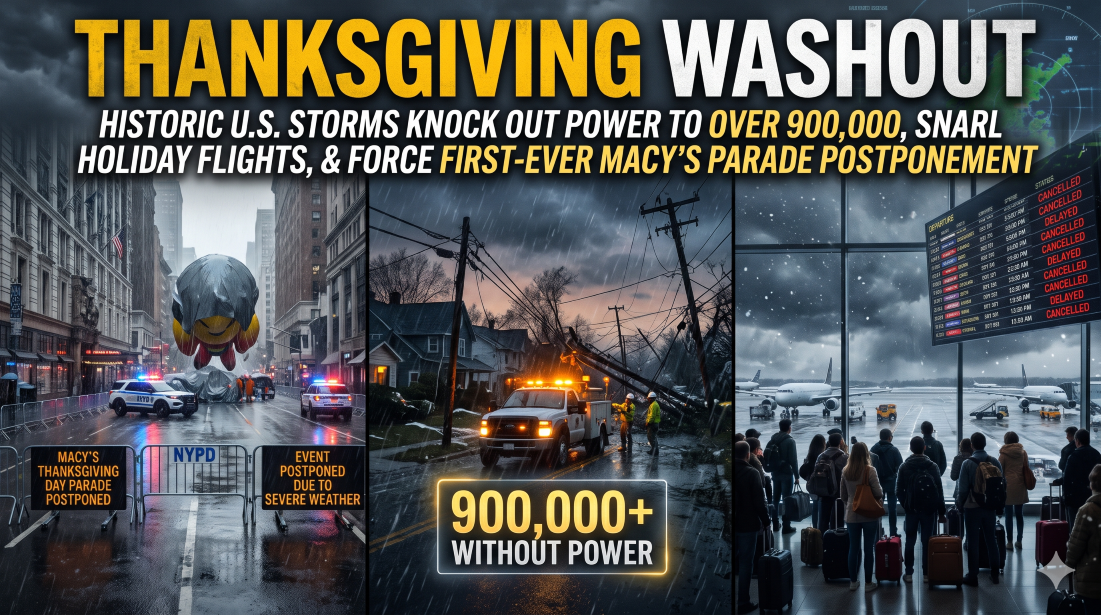
A sprawling, powerful storm system battered vast stretches of the United States across the Thanksgiving holiday on Thursday, November 26, 2026, leaving more than 900,000 homes and businesses without electricity, triggering thousands of flight delays and cancellations, and forcing New York City officials to make history by postponing the iconic Macy’s Thanksgiving Day Parade by two days.
From torrential coastal downpours and gale-force winds along the Eastern Seaboard to heavy, roof-collapsing snow in the Midwest and king-tide coastal flooding in California, the multi-pronged weather assault collided head-on with what the Federal Aviation Administration (FAA) projected to be the busiest Thanksgiving travel period in 16 years. While emergency crews worked through the night to restore downed power lines and rescue stranded motorists, millions of Americans found their holiday traditions dramatically reshaped by the elements.
History Made in Manhattan: Why Macy’s Delayed Its Iconic Parade for the First Time in 100 Years
For generations, waking up on Thanksgiving morning to watch giant character balloons float down Manhattan’s avenues has been an unbroken American holiday ritual. That century-long streak ended on Wednesday evening, November 25, when New York City Mayor Zohran Mamdani and Macy’s organizers announced that the 2026 parade would be postponed by two days to Saturday, November 28.
While the parade was canceled outright for three consecutive years during World War II due to rubber and helium shortages, this marks the first weather-related postponement in the event’s 100-year history. Crews who had already begun inflating the giant helium balloons on Manhattan’s Upper East Side on Wednesday afternoon were forced to deflate them hours later as forecasts locked in dangerous wind gusts and driving rain.
- Safety Over Spectacle: Explaining the decision, Mayor Mamdani stressed, “Safety is, and will always remain, our top priority,” warning New Yorkers of winds strong enough to topple tree limbs and power lines. Macy’s parade executive producer Will Coss echoed that sentiment, noting that organizers acted out of an “abundance of caution” to protect spectators, marchers, and balloon handlers.
- Lessons from 1997: City officials and parade planners have long enforced strict wind thresholds—typically prohibiting giant balloons from flying when sustained winds exceed 23 mph or gusts top 34 mph—following a notorious 1997 incident in which a wind-whipped Cat in the Hat balloon struck a lamppost and critically injured a spectator. On Thursday afternoon, wind gusts reached 56 mph (90 km/h) at New York’s LaGuardia Airport while Central Park recorded its wettest Thanksgiving on record with 1.82 inches of rain.
- Scramble for Visiting Performers: The two-day delay created sudden logistical and financial hurdles for out-of-state participants. While Broadway casts from Wicked, Hamilton, and The Rocky Horror Show as well as the University of Connecticut’s marching band confirmed they would perform on Saturday, the University of Alabama’s Million Dollar Band had to return home for a scheduled college football game. Meanwhile, visiting high school bands—including Pearland High School from Texas and Hawaiʻi’s Nā Koa Aliʻi All-State marching band—launched urgent fundraising drives to cover extra hotel and meal costs in New York.
Lights Out Across the East Coast: Over 900,000 Households Plunged Into Darkness
As the fast-moving coastal storm swept northward from the Carolinas through the Mid-Atlantic and into New England, ferocious wind gusts of up to 70 mph (112 km/h) snapped trees and brought down utility lines across multiple states.
According to tracking data from PowerOutage.us, utility outages peaked at roughly 961,000 customers on Thursday evening before settling just above 908,000 late Thursday night. Pennsylvania, Maryland, and Virginia bore the brunt of the blackouts, leaving hundreds of thousands of families cooking Thanksgiving dinners by flashlight or relying on backup generators.
| Affected Region / Sector | Peak / Reported Impact | Key Details & Locations |
| U.S. Power Grid | 961,000 peak outages (908,000+ late Thursday) | Pennsylvania, Maryland, and Virginia hardest hit as winds up to 112 km/h downed lines |
| Thanksgiving Day Air Travel | 454 cancellations & 2,411 delays | Followed Wednesday’s pre-holiday snarl of 6,000+ delays and ~150 cancellations |
| Mid-Atlantic Coastal Flooding | Historic high-tide surges | Severe street flooding in Norfolk (VA) and New Jersey shore towns including Avalon and Ocean City |
| Midwest Winter Storm | 7.3 to 14 inches of snow | Heavy snowfall hit St. Louis and Ste. Genevieve, Missouri; empty ice arena roof collapsed in Wentzville |
Holiday Gridlock: Flight Cancellations, Flooded Highways, and Rail Disruptions
The storm struck during the peak of America’s busiest holiday travel window, colliding with more than 417,000 scheduled flights across the nine-day Thanksgiving stretch.
- Airports Under Pressure: After more than 6,000 flights were delayed and roughly 150 canceled on Wednesday—compounded by a temporary ground stop at Miami International Airport when a cargo plane overran a runway—disruptions continued throughout Thanksgiving Day, with 454 flights canceled and 2,411 delayed nationwide, centered heavily on Northeast and East Coast hubs. Major carriers issued flexible travel waivers allowing passengers to rebook without penalty.
- Coastal Flooding and Water Rescues: Where torrential rain coincided with high tides, coastal communities faced severe inundation. States of emergency were declared in New Jersey and parts of New York. In Norfolk, Virginia, residents were seen kayaking down flooded Hampton Boulevard, while in southern New Jersey, Avalon Borough officials described the flooding as among the worst in the town’s history. Emergency crews rescued dozens of stranded motorists across New York City, Virginia, and the Jersey Shore.
- Multi-Coast Transit Disruptions: Beyond East Coast highways—where strong winds also forced the temporary closure of Virginia’s Chesapeake Bay Bridge-Tunnel and prompted the MTA to suspend several New York commuter rail lines—a separate Pacific weather system brought king tides and track washouts to California, forcing Amtrak’s Pacific Surfliner to suspend coastal rail services near San Clemente.
Coast-to-Coast Fury: Heavy Midwest Snow Collapses Arena Roof in Missouri
While the East Coast battled wind-driven rain and coastal surge, the western flank of the storm system unleashed early-season winter conditions across the Midwest. Winter storm warnings blanketed eastern Missouri and parts of Illinois, dumping 7.3 inches of snow in St. Louis and 14 inches in Ste. Genevieve, Missouri.
In Wentzville, Missouri, the weight of accumulated snow and ice caused the roof of a municipal ice arena to partially collapse at approximately 3:00 a.m. on Thanksgiving morning. City officials confirmed the facility was empty at the time, averting injuries, though slick overpasses and whiteout conditions caused widespread highway slowdowns across the region.
The Weekend Outlook: Dry Skies for Saturday’s Parade Before Another Storm Looms
Meteorologists offered welcome news for New York City and the millions of fans awaiting the rescheduled Macy’s Thanksgiving Parade: as the primary storm system pulls away on Friday, Saturday is forecast to bring dry conditions and breaks of sunshine to Manhattan, allowing the giant balloons and marching bands to finally take their delayed victory lap.
However, recovery efforts remain urgent. Utility crews across the Mid-Atlantic and Northeast are racing against the clock to restore electricity to hundreds of thousands of customers before another round of rain and wind moves into New York City, Philadelphia, and Boston late Sunday night into Monday morning—just as millions of holiday travelers begin their journey home