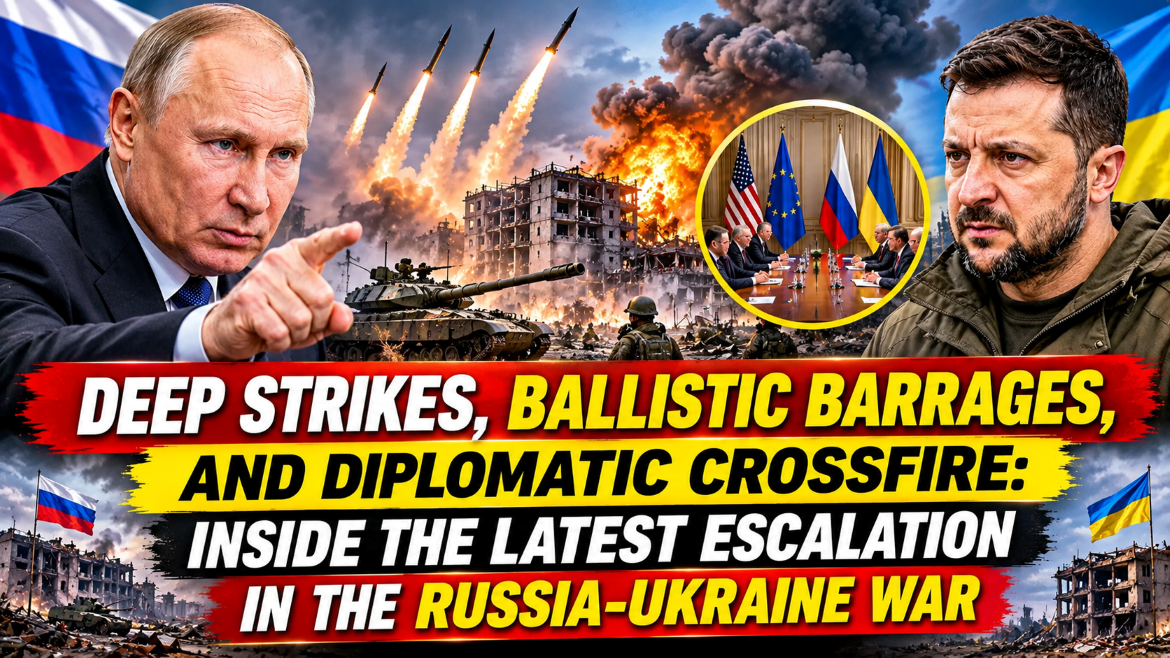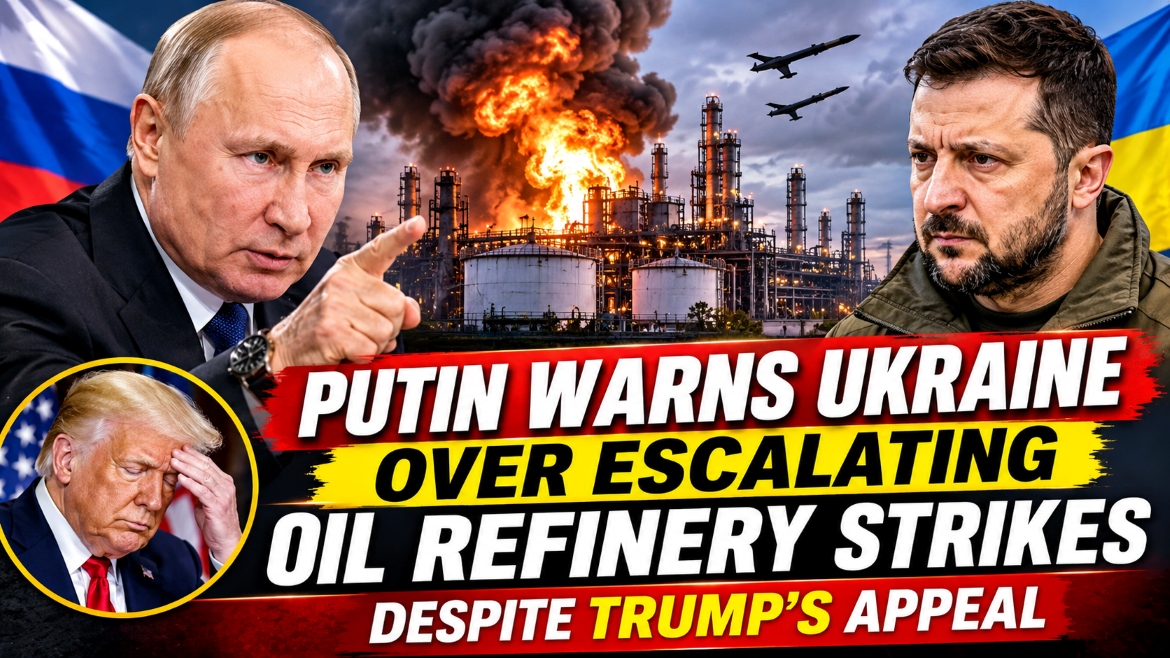
Russian President Vladimir Putin has issued a stark warning that retaliation from Moscow is “inevitable” following a sustained wave of Ukrainian drone attacks on Russian oil refineries. Speaking during a Kremlin meeting with senior government officials and top energy executives—including Rosneft chief Igor Sechin—Putin accused Kyiv of deliberately ignoring direct appeals from U.S. President Donald Trump to halt strikes against Russia’s petroleum infrastructure.
The warning comes as relentless long-range Ukrainian strikes have inflicted severe operational strain on Russia’s downstream energy sector, slashing combined crude processing volumes and forcing several Russian regions to ration retail fuel sales. While Putin stopped short of detailing what form Moscow’s response will take, his remarks underscore how energy infrastructure has become the central economic battleground of the war—and how fragile U.S.-brokered de-escalation efforts remain.
Inside Putin’s Kremlin Warning: Accusations Over a Broken Energy Truce
Addressing the Kremlin’s Commission for Strategic Development of the Fuel and Energy Sector on November 24, 2026, Putin framed Ukraine’s continued targeting of oil plants as a direct breach of diplomatic restraint encouraged by Washington.
“We see that the Kyiv regime continues to attack our refining facilities, despite the U.S. president’s appeal and direct request to refrain from such attacks. But the Kyiv authorities are ignoring this advice. In this regard, I would like to stress that retaliatory measures on our part are inevitable, and everyone should know it.” — Vladimir Putin, President of Russia
Earlier in the autumn, President Donald Trump had publicly urged restraint on energy infrastructure strikes, declaring a mid-October energy ceasefire after asking Ukrainian President Volodymyr Zelenskyy to scale back attacks on Russian oil plants. While Ukrainian drone strikes temporarily subsided following Trump’s mid-October declaration, operations resumed aggressively at the end of October and continued into late November—including overnight strikes that sparked fires at two major refineries in Russia’s Samara region.
Putin urged Russian officials and energy companies to accelerate “systemic work” to fortify refineries and protect facility workers, even while insisting that Kyiv’s campaign cannot inflict critical long-term damage on Russia’s standing in global energy markets.
Kyiv’s Defiant Response: “Stop Complaining. End the War.”
Ukrainian officials swiftly rejected Moscow’s framing, maintaining that Kyiv has consistently offered a reciprocal moratorium on energy strikes—and will only halt attacks on Russian oil plants when Russian forces stop bombarding Ukraine’s power grid and civilian infrastructure.
Ukrainian Foreign Minister Andrii Sybiha dismissed Putin’s complaints directly, arguing that the Kremlin’s grievances ignore the reality of Russia’s own ongoing offensive:
- Reciprocity as the Core Condition: Kyiv reiterated that its long-range drone campaign against Russian fuel depots and refineries is a direct, symmetrical response to Moscow’s systematic missile and drone barrages targeting Ukrainian electrical substations, heating plants, and transport networks.
- Sharp Diplomatic Pushback: Responding to Putin’s remarks, Sybiha stated that if the Russian leader does not want his energy facilities and military assets struck, “he can order an end to the war,” adding that Putin was paying little attention to mounting Russian battlefield losses while failing to achieve his invasion goals: “Clearly, he doesn’t care about them. Stop complaining. End the war.”
45% Processing Drop and Fuel Rationing: The Real Toll on Russia’s Oil Sector
Behind the Kremlin’s rhetoric lies acute economic and logistical pressure on Russia’s domestic fuel supply. While Putin maintained that domestic gasoline prices have stabilized after peaking in October, he acknowledged that “the current situation on the domestic oil-product market remains challenging.”
| Metric / Operational Area | Reported Impact on Russian Energy Sector | Kremlin Policy Response |
| Refinery Crude Processing | Combined refinery throughput cut by an estimated 45% since late October due to drone strikes. | Emergency repair prioritization and heightened physical/air-defense security at plants. |
| Domestic Retail Fuel | Several Russian regions forced to introduce restrictions on retail gasoline and diesel sales. | Export curbs on gasoline and jet fuel, fuel imports, and domestic logistics adjustments. |
| Global Diesel & LNG Trade | EU preparing to ban Russian seaborne LNG imports starting Jan. 1, 2027, and pipeline gas by Nov. 2027. | Limited diesel exports resumed under an agreement with Trump; pivot toward Asian buyers and Arctic shipping. |
Industry estimates cited by Reuters indicate that sustained Ukrainian drone attacks since late October have reduced the combined crude processing volumes of Russian oil refineries by 45%. To prevent severe domestic shortages across agricultural, industrial, and military supply chains, Moscow has enacted emergency export restrictions on gasoline and jet fuel, adjusted internal rail and pipeline logistics, and turned to fuel imports to balance domestic supply and demand.
Pivoting East and North: Russia’s Strategy Amid Tightening Western Sanctions
Beyond immediate refinery defenses, Putin used the Kremlin energy session to outline a longer-term structural shift away from European energy markets. With the European Union set to prohibit imports of Russian seaborne liquefied natural gas (LNG) starting January 1, 2027, and phase out all remaining Russian pipeline gas by November 2027, Moscow is racing to reorient its export infrastructure.
During the meeting, Putin emphasized two strategic priorities:
- Expanding Eastern Refining and Petrochemicals: Putin called for accelerating the construction of transport infrastructure across Siberia and the Russian Far East—alongside new regional refining and petrochemical capacity—to serve growing demand from Asian trading partners.
- Developing the Northern Sea Route: Asserting that European restrictions have backfired on the bloc, Putin highlighted Russia’s growing reliance on the Northern Sea Route along its Arctic coastline to ship hydrocarbons directly to non-Western buyers. Notably, Moscow has also resumed limited diesel deliveries to global markets following a targeted arrangement with U.S. President Donald Trump.
What Happens Next? High Stakes for Winter Energy Security
Putin’s declaration that retaliation is “inevitable” raises immediate alarm as winter sets in across Eastern Europe. Military analysts note that Moscow’s options range from intensified long-range missile and drone salvos against Ukraine’s remaining power generation and gas storage facilities to broader asymmetric pressure on Black Sea and Baltic shipping routes.
At the same time, the standoff tests the diplomatic leverage of the White House. With Kyiv unwilling to pause its refinery campaign unilaterally while Ukrainian cities face nightly aerial bombardment—and Moscow struggling to shield sprawling petrochemical complexes thousands of kilometers from the front lines—energy infrastructure remains both a vital economic lifeline and a primary instrument of leverage in the conflict