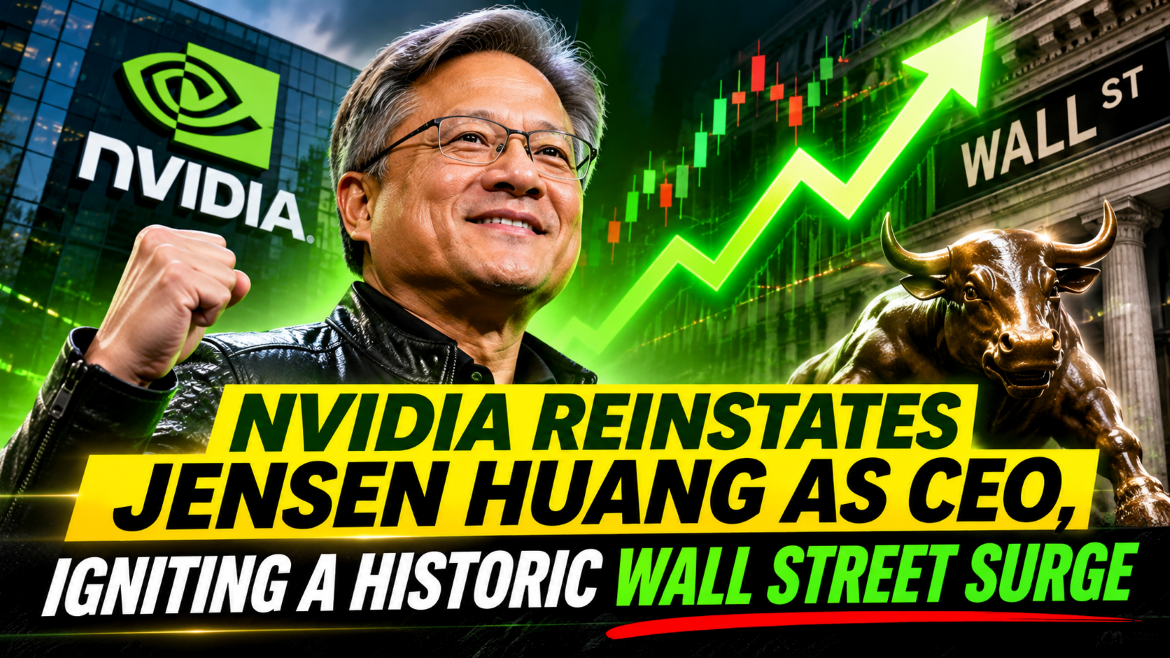
In one of the most dramatic boardroom reversals in corporate history, Nvidia has officially reinstated co-founder Jensen Huang as President, Chief Executive Officer, and member of the Board of Directors, effective immediately. The surprise announcement on Monday, November 23, 2026—just 11 days after Huang stepped down amid revelations of undisclosed workplace relationships and a national security probe—sent shockwaves of euphoria across global financial markets.
Wall Street responded with historic buying pressure. Shares of Nvidia (NASDAQ: NVDA) surged 31.48% to close at $165.05, restoring roughly $950 billion in market capitalization in a single session—the largest single-day value gain for any company in stock market history. The rebound lifted the broader technology sector by approximately $2.7 trillion and propelled major U.S. stock indexes to their strongest daily gains since April 2025.
Historic Wall Street Euphoria: Inside Nvidia’s Record $950 Billion Single-Day Rally
For nearly two weeks following Huang’s November 12 resignation, semiconductor and artificial intelligence equities had endured steep selling pressure. Between its November 11 pre-resignation close of $173.73 and Friday, November 20, Nvidia’s stock had slid to $125.53—contributing to a broader market pullback that pushed both the S&P 500 and the Dow Jones Industrial Average toward correction territory.
News of Huang’s immediate return reversed that sentiment overnight. By the closing bell on Monday, November 23, Nvidia recorded its best single-day percentage gain since May 2003, dragging global technology benchmarks higher along with it:
| Index / Asset | Monday, Nov. 23 Performance | Key Market Milestone |
| Nvidia (NVDA) | +31.48% (Closed at $165.05) | Added ~$950B–$952B in market cap; largest 1-day gain in market history |
| Nasdaq Composite / 100 | +6.7% to nearly +7.0% | Rebounded sharply after worst weekly tech slump |
| S&P 500 | +4.6% to +4.7% | Best single-day rally for Wall Street since April 2025 |
| Dow Jones Industrial Average | +2.8% | Broad blue-chip recovery led by semiconductor and AI names |
| European Tech Stocks | +4.7% | Global spillover rally across semiconductor equipment and software peers |
Rival and partner chipmakers—including Intel and SanDisk—also posted sharp gains as institutional investors recalibrated their outlook on AI infrastructure spending. Despite the leadership turbulence earlier in the month, Nvidia’s underlying financial engine had remained formidable: during its Q3 FY2027 earnings release on November 17 under interim CEO Colette Kress, the chipmaker reported $107.6 billion in quarterly data center revenue (up 110% year-over-year) and projected $130 billion in fourth-quarter revenue.
Behind the Board’s U-Turn: How Trump, Tech Leaders, and Petitions Reshaped the Decision
Nvidia’s decision to bring Huang back marked a stunning reversal from just days earlier. On November 17, after Huang publicly signaled he would be open to returning if asked, Nvidia Board Chair Harvey C. Jones had stated during the company’s earnings call that the board did not intend to reinstate him.
However, intense pressure from multiple fronts rapidly shifted the calculus inside Nvidia’s boardroom:
- Direct White House Intervention: U.S. President Donald Trump publicly campaigned for Huang’s return, calling the Nvidia founder a “great patriot” who deserved a second chance. Following the announcement, Trump told CNBC that he had spoken directly and indirectly with Nvidia’s directors to broker the outcome, stating, “I made the deal… I felt very strongly that he should come back”.
- Silicon Valley and Investor Mobilization: Within days of Huang’s exit, an online petition demanding his reinstatement gathered more than 180,000 signatures—including high-profile backing from Tesla and SpaceX CEO Elon Musk. Meanwhile, portfolio managers and analysts warned that Nvidia risked losing up to 30% of its long-term valuation without its visionary founder.
- National Security Consultations: In its official statement announcing the unanimous Sunday, November 22 board vote, Nvidia emphasized that directors had consulted extensively with Huang and senior U.S. government officials. Based on that input, the board concluded that Huang’s candor, leadership capabilities, and return posed no national security risk and served the best interests of stockholders, employees, partners, and customers.
“A Better CEO the Second Time Around”: Jensen Huang’s Return to Silicon Valley
Returning to Nvidia’s Silicon Valley headquarters on Monday morning to loud cheers from employees gathered in the building’s atrium, Huang struck a humbled yet determined tone.
“I am going to be a better CEO the second time around. I am honored to return to Nvidia and lead one of the most consequential technology companies in the world. I take this responsibility with the greatest humility and renewed commitment.” — Jensen Huang, Nvidia CEO
With Huang resuming his dual roles as CEO and director, Colette Kress—who steered the company through the volatile 11-day interim period and delivered blowout quarterly results—returns full-time to her role as Chief Financial Officer, while Harvey C. Jones continues as Board Chair. Industry observers immediately drew parallels to OpenAI’s November 2023 boardroom crisis, when CEO Sam Altman was ousted and reinstated five days later following employee and investor revolt; Altman himself celebrated Huang’s return on X with a single-word post: “Jensen!”
Lingering Probes and Washington Pushback: The Risks Still Ahead for Nvidia
While Wall Street celebrated the removal of leadership uncertainty, Nvidia’s dramatic governance saga is far from over. Both the company and Washington policymakers face unresolved questions on multiple fronts:
- Ongoing Independent and Federal Investigations: Nvidia confirmed that its independent board investigation into allegations that Huang was targeted by a foreign intelligence operation—stemming from his past relationship with former Megaspeed executive Alice Huang—remains active and will proceed to conclusion. Separately, investigations by the U.S. Securities and Exchange Commission (SEC) and Department of Justice (DOJ) remain underway, alongside a California inquiry into whether restricted AI chips reached China.
- New Export-Control Oversight: Alongside Huang’s reinstatement, Nvidia introduced additional internal national security and export-control oversight measures, while the U.S. government added Singapore-based cloud firm Megaspeed to its trade blacklist.
- Bipartisan Congressional Scrutiny: Lawmakers in Washington sharply criticized the board’s reversal. Several senators and House members warned that Huang’s return heightens the urgency for Congress to pass stricter semiconductor export-control legislation and scrutinize executive branch approvals of AI chip shipments abroad.
- Corporate Governance Questions: Governance experts noted that while reinstating a founder can restore market confidence, reversing an ouster within 11 days raises fresh questions about board independence and executive accountability.
What Jensen Huang’s Reinstatement Means for the Global AI Race
For hyperscalers, enterprise customers, and global investors, Jensen Huang’s return eliminates the single biggest overhang threatening Nvidia’s momentum at the height of the artificial intelligence buildout. As Nvidia scales production of next-generation AI architectures and deepens multi-billion-dollar ecosystem partnerships—including its $20 billion cumulative commitment to newly public AI giant Anthropic—Wall Street has made its verdict unmistakably clear: in the eyes of the market, Nvidia’s founder remains irreplaceable. Sustaining that $950 billion vote of confidence will now depend on pairing Huang’s relentless product execution with rigorous governance and transparent compliance in Washington.