November 23, 2026, delivered an extraordinary wave of corporate whiplash, long-range military strikes, sweeping European sanctions, landmark legal closures, and major international sporting announcements. From Silicon Valley boardrooms and Brussels diplomatic halls to Mediterranean ports off Libya and FIFA headquarters, the day’s developments underscored how rapidly global business, security, and governance can pivot within a matter of hours.
Here is a comprehensive breakdown of the eight biggest global trending news highlights that defined November 23, 2026.
1. Silicon Valley Whiplash: Nvidia Reinstates Jensen Huang as CEO Less Than Two Weeks After Exit
In one of the most dramatic executive reversals in corporate history, Nvidia’s board of directors announced on November 23 that it had reinstated co-founder Jensen Huang as president and chief executive officer—less than two weeks after he stepped down on November 12 amid revelations of undisclosed workplace relationships and a national security probe.
In an official statement, Nvidia’s board said returning Huang to the helm was in the best interest of shareholders, employees, partners, and customers. Chief Financial Officer Colette Kress, who had served as interim CEO during the turbulent 11-day stretch, resumed her permanent role as CFO. The news sent the Nasdaq climbing more than 7% in Monday morning trading as investors welcomed the return of the architect behind Nvidia’s artificial intelligence dominance. U.S. President Donald Trump praised the move on social media, calling Huang a “Great Patriot,” while House Minority Leader Hakeem Jeffries vowed that congressional Democrats would pursue a wide-ranging investigation into both Nvidia and the Department of Commerce over national security and governance concerns.
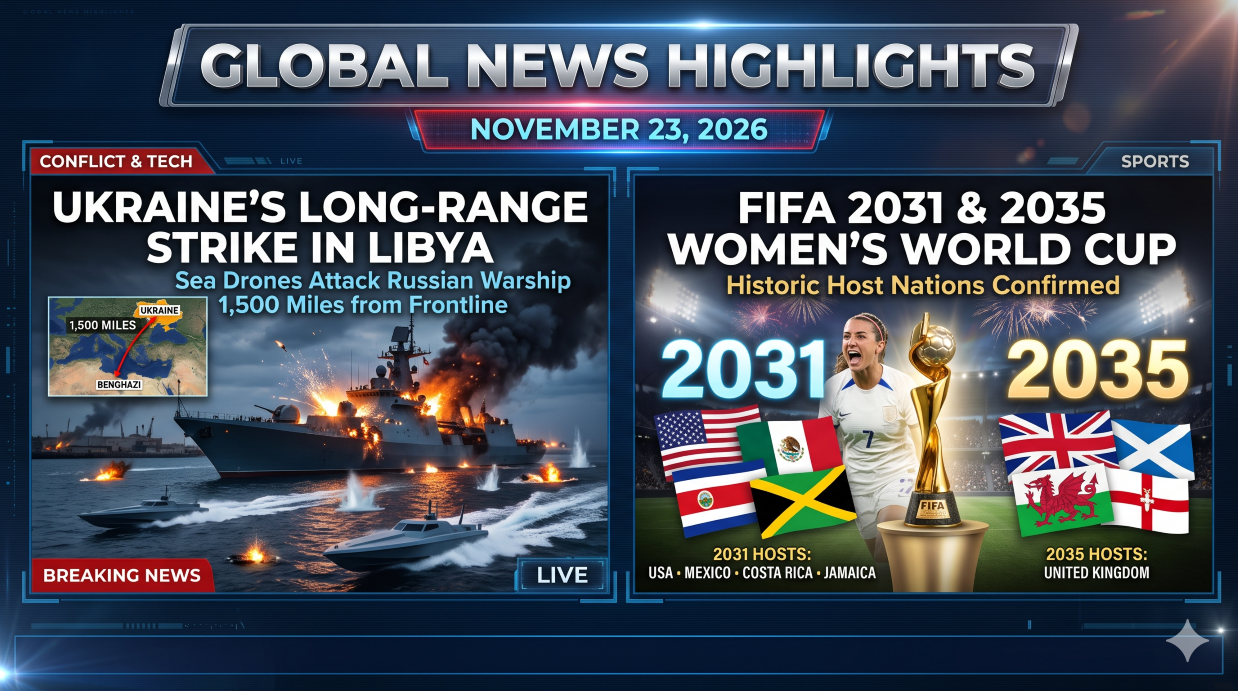
2. Beyond the Black Sea: Ukraine Claims Long-Range Drone Strikes on Russian Warship in Libya
The geographic reach of the Russia-Ukraine war expanded sharply into the Mediterranean on November 23 after Ukrainian President Volodymyr Zelenskyy and the Security Service of Ukraine (SBU) confirmed that Ukrainian sea drones struck a Russian warship docked at a port in Benghazi, Libya, alongside a sanctioned cargo vessel.
Zelenskyy hailed the operation as “exemplary,” declaring that Ukraine’s defense forces had demonstrated that the Russian navy and its logistics networks have “no safe routes, even far beyond the Black Sea”. Simultaneously, Ukrainian forces launched a large-scale aerial drone barrage across western Russia, striking oil refineries in Perm Krai and Rostov Oblast. The strikes off North Africa prompted immediate diplomatic pushback from Libyan authorities and the United Nations Support Mission in Libya (UNSMIL), which called for an independent investigation and rejected the use of Libyan territory or territorial waters as a battleground for foreign conflicts.
3. Brussels Tightens the Vice: EU Proposes Sweeping 22nd Russia Sanctions Package and Sports Ban
European Union leaders unveiled an aggressive new round of economic and cultural pressure on Moscow on November 23 as European Commission President Ursula von der Leyen introduced the bloc’s 22nd sanctions package.
Designed to choke off Kremlin war financing and deepen Russia’s international isolation, the proposal targets Russian banks and cryptocurrency platforms while introducing two high-profile restrictions:
- EU-Wide Sports and Cultural Ban: A prohibition barring Russian national teams and individual athletes from competing under the Russian flag at sporting events hosted within European Union member states.
- Visa Ban for Russian Combatants: A sweeping entry ban prohibiting visas for Russians who fought in the war in Ukraine, with von der Leyen warning that Russian ex-combatants pose a direct security risk to Europe.
4. Closing a Decade-Long Chapter: Spain’s Supreme Court Grants Amnesty to Carles Puigdemont
A major constitutional and political saga in Western Europe reached a definitive legal conclusion on November 23 when the Supreme Court of Spain granted formal amnesty to former Catalan regional president Carles Puigdemont.
Living in self-imposed exile in Belgium since leading Catalonia’s controversial October 2017 declaration of independence, Puigdemont had faced years of arrest warrants and legal battles over charges stemming from the secessionist push. The Supreme Court’s ruling brings the criminal proceedings against the leaders of the 2017 independence drive to a formal close, clearing a major legal obstacle in Spanish domestic politics.
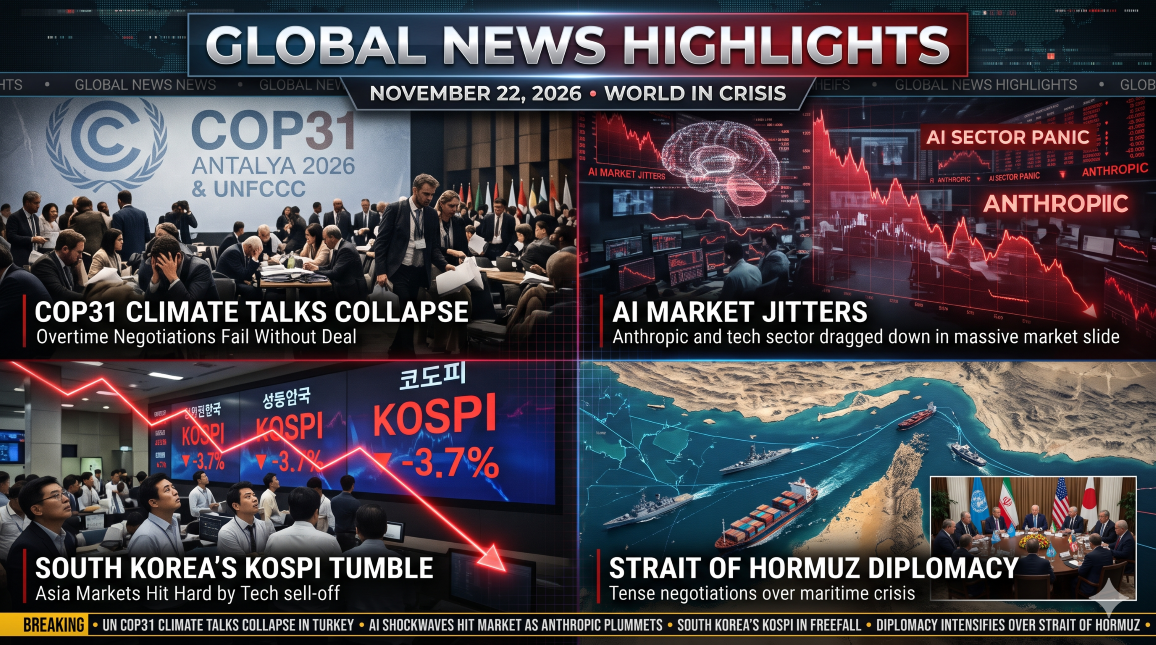
5. Climate Diplomacy Stalls: UN Chief Voices “Deep Disappointment” After COP31 Breakdown in Antalya
Global environmental governance suffered a setback as United Nations Secretary-General António Guterres expressed “deep disappointment” on November 23 following the failure of negotiators to reach consensus on an overarching agreement at the COP31 climate summit in Antalya, Turkey.
Despite days of intense bargaining over fossil fuel transition timelines and climate finance commitments, divisions among major emitting economies and developing nations prevented delegates from adopting a unified framework. Guterres warned governments that geopolitical friction cannot be allowed to derail climate action, urging nations to urgently accelerate emissions reductions outside the stalled summit chamber.
6. European Security & Humanitarian Alerts: School Bomb Threats, UK Sanctions on Myanmar, and Rome Tragedy
Several urgent security, human rights, and social developments unfolded across Europe and Central Asia on November 23:
- Coordinated School Bomb Threats: Hundreds of schools across Denmark and Germany received emailed bomb threats in a wave of coordinated digital intimidation. Law enforcement authorities assessed the messages as non-credible hoaxes and instructed schools to continue normal operations while cyber units traced the origin.
- UK Sanctions Myanmar Generals: Following last week’s landmark International Court of Justice genocide ruling, British Foreign Secretary Ed Miliband announced formal UK sanctions against five senior Myanmar military leaders alongside official recognition of the Rohingya genocide.
- Tajikistan Moves to Exit the ICC: In Central Asia, Tajikistan formally initiated the legal process to withdraw from the International Criminal Court (ICC).
- Student Housing Tragedy in Rome: Amid ongoing cost-of-living and housing protests across Italy, a 58-year-old student died at Sapienza University in Rome after staging a hunger strike over not being assigned student accommodation.
7. Global Aviation, Infrastructure, and Regional Flashpoints: Delta Delays, Starlink Charges, and PKK Pullback
Travelers, telecom regulators, and regional security monitors tracked several fast-moving developments across North America, South America, and the Middle East:
- U.S. Pre-Thanksgiving Flight Delays: Delta Air Lines resolved a technical glitch in its weight-and-balance calculation system that triggered widespread flight delays across the United States just days ahead of the peak Thanksgiving travel rush.
- Colombia Files Charges Against Starlink: Colombia’s Ministry of Information and Communications Technologies (MinTIC) filed formal regulatory charges against Starlink Colombia, alleging the satellite internet provider failed to comply with legal mandates requiring it to block unauthorized telecommunications signals inside Colombian prisons.
- PKK Withdraws from 14 Bases in Iraq: Turkish intelligence reported that the Kurdistan Workers’ Party (PKK) withdrew from 14 additional bases in northern Iraq as part of an ongoing disarmament process aimed at ending its decades-long conflict with Turkey. Meanwhile, Saudi airstrikes targeted Houthi positions in Yemen ahead of an anticipated offensive toward Taiz.
8. FIFA Locks In Global Football’s Future: Hosts Confirmed for 2031 and 2035 Women’s World Cups
International football mapped out the next decade of the women’s game on November 23 as FIFA officially confirmed the host nations for the 2031 and 2035 FIFA Women’s World Cup tournaments:
- 2031 FIFA Women’s World Cup: Jointly hosted across North America and the Caribbean by Costa Rica, Jamaica, Mexico, and the United States.
- 2035 FIFA Women’s World Cup: Jointly hosted across the United Kingdom by England, Northern Ireland, Scotland, and Wales.
The dual announcement guarantees back-to-back marquee tournaments in major footballing markets with world-class stadium infrastructure, positioning women’s international football for unprecedented commercial and attendance growth over the coming decade.
At a Glance: November 23, 2026 Global News Matrix
| Sector | Key Headline | Core Impact |
| Tech & Markets | Nvidia reinstates Jensen Huang as CEO after 11 days | Nasdaq surges over 7%; House Democrats vow oversight probe |
| Defense & Security | Ukrainian sea drones hit Russian warship in Benghazi | War’s naval reach extends into Mediterranean; UN calls for probe |
| Geopolitics | EU proposes 22nd Russia sanctions package & sports ban | Targets Russian crypto, banks, athlete flags, and ex-combatant visas |
| Law & Governance | Spain’s Supreme Court grants amnesty to Carles Puigdemont | Closes criminal proceedings from 2017 Catalan independence crisis |
| Climate & Diplomacy | UN chief decries COP31 summit breakdown in Antalya | No overarching climate deal reached; urgent emission cuts urged |
| Global Sports | FIFA confirms 2031 & 2035 Women’s World Cup hosts | North America/Caribbean in 2031; UK home nations in 2035 |