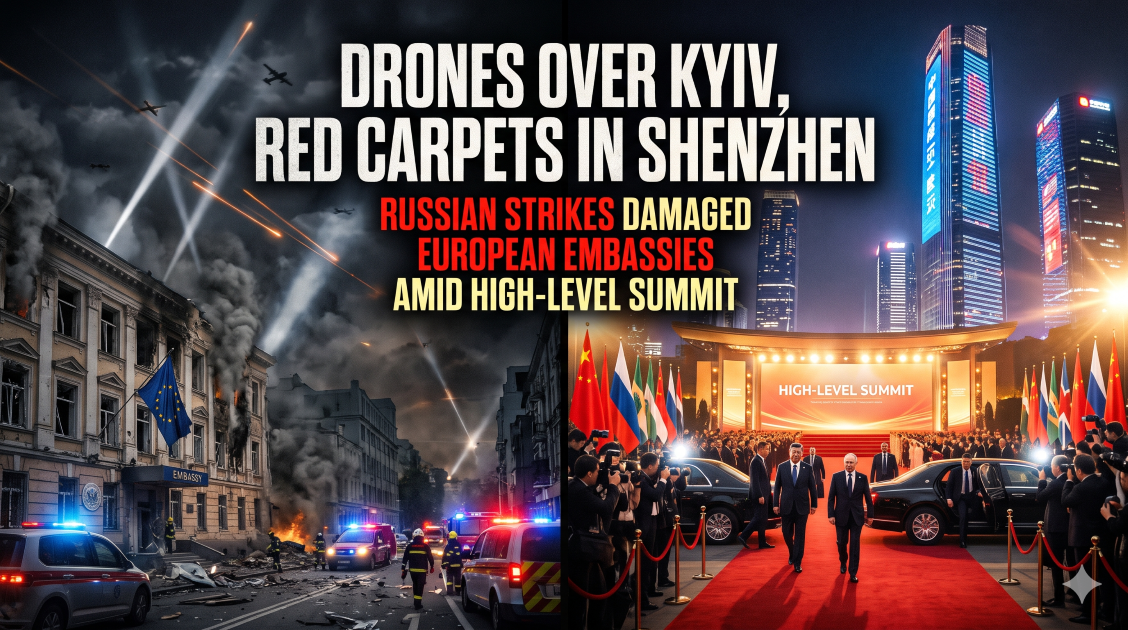
A stark contrast between battlefield escalation and high-level international diplomacy defined mid-November 2026. Even as Russian President Vladimir Putin joined U.S. President Donald Trump and Chinese President Xi Jinping for an unprecedented trilateral summit on the sidelines of the Asia-Pacific Economic Cooperation (APEC) meeting in Shenzhen, China, Russian forces unleashed intense drone and missile barrages across Ukraine. Those strikes damaged several European diplomatic missions in central Kyiv—including the embassies of the Netherlands, Austria, and Sweden—triggering immediate diplomatic backlash across Europe and raising urgent questions about the viability of ongoing peace negotiations.
The simultaneous unfolding of diplomatic pomp in southern China and shattered glass across diplomatic compounds in Ukraine’s capital underscored the widening gulf between geopolitical summitry and military reality. As European Union leaders summoned Russian envoys and called for emergency United Nations Security Council consultations, the incidents tested international legal norms governing diplomatic protection while hardening European resolve to sustain support for Kyiv.
Firepower in Central Kyiv: How Russian Drone Strikes Damaged European Embassies
During a series of Russian aerial assaults on Kyiv on November 19 and overnight into November 20, 2026, explosions struck densely populated neighborhoods and historic districts in the heart of the Ukrainian capital. Beyond killing civilians and damaging residential apartments, energy infrastructure, and cultural landmarks such as St. Volodymyr’s Cathedral, shockwaves and falling debris struck diplomatic premises protected under international law.
Multiple European governments confirmed physical damage to their missions in Kyiv:
- The Netherlands: A Russian drone struck a building immediately behind the Dutch embassy in central Kyiv on November 19, causing structural and window damage. Dutch Foreign Minister Tom Berendsen confirmed that all embassy personnel were safe while condemning the strike as “unacceptable”.
- Austria: Austrian Chancellor Christian Stocker and Foreign Minister Beate Meinl-Reisinger reported that the Austrian embassy sustained damage for the second time during the conflict. Meinl-Reisinger ordered heightened security protocols for diplomatic staff and accused Moscow of intensifying attacks against civilian and diplomatic infrastructure.
- Sweden: Swedish Foreign Minister Maria Stenergard confirmed that an explosion occurred near Sweden’s diplomatic mission in Kyiv, reporting that while all staff remained unharmed, the proximity of the blast underscored the acute danger facing foreign diplomats.
In addition to embassy damage, drone debris landed on the grounds of Ukraine’s Ministry of Foreign Affairs, and during the broader overnight barrage into November 20, Russian missiles briefly crossed into neighboring Polish airspace—prompting Warsaw to summon Russia’s ambassador and request additional NATO air defense reinforcements.
Europe Strikes Back Diplomatically: Envoy Summonses and UN Security Council Demands
The physical damage to diplomatic compounds—which enjoy strict inviolability under the 1961 Vienna Convention on Diplomatic Relations—sparked an immediate, coordinated diplomatic response across Brussels and European capitals.
EU High Representative for Foreign Affairs and Security Policy Kaja Kallas sharply contrasted the Kremlin’s diplomatic messaging in Asia with its military actions in Ukraine. “As Putin walked the red carpet in Shenzhen, Russian strikes hit Kyiv and damage several European and non-European embassies,” Kallas wrote, emphasizing that diplomatic premises are protected under international law and pledging increased EU assistance to Ukraine alongside tougher pressure on Moscow.
| Diplomatic Actor | Official Action Taken | Core Message to Moscow |
| European Union (EEAS) | Summoned Russia’s chargé d’affaires in Brussels | Attacks on diplomatic premises violate international law; EU will expand aid to Kyiv. |
| France | Requested an urgent UN Security Council meeting | Condemned strikes on civilians and embassies; demanded international accountability. |
| The Netherlands & Austria | Summoned Russian ambassadors in The Hague and Vienna | Denounced damage to embassy buildings and called for tighter sanctions. |
| Sweden & Poland | Summoned Russian envoys in Stockholm and Warsaw | Protested blasts near diplomatic missions and Russian missile violations of Polish airspace. |
French Foreign Minister Jean-Noël Barrot pushed the response onto the global stage by calling for a formal meeting of the United Nations Security Council. Expressing solidarity with Ukraine, Austria, and the Netherlands, Barrot stated that Russia must answer for violating the inviolability of diplomatic missions and continuing deadly strikes on civilian infrastructure.
Red Carpets in Shenzhen: High-Level Summit Diplomacy Meets Battlefield Reality
What made the Kyiv embassy strikes particularly jarring for international observers was their exact timing. On November 19—the very day drones struck behind the Dutch embassy and damaged Austrian diplomatic premises—Vladimir Putin was participating in high-profile summit diplomacy in Shenzhen, China.
During the APEC gathering, Putin held an unprecedented trilateral meeting with U.S. President Donald Trump and Chinese President Xi Jinping, alongside bilateral discussions. While the three leaders issued broad statements emphasizing nuclear risk reduction and global stability, the Shenzhen talks produced no ceasefire agreement or concrete breakthrough toward halting the war in Ukraine.
For European policymakers, the juxtaposition was unmistakable. While Moscow projected an image of constructive statesmanlike engagement on the world stage in China, its military continued pummeling Ukraine’s energy grid, civilian neighborhoods, and diplomatic quarter. European leaders argued that the timing was deliberate—designed to demonstrate military leverage during negotiations while intimidating Western governments supporting Kyiv.
“Cognitive Warfare”: Why Western Diplomats Refuse to Abandon Kyiv
The embassy damage followed explicit warnings issued by Moscow just days earlier urging Western diplomats to evacuate the Ukrainian capital or face “mortal danger”. Despite shattered windows, frequent power outages, water disruptions, and daily air raid sirens, European and allied ambassadors in Kyiv have refused to leave.
Western envoys stationed in the capital—including representatives from the European Union, Denmark, Germany, France, Italy, Spain, Sweden, Poland, Estonia, and the United States—have characterized Russia’s bombardment of central Kyiv as a form of “cognitive warfare” aimed at spooking European public opinion and fracturing political solidarity with Ukraine. By remaining at their posts, diplomats argue they are sending an unmistakable signal that intimidation will neither shutter diplomatic missions nor force Europe to accept a peace settlement dictated under fire.
What the Clash Between Embassy Strikes and Summitry Means for Peace Talks
The events of mid-November 2026 highlight three critical realities shaping the next phase of the Russia-Ukraine conflict:
- Diplomacy Without Deterrence Falls Short: High-level summits in distant capitals cannot pause hostilities on the ground unless paired with enforceable security guarantees and credible deterrence.
- Air Defense Remains Ukraine’s Top Priority: Ukrainian President Volodymyr Zelenskyy renewed urgent appeals to Western partners for additional air defense systems, noting that protecting Kyiv’s skies is essential not only for Ukrainian civilians and winter energy infrastructure, but also for the international diplomatic community operating within the city.
- Transatlantic Alignment Faces New Tests: With Washington questioning aspects of long-term aid spending while European capitals push for tighter sanctions and robust security assurances for Kyiv, European leaders are increasingly determined to ensure that neither Ukraine nor Europe is sidelined in future peace negotiations.
A Defining Test of International Law and Diplomatic Resolve
The damage inflicted on European embassies in Kyiv during November 2026 stands as a stark reminder that modern conflict rarely respects traditional boundaries. Even as world leaders gathered under the banner of global cooperation in Shenzhen, the blast waves echoing through central Kyiv tested foundational principles of international law and diplomatic immunity. How unified the international community remains in holding Moscow accountable—and in reinforcing Ukraine’s air defenses—will play a decisive role in determining whether future diplomacy brings genuine peace or merely pauses between escalations