
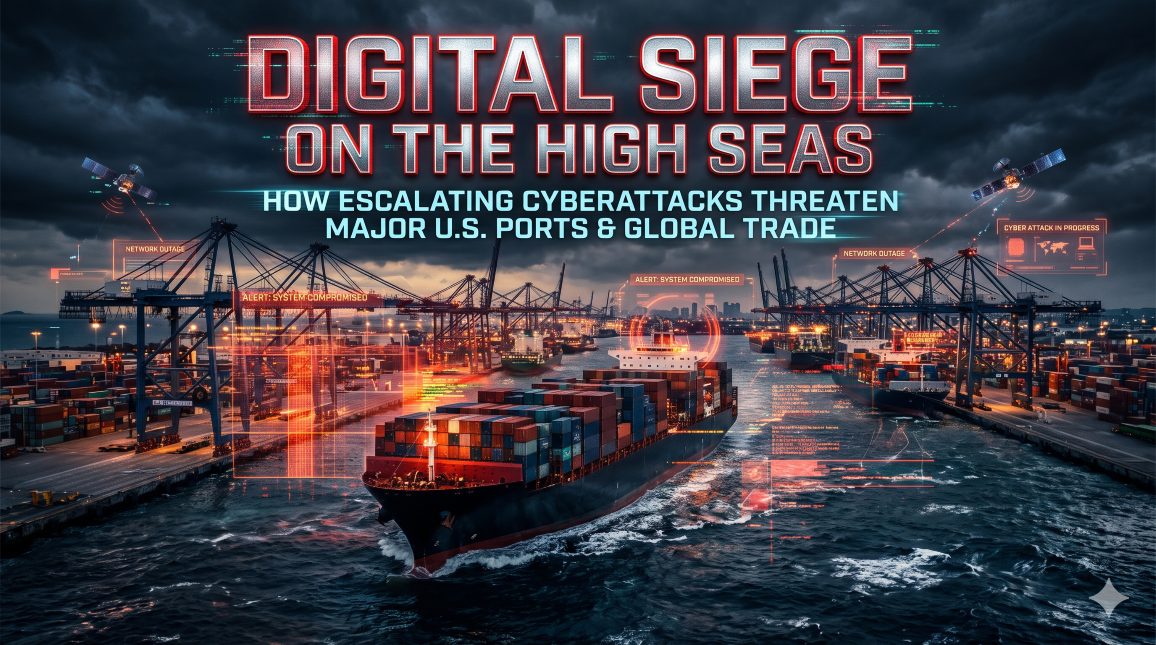
America’s seaports—the critical arteries that keep retail shelves stocked, factories running, and global energy markets supplied—are facing an unprecedented digital siege. According to major industry disclosures and federal maritime data in November 2026, cyberattacks targeting major U.S. ports, shipping carriers, and commercial vessels have escalated sharply. Highlighted by a 17% year-over-year increase in maritime cyber incidents recorded by the U.S. Coast Guard and a staggering 120 million blocked hacking attempts in a single month at the Port of Los Angeles, the surge has raised urgent alarms across Washington and the global logistics sector.
As port terminals and ocean vessels rely ever more heavily on automated cranes, digital gate systems, GPS navigation, and networked cargo tracking, the boundary between physical maritime security and cybersecurity has effectively vanished. A single successful intrusion at a major hub no longer just compromises corporate data—it threatens to paralyze national supply chains, stall energy exports, and endanger vessels at sea.
1. 120 Million Attacks in 30 Days: Los Angeles Becomes Ground Zero for Port Cyber Defense
Nowhere is the sheer volume of digital hostility more visible than at the Port of Los Angeles, the busiest container gateway in the United States. Port officials revealed that their cybersecurity defenses thwarted approximately 120 million attempted cyberattacks during the month of August 2026 alone—nearly double the port’s monthly average recorded in 2023.
The relentless barrage included automated password-guessing campaigns, credential-theft attempts, network probing, and efforts to implant malicious software inside operational systems. To withstand that volume of daily hostility, Executive Director Gene Seroka noted that the port operates a sophisticated, seven-layer digital defense shield in partnership with private cybersecurity firms and federal intelligence agencies.
Meanwhile, energy hubs along the Gulf Coast are experiencing similar pressure:
- Port of Corpus Christi Under Daily Fire: As the largest U.S. gateway for crude oil exports—handling roughly 2.3 million barrels per day—the Texas port faces hundreds to thousands of attempted cyberattacks every single day. Port Chief Executive Kent Britton reported that threat actors routinely probe network perimeters for unpatched vulnerabilities while launching spear-phishing campaigns that impersonate senior executives to trick staff into granting unauthorized access.
- Economic Pinch Points on the East Coast: At the Port of Virginia, spokesperson Joe Harris warned that cyber risks have grown substantially more acute, emphasizing that major ports function as critical economic pinch points where “getting taken offline is not an option”.
2. From Port Gates to Open Water: Real-World Breaches and Hijacked Tanker Networks
While Los Angeles successfully repelled millions of probes, several real-world intrusions across the maritime sector in 2026 demonstrated how quickly digital breaches can spill into physical disruption.
| Maritime Entity | Date of Incident | Nature of Cyber Incident | Operational Impact |
| Port of Los Angeles | August 2026 | ~120 million automated and targeted hacking attempts | All attempts blocked; cargo operations continued uninterrupted |
| North Carolina Ports | August 2026 | External actor breached IT systems across three facilities | Delayed gate openings at Wilmington; forced temporary switch to manual cargo processing |
| Two U.S.-Bound Tankers | August 2026 | Suspected network intrusions near the Strait of Gibraltar | Joint U.S. Coast Guard and FBI teams boarded vessels in Galveston, Texas for inspections |
| A.P. Moller–Maersk | November 2026 | Data exfiltrated from a legacy IT system acquired via a past takeover | Non-ransomware breach; global shipping schedules remained unaffected |
In August 2026, an external cyberattack hit North Carolina Ports, disrupting IT infrastructure across all three of its facilities. While vessel schedules continued, gate openings at the Port of Wilmington were delayed as IT teams isolated systems and operators fell back on manual gate processing until networks were restored.
Even more concerning were intrusions aboard vessels at sea. Also in August, joint U.S. Coast Guard and FBI teams boarded two foreign-flagged tankers carrying crude oil and liquefied petroleum gas from the Mediterranean toward Galveston, Texas, after intelligence indicated their onboard networks had been compromised near the Strait of Gibraltar. Separately, Danish shipping giant Maersk disclosed in November 2026 that attackers stole data from an older legacy IT system inherited from a previous acquisition, underscoring how historical mergers can leave hidden backdoors in global logistics networks.
3. State-Sponsored Actors and AI-Powered Weapons Are Accelerating the Threat
Cybersecurity analysts and federal officials point to two converging drivers behind the 17% surge in maritime cyber incidents tracked by the U.S. Coast Guard: geopolitical statecraft and artificial intelligence.
Intelligence assessments link a substantial share of maritime reconnaissance and intrusion activity to state-aligned threat groups connected to Iran, North Korea, and China—frequently routed through third-party servers to obscure attribution. For adversarial states, compromising port logistics software or vessel navigation networks offers asymmetric leverage: the ability to monitor military and energy shipments during peacetime or disrupt critical supply chokepoints during a crisis.
At the same time, artificial intelligence has dramatically lowered the barrier to entry for complex cyber operations. The FBI recently warned infrastructure operators that attackers are deploying AI-driven automation tools—such as a toolkit known as Artex—to scan port networks continuously, identify software flaws at machine speed, and craft hyper-realistic executive impersonation emails. Instead of launching sporadic manual probes, automated AI agents can test millions of entry points across global shipping networks around the clock.
4. Washington Fights Back: Mandatory Coast Guard Cyber Rules and Manual Drills
Recognizing that voluntary cybersecurity guidelines are no longer sufficient to safeguard vital trade gateways, federal regulators and port authorities have moved aggressively to harden America’s maritime infrastructure.
Under landmark U.S. Coast Guard cybersecurity regulations enacted in 2025, covered U.S.-flagged vessels, outer continental shelf facilities, and maritime port operators face strict federal compliance mandates:
- Mandatory Incident Reporting: Operators must promptly report suspected or confirmed cyber incidents to federal authorities so threat intelligence can be shared rapidly across ports.
- Annual Workforce Training: All personnel with network access must complete annual cybersecurity awareness training to counter phishing and social engineering.
- Dedicated Cybersecurity Officers: Covered organizations must designate a qualified Cybersecurity Officer accountable for risk management and regulatory compliance.
- Formal Cybersecurity Plans by 2027: Operators are required to submit comprehensive cybersecurity plans for Coast Guard review ahead of a July 16, 2027 compliance deadline.
Beyond regulatory compliance, port leaders are investing heavily in operational resilience. Major terminals are running live emergency tabletop exercises, expanding dedicated security operations centers, and rehearsing manual fallback procedures—ensuring that if digital gate systems, crane controllers, or manifests are ever knocked offline, dockworkers can continue moving essential cargo without bringing U.S. commerce to a standstill.
5. Why Maritime Cybersecurity Is Now a Core Pillar of National Security
The wave of cyberattacks hitting U.S. ports in 2026 marks a permanent shift in how global trade must be defended. Modern ports are no longer isolated waterfront warehouses; they are hyper-connected industrial technology hubs linking ocean carriers, railroads, trucking fleets, energy pipelines, and customs agencies in real time.
With the Port of Los Angeles fending off 120 million attacks in a single month and the U.S. Coast Guard documenting steady double-digit growth in maritime incidents, cyber resilience has become just as vital to port operations as physical perimeter patrols and harbor tugboats. How effectively port authorities, shipping lines, and federal agencies implement AI-assisted defenses and enforce the Coast Guard’s new cybersecurity standards will determine whether America’s maritime gateways remain secure in an era of relentless digital warfare