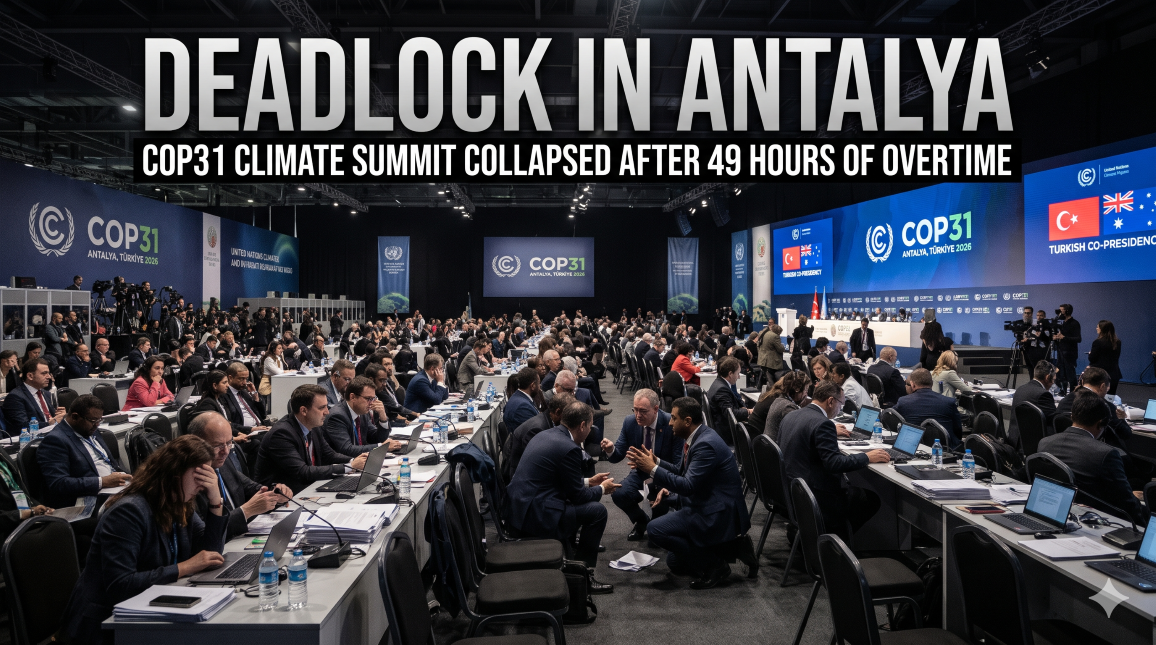
After running more than 49 hours past its scheduled Friday deadline—becoming the longest United Nations climate conference in history—the COP31 climate summit in Antalya, Turkey concluded in failure on Sunday, November 22, 2026. Nearly 200 countries walked away without adopting a final political agreement after irreconcilable divisions over phasing out fossil fuels, carbon capture technology, and adaptation finance brought multilateral climate diplomacy to a standstill.
When COP31 President and Turkish Environment Minister Murat Kurum brought down the closing gavel to announce that the proposed Antalya Pact lacked unanimous consensus, the moment immediately revived painful memories of the collapsed 2009 Copenhagen summit. More importantly, it underscored a deepening crisis of confidence in whether consensus-based UN climate talks can keep pace with a warming planet.
Record Overtime in Antalya: How the Longest COP Summit Unraveled
Scheduled to wrap up on Friday, November 20, negotiations in Antalya dragged through two grueling nights of double overtime before finally collapsing on Sunday afternoon. Australian Climate Minister Chris Bowen, who co-chaired the talks alongside Kurum, acknowledged that opposing camps had hardened into “unbridgeable red lines”.
Under UN Framework Convention on Climate Change (UNFCCC) rules, final political declarations—known as “cover decisions”—require unanimous consensus, meaning objections from even a single country or bloc can block adoption. At the closing plenary, Kurum stated that the presidency refused to force a “take-it-or-leave-it” text on unwilling nations, leaving both the Paris Agreement cover decision and the broader convention declaration unadopted.
| Key Summit Metric | COP31 Outcome (Antalya, Turkey) | Historical Context |
| Overtime Duration | Over 49 hours past scheduled close | Longest UN climate summit on record, surpassing COP25 in Madrid (2019) |
| Final Political Deal | None adopted (Antalya Pact rejected) | Most severe diplomatic breakdown since COP15 in Copenhagen (2009) |
| Core Sticking Points | Fossil fuel phase-out language, carbon capture, and $120B adaptation finance | Over 130 nations backed explicit fossil fuel transition language; oil producers resisted |
| U.S. Presence | Absent for the second consecutive year | Followed the Trump administration’s withdrawal from the 2015 Paris Agreement |
“Unbridgeable Red Lines”: The Battle Over Phasing Out Fossil Fuels
At the heart of the COP31 collapse was a fierce standoff over whether the summit’s final political declaration should explicitly commit nations to phasing out coal, oil, and gas.
At COP28 in Dubai in 2023, governments made a landmark pledge to “transition away from fossil fuels in energy systems”. However, explicit fossil fuel language was omitted from final agreements at COP29 and COP30. Entering Antalya, a broad coalition of more than 130 countries—including the European Union, Panama, and climate-vulnerable island states—insisted they would no longer accept watered-down declarations that ignored the primary driver of global warming.
The timeline of the Antalya text revealed how quickly trust eroded:
- November 19 Draft: Initial language referencing fossil fuels was stripped out of the negotiating text and never restored despite two days of overtime talks.
- Carbon Capture Friction: Subsequent drafts offered only indirect allusions to energy transitions while retaining provisions supporting carbon capture and storage (CCS)—a compromise that climate-ambitious nations feared would serve as a loophole to prolong oil and gas production.
- European and Vulnerable-Nation Veto: Speaking for the European Union, Irish Climate and Environment Minister Darragh O’Brien declared that the bloc would not endorse an Antalya Pact that failed even to mention fossil fuels. Panama similarly vowed to formally block any agreement omitting fossil fuels.
- Oil-Producing Pushback: Conversely, Saudi Arabia, Russia, and other fossil-fuel-dependent economies firmly resisted binding or explicit phase-out targets, arguing that nations must retain flexibility over their energy mixes and economic development pathways.
Vanishing Billions: Developing Nations Left Empty-Handed on Climate Finance
Alongside the fossil fuel clash, bitter divisions over climate adaptation finance alienated developing economies already battering against extreme heat, floods, and droughts.
Developing countries arrived in Antalya seeking a concrete financial commitment to help vulnerable populations adapt to accelerating climate impacts. An early draft of the Antalya Pact included a target of $120 billion per year by 2035 for adaptation finance. However, that figure was deleted from the second draft and never reinstated—even though the text cited UN Environment Programme estimates showing developing nations actually need roughly $305 billion annually for adaptation through 2035.
“We didn’t come here to beg,” Ghana’s Environment Minister Zanetor Agyeman-Rawlings stated during the talks, capturing widespread frustration across the Global South.
Meanwhile, India—speaking on behalf of the Like-Minded Developing Countries (LMDC) bloc—raised sharp objections over climate equity, warning that the draft text diluted the foundational principle of “common but differentiated responsibilities” and weakened expectations that wealthy, historically high-emitting nations must lead on emissions cuts and financial delivery.
Geopolitical Headwinds and the Absence of the United States
The deadlock in Turkey unfolded against a fractured geopolitical backdrop that complicated consensus-building from day one. For the second consecutive year, the United States sent no official negotiating delegation following the Trump administration’s withdrawal from the 2015 Paris Agreement—leaving a leadership vacuum at the world’s premier climate forum.
While China expressed disappointment at the collapse and maintained that the global green energy transition remains “irreversible”, deep economic anxieties over energy security, trade tariffs, and industrial competitiveness made major emitters reluctant to sign onto binding timelines in Antalya.
“No Ambiguity in the Science”: Global Reaction and Calls for UN Reform
The collapse of COP31 drew immediate warnings from UN leadership and veteran climate advocates that the current diplomatic model is breaking down:
- UN Secretary-General António Guterres: Expressing “profound frustration,” Guterres warned that while there was no consensus in the negotiating hall, “there is no ambiguity in the science”. “Temperatures keep shattering records. Climate extremes keep intensifying. Emissions remain far too high,” he stated, urging civil society and frontline communities to keep pressing governments for accountability.
- UN Climate Chief Simon Stiell: Calling the outcome a clear shortfall, Stiell warned that “the world cannot afford a repeat of this moment” as nations prepare for COP32 in Ethiopia in 2027.
- Growing Calls for Process Reform: Former U.S. Vice President Al Gore declared that the COP process is “in need of significant reform,” echoing widespread criticism that allowing a handful of petro-states to veto the will of over 130 nations paralyzes global action.
Beyond Consensus: What Happens to Global Climate Action Now?
Crucially, the failure to adopt a political declaration in Antalya does not erase existing legal obligations under the 2015 Paris Agreement or previous UN climate decisions. Instead, analysts expect climate diplomacy to fragment into faster, smaller coalitions of the willing outside the rigid UN unanimity rule.
Initiatives such as the Santa Marta coalition—bringing together governments explicitly committed to phasing out fossil fuels—are gaining momentum alongside regional clean-energy partnerships. At the same time, legal pressure is mounting following an International Court of Justice (ICJ) advisory opinion confirming that states bear binding legal obligations under international law to combat climate change.
Ultimately, the 49-hour overtime collapse in Antalya exposed a stark reality: the era of paper compromises that papering over fundamental disagreements on fossil fuels has ended. Whether world leaders can rebuild multilateral trust before COP32 in Ethiopia—or whether real decarbonization will increasingly be driven by plurilateral coalitions, market economics, and climate litigation—will define the next chapter of the global climate fight.