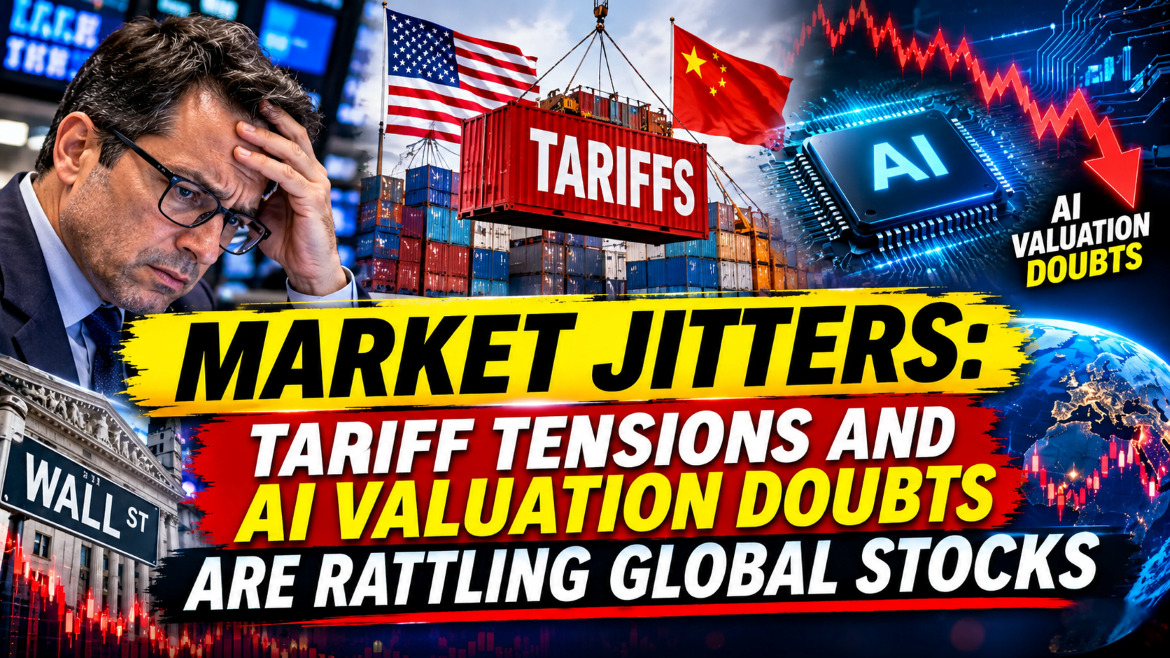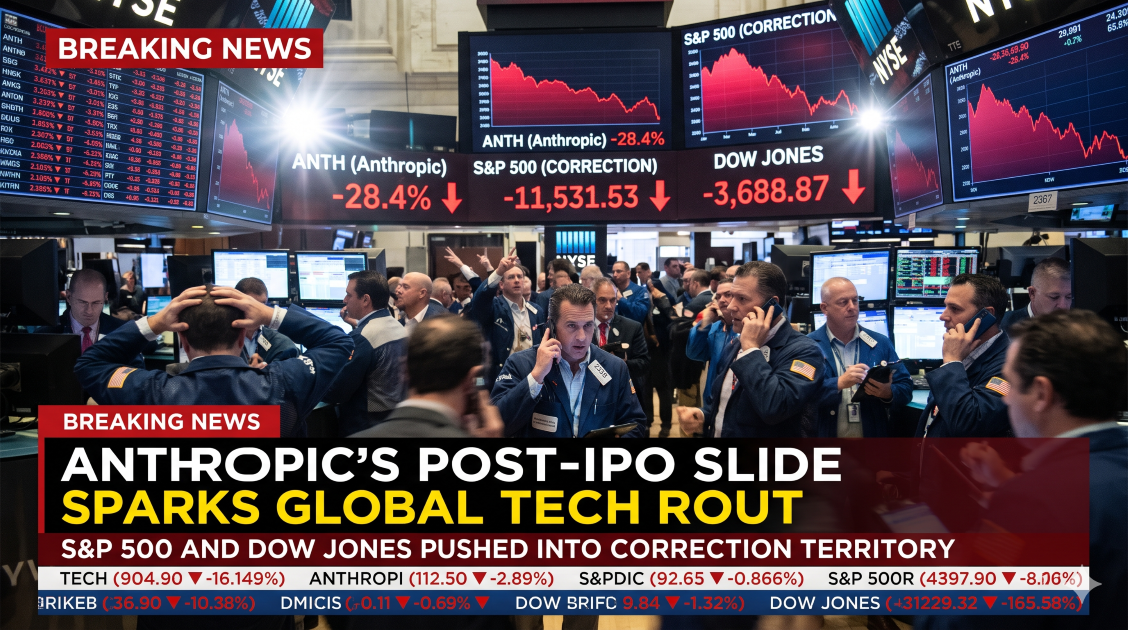
Global financial markets suffered one of their sharpest reversals of the year on Friday, November 20, 2026, as an aggressive sell-off across artificial intelligence and semiconductor stocks dragged major equity benchmarks deep into the red. Triggered by a steep second-day retreat in newly listed AI giant Anthropic (NASDAQ: ANT), the rout pushed both the S&P 500 and the Dow Jones Industrial Average into official correction territory—defined as a decline of 10% or more from their recent peaks—while erasing all of the Nasdaq Composite’s year-to-date gains.
What had been hailed just 24 hours earlier as a triumphant, record-shattering public debut for the maker of the Claude chatbot quickly turned into a sobering stress test for the broader AI trade. As institutional investors scrutinized massive capital expenditure commitments, lofty valuations, and shifting macroeconomic headwinds, selling pressure rippled from Wall Street across European and Asian exchanges.
From Euphoria to Reality Check: Anthropic’s Volatile Second Day on Nasdaq
When Anthropic priced its initial public offering at $83 per share—valuing the company at roughly $1.51 trillion—and closed its Thursday debut with a 17% gain after briefly surging past $111, bulls hoped the listing would reignite enthusiasm for the technology sector. Unlike diversified tech giants such as Alphabet or Meta, Anthropic was pitched to Wall Street as the market’s premier “pure play” on foundational AI models.
By Friday, however, that momentum evaporated. Anthropic shares tumbled roughly 8.5% to 9.3% to settle near $88—shedding more than 20% from Thursday’s intraday peak and hovering uncomfortably close to their $83 IPO price.
Market analysts pointed directly to disclosures within Anthropic’s own IPO prospectus as a catalyst for the sudden reassessment:
- Massive Compute Commitments: Investors zeroed in on Anthropic’s roughly $900 billion in long-term commitments for computing power—including $70 billion due within the next 12 months—which strategists compared to debt-like obligations requiring relentless revenue expansion to sustain.
- Customer Concentration Risk: Disclosures showing that roughly 25% of Anthropic’s revenue is generated by just five major customers raised questions about vulnerability should enterprise AI budgets tighten.
Wall Street in Correction: Breaking Down the Index Damage
The reversal in Anthropic acted as a tipping point for an already fragile technology market, triggering broad-based liquidation across North American equities on Friday.
| Market Benchmark | Friday, Nov. 20 Performance | Key Milestone / Threshold Breached |
| Nasdaq Composite | Down ~5.1% to 5.3% (closed near 22,654) | Erased all 2026 gains; capped worst week since April 2025 |
| S&P 500 | Down ~3.6% to 3.7% (closed near 6,918) | Entered official correction territory (10%+ drop from recent high) |
| Dow Jones Industrial Average | Down ~1.85% to 1.93% (closed near 48,188) | Entered official correction territory alongside S&P 500 and Canada’s TSX |
| Cboe Volatility Index (VIX) | Surged ~25.5% to 35.69 | Reached its highest fear-gauge reading of 2026 |
On the Nasdaq alone, more than 620 stocks hit new 52-week lows compared to just a dozen new highs, underscoring the breadth of the tech exodus. Meanwhile, Wall Street’s fear gauge—the Cboe Volatility Index (VIX)—spiked more than 25% to its highest level of the year as traders scrambled for downside protection.
Chipmakers Bear the Brunt: Nvidia and Semiconductors Lead the Rout
Nowhere was the pain more acute than across the semiconductor and AI hardware ecosystem, whose valuations depend heavily on uninterrupted hyperscaler spending.
Nvidia, long viewed as the bellwether of the AI infrastructure boom, plunged 13% to 14% on Friday—marking its ninth losing session in ten trading days and eliminating hundreds of billions of dollars in market capitalization. Compounding broader fears of an AI capital-spending slowdown, Nvidia has remained under acute pressure following the sudden resignation earlier this month of co-founder and longtime CEO Jensen Huang, dragging the chipmaker’s stock down more than 25% since the leadership crisis erupted.
The sell-off cascaded across the entire chip supply chain:
- Memory Chipmakers: Micron Technology tumbled roughly 12%, while SanDisk dropped 14%.
- Logic and Design Leaders: Broadcom, Advanced Micro Devices (AMD), and Arm Holdings each suffered double-digit declines of around 10% to 11%.
- High-Growth Space & Tech Names: Recently listed SpaceX and legacy chipmaker Intel also ranked among the heaviest drags on the Nasdaq.
Global Contagion: Asian and European Markets Reeling from Tech Shockwaves
The downturn was far from confined to New York. Because global equity portfolios are heavily weighted toward U.S. technology and Asian semiconductor suppliers, overnight and European trading sessions suffered steep parallel declines:
- Asia-Pacific Markets: South Korea’s tech-heavy Kospi index plunged 5.5%, while Japan’s Nikkei dropped more than 5% as regional hardware and memory exporters tracked Wall Street’s losses.
- European Equities: London’s blue-chip FTSE 100 sank to a five-month low amid broad selling across European industrial and technology shares.
- Crypto and Commodities: Risk-off sentiment spilled into alternative assets as well, pushing Bitcoin below $60,000 to a four-month low, while spot gold slipped to a 14-month low near $3,514 per ounce as investors raised cash.
Why Investors Are Questioning the Unlimited AI Spending Narrative
Market strategists emphasize that Friday’s sell-off reflects a deeper structural debate rather than a single day of post-IPO profit-taking. For more than two years, global equity gains were powered by the assumption that hyperscalers and AI labs could pour virtually unlimited sums into data centers and chips without immediate scrutiny over return on investment.
Several converging pressures have challenged that thesis:
- Return-on-Investment (ROI) Price Discovery: Institutional investors are demanding concrete evidence that enterprise and consumer software adoption can generate enough cash flow to justify multi-hundred-billion-dollar infrastructure bills.
- Interest Rate and Policy Headwinds: Warnings from international financial leaders that massive AI borrowing could keep global interest rates elevated—paired with expectations of tighter regulatory oversight in Washington—have compressed valuation multiples across high-growth tech stocks.
- Defensive Sector Rotation: Notably, money rotating out of mega-cap tech did not exit equities entirely. Defensive consumer staples, telecommunications, and homebuilders—including General Mills and Lennar—posted solid gains on Friday as fund managers sought shelter in cash-generative, non-AI businesses.
What Comes Next for Investors Navigating the Correction
Entering correction territory does not automatically spell the end of a broader bull market, as market veterans point out that periodic 10% pullbacks are a natural mechanism for resetting overextended valuations. However, the post-IPO stumble of Anthropic marks a clear inflection point: Wall Street is no longer willing to reward AI spending on faith alone. Over the coming weeks, market stabilization will depend on whether software revenues, enterprise adoption metrics, and upcoming corporate earnings can prove that the economics of artificial intelligence are built on durable profit rather than speculative momentum.