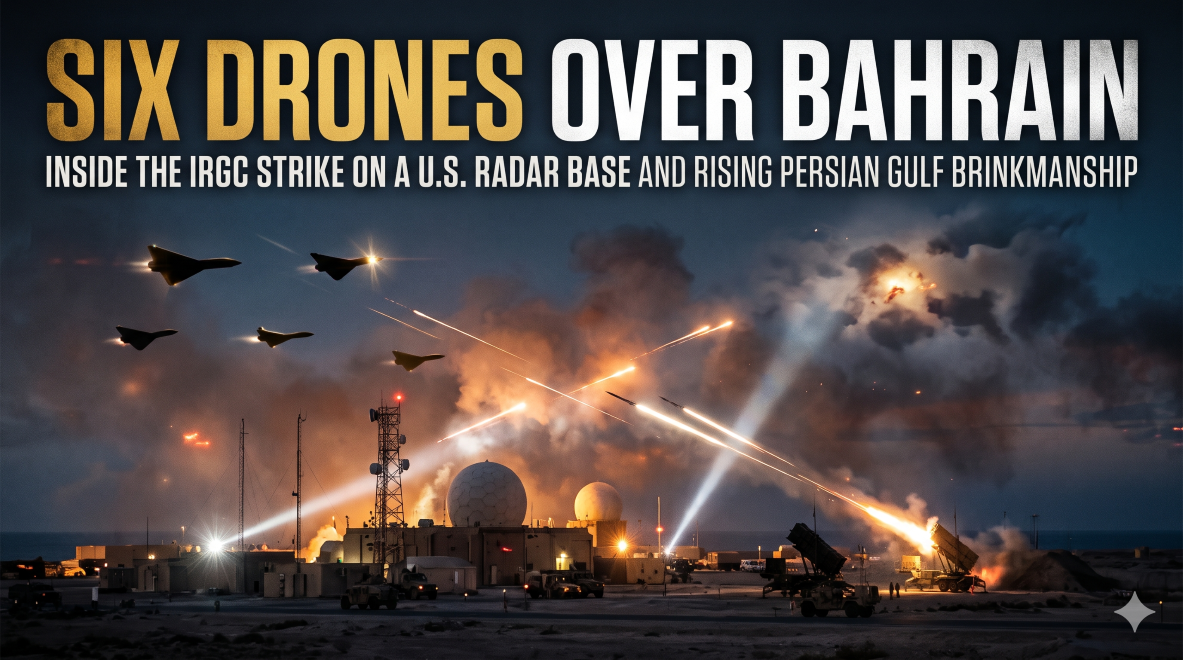
Iran’s Islamic Revolutionary Guard Corps (IRGC) announced on Sunday, November 15, 2026, that its Aerospace Force launched six drones targeting a U.S. air defense radar system at Bahrain’s al-Riffa Air Base in response to what Tehran described as hostile U.S. actions. The strike—carried out amid a nearly nine-month conflict between Tehran and Washington—immediately triggered emergency shelter alerts across the island kingdom and renewed fears that stalled diplomacy could give way to a wider regional confrontation across the Persian Gulf.
While Iranian state media framed the operation as a calibrated retaliatory blow against American military infrastructure, Bahraini defense officials reported that their air defense networks intercepted and destroyed incoming aerial threats before they could reach their targets. Coming just 48 hours after a separate drone incident targeting a U.S. early-warning radar facility in Bahrain, Sunday’s escalation underscores how vulnerable critical Gulf infrastructure remains—and how narrow the margin for miscalculation has become.
Inside the Riffa Air Base Drone Strike and Bahrain’s Air Defense Response
According to an official statement broadcast by Iran’s state-run Islamic Republic of Iran Broadcasting (IRIB), the IRGC Aerospace Force directed six unmanned aerial vehicles at a U.S. radar defense installation situated at the al-Riffa Air Base—also referred to in military dispatches as the al-Riffa helicopter base—in central Bahrain. Tehran did not provide verifiable battle-damage assessments or visual confirmation of direct hits, instead issuing a warning that any further U.S. aggression would be met with “an even harsher and more devastating response”.
Hours before the IRGC statement became public, Bahrain’s Interior Ministry issued urgent nationwide security notifications via social media, instructing residents to remain calm, move immediately to the nearest safe location, and follow updates exclusively through official government channels. Later on Sunday, Bahrain’s military confirmed that its air defense systems had engaged and neutralized several Iranian aerial attacks prior to impact. Manama sharply condemned what it characterized as Tehran’s “systematic hostile approach” and ongoing aggression against Bahraini territory, while U.S. military officials did not immediately confirm any physical damage or personnel casualties from the Sunday launch.
Sunday’s incident marked the second time in three days that Iranian drones targeted American radar assets in Bahrain following an extended autumn lull in direct strikes on the kingdom:
| Incident Date | IRGC Claim & Target | U.S. & Bahraini Official Response | Reported Outcome |
| Friday, Nov. 13, 2026 | IRGC claimed retaliatory strike on a U.S. early-warning radar facility in Bahrain. | U.S. Central Command (CENTCOM) stated forces shot down two Iranian drones targeting Bahrain. | No human casualties or physical damage reported by CENTCOM. |
| Sunday, Nov. 15, 2026 | IRGC Aerospace Force announced six drones launched at U.S. air defense radar at al-Riffa Air Base. | Bahrain’s Interior Ministry issued shelter alerts; Bahraini military reported intercepting incoming aerial attacks. | U.S. military did not immediately confirm damage or injuries. |
Why U.S. Radar Installations in Bahrain Are Strategic Flashpoints
Bahrain occupies a pivotal role in regional security architecture, hosting major U.S. naval and logistics installations alongside integrated air and missile defense networks that monitor airspace across the Persian Gulf. In modern asymmetric warfare, early-warning and air-defense radar systems represent high-value operational targets. Rather than attempting to overwhelm heavily fortified naval ports outright, drone operators frequently seek to degrade or blind sensor arrays that detect incoming ballistic missiles, cruise missiles, and low-altitude unmanned aircraft.
For Tehran, targeting a U.S. radar installation at Riffa Air Base serves both a tactical and political purpose. Tactically, probing air defense batteries tests interceptor readiness and response times across Gulf Cooperation Council states. Politically, claiming strikes on U.S. military infrastructure allows Iranian commanders to project deterrence domestically and regionally—particularly after Iranian officials accused regional states of providing logistical and basing support for earlier U.S. strikes against Iranian territory, including communications infrastructure on Sirik and Qeshm Island.
Spillover Across the Gulf: Strait of Hormuz Mines and Red Sea Shifts
The drone launch toward Bahrain unfolded alongside a broader wave of military activity across West Asia’s most critical maritime chokepoints on November 15:
- Strait of Hormuz Blockade and Tanker Fires: In the same communiqué announcing the Riffa Air Base strike, the IRGC reiterated that the Strait of Hormuz remains closed to unauthorized commercial transit, pointing to what it called Washington’s failure to escort vessels through the strategic oil corridor. Iranian state media simultaneously reported that three oil tankers struck naval mines overnight and caught fire in the waterway—claims that could not be independently verified and which contrast with recent U.S. military assertions that main shipping lanes had been cleared of mines.
- Missile and Drone Interceptions in Saudi Arabia: Saudi Arabia’s Defense Ministry announced on Sunday that its air defenses intercepted two ballistic missiles fired by Iran-aligned Houthi forces toward Riyadh, alongside three drones targeting the kingdom’s oil-rich Eastern Province.
- Control Shifts at Bab el-Mandeb: At the southern entrance to the Red Sea, Yemeni forces aligned with the internationally recognized, Saudi-backed government confirmed they were withdrawing from the Bab el-Mandeb area toward Aden to reinforce security in southern governorates. The pullback handed Houthi militants heightened leverage over a maritime artery linking the Red Sea with the Gulf of Aden.
- Regional Diplomatic Backlash: Neighboring Arab states moved swiftly to denounce the strikes on Bahrain. Jordanian Foreign Minister Ayman Safadi condemned the Iranian attacks as a “flagrant violation of its sovereignty, a threat to its security, stability and territorial integrity, a dangerous escalation, and a blatant breach of international law and the United Nations Charter”.
Diplomacy on a Razor’s Edge Between Washington and Tehran
The latest exchange of drone launches and air-defense interceptions highlights the fragile, unresolved state of the conflict that erupted on February 28, 2026, when the United States and Israel launched major strikes against Iran. Although the warring sides agreed to a ceasefire in April and signed a tentative memorandum of understanding in June, substantive negotiations over Iran’s nuclear program, regional militant proxies, and freedom of navigation in the Strait of Hormuz have repeatedly stalled.
Even as military friction flared over Bahrain, officials in both capitals signaled that the door to diplomacy has not slammed shut entirely. U.S. President Donald Trump recently told senior advisers that he is prepared to hold off on launching new military strikes against Iran provided Tehran and Houthi fighters in Yemen refrain from fresh provocations, even though the U.S. naval blockade on Iranian shipping remains firmly in place.
In Tehran, Iranian Parliament Speaker Mohammad Bagher Ghalibaf—a key figure in Iran’s negotiating track with Washington—stated on Sunday that a diplomatic path to ending the nine-month conflict remains open if the United States accepts what he termed Iran’s “logical conditions”. At the same time, Ghalibaf warned that Iran will not accept an indefinite state of “neither war nor peace,” declaring that Iranian armed forces would “determine the geography of battle” should Washington resume direct strikes.
What the Riffa Air Base Incident Means for Global Stability
Whether the six drones launched toward Bahrain’s Riffa Air Base represent a limited warning shot or the prelude to renewed sustained hostilities depends heavily on how Washington, Manama, and Tehran calibrate their next moves. For global energy markets and international shipping companies, the combination of aerial attacks near U.S. Gulf bases, contested mine threats in the Strait of Hormuz, and shifting control near the Bab el-Mandeb Strait reinforces the persistent vulnerability of global supply chains. Until negotiators bridge the core disputes over maritime passage and regional security guarantees, every radar ping over the Persian Gulf carries the potential to ignite a much wider crisis.