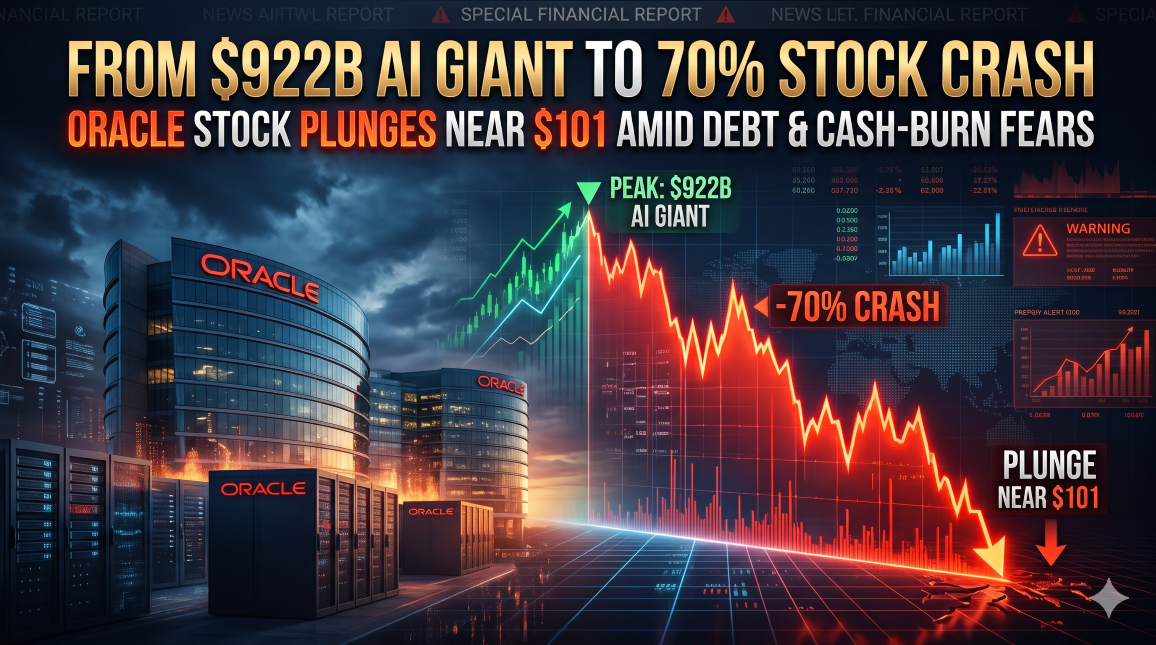
Few reversals on Wall Street have been as dramatic—or as sobering for artificial intelligence investors—as the fall of Oracle Corporation (NYSE: ORCL). In September 2025, riding a wave of euphoria over massive cloud infrastructure bookings, Oracle shares surged to an all-time peak around $328–$345, briefly vaulting the legacy database giant’s market valuation to roughly $922 billion. Just fourteen months later, in late November 2026, Oracle stock plunged to near $101–$104—a staggering 70% collapse that erased over $600 billion in shareholder value and dragged the stock back to levels last seen in late 2023.
At the heart of the sell-off lies a fundamental collision between sky-high AI ambition and cold balance-sheet reality. While Oracle boasts a massive $664 billion contractual backlog, investors have grown increasingly alarmed by the staggering capital expenditures, mounting debt load, and deep negative free cash flow required to build out its global AI data center footprint.
The Great Unraveling: Inside Oracle’s 70% Market Value Wipeout
When Oracle’s stock rocketed 36% in a single session on September 10, 2025, Wall Street celebrated the company’s transformation into an indispensable hyperscale AI infrastructure provider. Backed by monumental cloud commitments—most notably a reported $300 billion multi-year infrastructure agreement with OpenAI slated to ramp in 2027—investors priced Oracle for near-flawless execution.
By late November 2026, however, market sentiment had flipped entirely. On November 25, ORCL shares tumbled more than 5% to close at $103.88 after touching an intraday low of $99.34—marking a roughly 70% drawdown from its 2025 record high and compressing its market capitalization to around $300 billion to $314 billion.
| Financial / Market Metric | September 2025 Peak Era | Late November 2026 Reality | Strategic Implication |
| ORCL Share Price | ~$328 – $345 | ~$101 – $104 (Intraday low $99.34) | ~70% drawdown from record highs |
| Market Capitalization | ~$922 Billion | ~$300 – $314 Billion | Over $600B in market value erased |
| Free Cash Flow (FCF) | Positive pre-buildout baseline | -$23.7B (FY26) & -$5.0B (Q1 FY27) | Heavy capital expenditure outpacing operating cash |
| S&P Credit Rating | Solid investment-grade buffer | BBB- (One notch above junk) | Downgraded July 9, 2026, over leverage & concentration |
| 5-Year CDS Spread | Under 80 basis points | 356 basis points (All-time record) | Bond market pricing elevated default/repayment risk |
Rather than rewarding backlog growth alone, institutional investors began demanding proof that Oracle’s capital-intensive data centers can generate sustainable cash returns before debt servicing costs overwhelm its balance sheet.
Burning Billions to Build AI: The Negative Free Cash Flow Crisis
The primary catalyst behind Oracle’s stock slide is the sheer scale of cash required to construct, power, and equip next-generation AI data centers with high-end GPUs and networking hardware. Unlike software licensing—which generates high margins with minimal upfront capital—hyperscale AI infrastructure demands tens of billions of dollars in upfront spending years before customer revenue flows in at full scale.
According to company filings, Oracle’s free cash flow swung to negative $23.7 billion in fiscal 2026, followed by another $5 billion cash deficit in the first quarter of fiscal 2027 alone. For equity investors accustomed to Oracle’s historically predictable cash generation and aggressive share buybacks, watching the company burn nearly $29 billion across five quarters triggered a sharp valuation reset.
To bridge that funding gap, Oracle turned to capital markets in early November 2026 with a massive $20 billion financing package:
- $10 Billion in New Senior Notes: Sold on November 4 at steep coupons ranging from 7% to 8.65%, locking in elevated annual interest expenses.
- $10 Billion in Common Stock: Issuance of roughly 86.2 million new shares, diluting existing shareholders at depressed stock prices.
While the $20 billion capital raise bolstered immediate liquidity, both equity and fixed-income investors balked at the high cost of capital—especially as Oracle signaled it does not expect to return to positive free cash flow until the second half of fiscal 2028.
Credit Markets Sound the Alarm: Near-Junk Ratings and Record CDS Spreads
Even more telling than the drop in Oracle’s share price has been the reaction in the corporate bond and credit derivatives markets. On July 9, 2026, S&P Global Ratings downgraded Oracle’s credit rating to BBB-—just one notch above speculative “junk” status—citing massive capital spending, rising leverage, and heavy customer concentration. Following its review on November 2, Moody’s upheld the Baa2 credit rating alongside a sustained negative outlook.
By late November 2026, anxiety among bondholders pushed the cost of insuring Oracle’s debt against default to historic highs. Having traded below 80 basis points a year prior, Oracle’s five-year credit default swap (CDS) spread experienced a more than fourfold expansion, culminating in an unprecedented peak of 356 basis points. Simultaneously, yields on newly issued Oracle bonds climbed toward 9%, underscoring how aggressively credit markets are pricing repayment and execution risks surrounding its AI expansion.
The OpenAI Concentration Dilemma: $664 Billion Backlog vs. Counterparty Risk
At the core of both Wall Street’s optimism and credit agencies’ warnings is Oracle’s deep financial entanglement with OpenAI. S&P Global Ratings estimated that OpenAI accounts for roughly half of Oracle’s massive contracted backlog—which reached $664 billion by late 2026.
In a classic circular AI infrastructure dynamic, Oracle is borrowing billions of dollars and signing long-term power and real estate leases today to build custom supercomputing clusters for OpenAI’s future workloads. However, analysts and rating agencies have raised two critical questions:
- Counterparty Payment Risk: Because the reported $300 billion OpenAI contract begins ramping in 2027, S&P warned that any delay, restructuring, or payment shortfall from OpenAI could leave Oracle stuck with expensive, difficult-to-unwind data center leases and debt obligations.
- Financing Ambiguity: Shares suffered sharp drops in October and November following media reports questioning OpenAI’s revenue trajectory and whether Oracle faced external financing hurdles for dedicated data center sites.
On November 20, 2026, Oracle pushed back forcefully against funding rumors, stating that its OpenAI contract is fully funded and that ongoing discussions with equipment vendors represent optional flexibility rather than a prerequisite for project delivery. Management also reaffirmed expectations for at least $90 billion in fiscal 2027 revenue, arguing that its core enterprise database and cloud applications provide a resilient cash foundation.
Contrarian Opportunity or Value Trap? How Wall Street Views ORCL Next
With Oracle trading near $101–$104—roughly 13.6 times forward earnings—Wall Street is sharply divided on whether the 70% crash represents a generational buying opportunity or a cautionary tale of AI overreach.
Bullish analysts point out that if OpenAI and Oracle’s enterprise cloud customers make their contracted payments on schedule starting in 2027, Oracle’s revenue scale and operating leverage could expand dramatically once peak data center construction tapers off in fiscal 2028. Skeptics, however, counter that until Oracle proves it can stem its multi-billion-dollar cash burn without further dilutive stock sales or 8%-plus debt offerings, the stock will remain weighed down by balance-sheet gravity.
What Oracle’s Plunge Means for the Broader AI Infrastructure Boom
Oracle’s 70% tumble from its 2025 zenith serves as a watershed reality check for the entire artificial intelligence sector. During the first phase of the AI boom, signing massive compute contracts was enough to send tech stocks soaring. In late 2026, markets have entered a far more demanding phase: execution, capital discipline, and free cash flow conversion. For Oracle—and every hyperscaler racing to wire the AI economy—the next two years will determine whether a $664 billion backlog translates into lasting shareholder wealth or an enduring lesson in debt-fueled expansion.